software development agencyTwo overlapping white elliptical loops on a black background, one solid and one dashed.
Thank you! Your submission has been received!
Oops! Something went wrong while submitting the form.

Our Articles

Business Strategy & growth
5 observations about growing companies
March 16, 2025
9 min read

Learn the top strategies for growing companies, including customer value, market-based assets, commoditization, and hypercompetition. Insights from Maxim Golikov’s studies at Antwerp Management School.

By Maxim GolikovCBDO @ Sigli | Digital Transformation, Product Development, Tech Business ConsultingReflecting on studies in the Antwerp Management SchoolSome people say that it doesn’t matter what you study, it’s more important what you learn. But when you study really useful things and manage to apply them to your work — that’s a perfect combo. That’s exactly how I felt after finishing my studies at the Antwerp Management School. And that, in and of itself, could have been enough.But in practice, some lessons remain a larger part of your day-to-day than others. Some are more applicable, more tangible, and more relatable. The more I thought about it, the more I wanted to write some of it down.And now we’re here.I am not going to retell everything that I was lucky to learn from my professors. Instead, I want to share my own interpretation of what I heard. I didn’t come up with these concepts, and can’t claim ownership of them. However, I do find them useful, and I hope you will as well.There is quite a lot of information that I want to share. But in this first article, let me start with 5 Observations on what growing companies do to achieve said growth. This is mostly based on a lecture by prof. Koen Vandenbempt.Observation 1. They focus on superior customer valueIt’s absolutely obvious that the growth of some companies and the stagnation of others is not just a random occurrence. There is something in the nature of these companies that makes them either move forward or stay where they are.But what is that “something”? Have you ever tried to detect this on your own based on common real-life examples?Non-growth companies are usually those that deliver mainly product offerings and focus only on the efficiency of their processes. As a result, they face low profitability and lack of growth.Companies that can successfully grow, as a rule, offer services and invest their efforts into bringing value to their customers. Yes, they still take care of their efficiency and may choose different approaches to creating value. But everything they do is aimed at enhancing the benefits that their customers can leverage thanks to their offerings. And that’s one of the key components (and secrets) of their growth.It’s worth noting that there can be two approaches to value creation. The first one is internally oriented. In this case, companies are focused mainly on increasing their efficiency.Courtesy: prof. Koen VandenbemptThe second approach is more about external orientation, value-based logic, and the implementation of new concepts and innovations.Courtesy: prof. Koen VandenbemptIn the end, you have to focus on either creating or capturing value to support continuous, sustainable growth.Observation 2. Core growth is keyTraditionally, when we think about business growth, we start considering various “tactics” that can boost it like expansion to international markets, price increases, aggressive accounting practices, mergers and acquisitions, etc. In other words, in such a situation, you try to get fruits from what you have, without introducing any fundamental changes. Nevertheless, such efforts are not enough.But what will work in this case? What should be taken as the main key to the core growth? These are market-based assets, such as customer relations, networks, partnerships, strategic market intelligence, etc. Growth companies work not only with physical resources but also with their intangible assets.And here it’s necessary not to forget about the importance of technology and design competencies. That’s all about the power of digitalization and delivering cost-efficient customer-centric solutions that represent real value.Courtesy: prof. Koen VandenbemptThis means that growth cannot be achieved synthetically, at least not on the long run. Yes, you can optimize a lot of your business, but if the core is weak it is only a matter of time until it will crack.Observation 3. Commoditization happens, alwaysIf you’ve never heard of commoditization, allow me to explain in simple terms. This process can be defined as the transformation of services or products into a standardized, marketable object that provides customers with a tangible value.Very innovative products (or services) that still haven’t found their regular consumers can’t be considered a commodity. However, when they gain their clear use cases and people see what value such offers bring, that’s already a completely different story. Very often such commodities become nearly indistinguishable from similar offers except for their price. And that’s where businesses should think about enriching their products and services with unique value.Let’s take plane tickets as an example. Today they are a commodity. People know what they are, how they can use them, and what value they will get when they buy these tickets. However, it was not always so. A few decades ago there were very few flights and tickets were absolutely inaccessible to the average person. But with time, the situation has changed. Today you have low-cost providers like Ryanair, premium jets that carry celebrities halfway across the world for a croissant, and small-scale private aviation with loads of options in-between. Flying has become a commodity.And probably, something similar may happen to space travel. Today “space tickets” are not a commodity. They are too expensive, too impractical, and their value for a wider audience can be best defined as “controversial”. But in the near future, who knows…Can commoditization be a feature of growth companies? Definitely yes. Growth companies should be good at meeting customers’ needs and creating offers that will include segment-oriented value propositions.You may say that commoditization (which is associated with a better market position for a company) leads to falling profitability. And, yes, it can be an alarming sign. Nevertheless, it is not exactly so. Falling profits can become an excellent incentive for businesses to look for ways to create new values for their customers in order to win a bigger market share. And that’s a continuous process that works like a perpetual motion machine.The only way to fight it is to understand that it is inevitable, and the process is unending. To escape the squeeze you must find new value for your company and clients.Observation 4. Hypercompetition is a fact of lifeCompetition fuels innovation. That’s only one side of the coin. Competition can also ensure intensified warfare for the customer. And today we can observe the competition across many points, including prices, branding, innovation, offer differentiation, and others. It exists in all the markets, including niche ones.Growth companies are always ahead of the game. What is required to achieve this? To attract your customers’ attention and to do it faster and better than your competitors, you need to deeply understand the needs and expectations of your target audience. Getting customer insights, interpreting market trends faster than others, and being ready to break the rules by crossing industry boundaries and relying on unstandardized segmentation — these are just a couple of things that you should do.In the conditions of hypercompetition, companies need to innovate fast, look for new opportunities, and deliver clear value to customers. Where can we observe the effect of hypercompetition today? Actually, across many sectors, including the smartphone market (where Apple, Samsung, Huawei, and others are fighting for the attention of their target audiences); online retail with such eCommerce giants as Amazon, Alibaba, and Walmart trying to win a bigger share; and video streaming with Amazon Prime, Disney+, and Netflix.But let’s dive deeper into some real-life examples. I have two opposite cases that come to my mind.In the 20th century, Kodak was practically the synonym of photography. The company’s tagline “Kodak moment” even entered the common vocabulary and was used to describe personal events that were worth being recorded for the future. It was the unrivaled leader in the film photography market. But what happened next? The first pitfall that it faced was the increasing competition from Fujifilm in the late 1990s. However, the main obstacle that it couldn’t overcome was the transition from film to digital photography.Despite its attempts to move to this technology and even the presentation of its first self-contained digital camera, Kodak hesitated to push forward with innovation in this area. The main fears of the company were related to concerns that digital photography would cannibalize its film business. Nevertheless, this refusal to innovate became fatal for Kodak.On the flip side, we can mention Apple. When it started its business journey, it wasn’t leading the mobile phone market. However, the introduction of the iPhone in 2007 revolutionized mobile technology and significantly changed our understanding of what such devices could offer us in terms of functionality and interfaces.While other market players were focused on introducing improvements to their existing technologies, Apple’s strategy was to redefine the entire user experience. Thanks to this bold approach, the company managed to win leadership not only in the smartphone market but also in the tech space at large.So what can we see here? Due to its reluctance to innovate, Kodak had no other choice but to file for Chapter 11 bankruptcy protection in 2012, which further resulted in the company’s reorganization. Meanwhile, as of May 2024, with over $2.8 trillion, Apple is one of the largest companies by market cap all over the globe. It has one of the most recognizable brands in the world, and it continues to evolve. I strongly believe that this example perfectly illustrates the power of innovation in achieving market dominance.Regardless of your current market position, competitive advantage, technical superiority, or any other factor you may feel makes you immune — competition will squeeze you out if you refuse to innovate.Observation 5. Customer retention is a mustIf you are building your own business, you’ve probably noticed that to attract customers, you need to promise something to them. But to retain you need not only to give it to them but also to adjust this to their needs. Customer retention is a rather complex process that requires continuous improvements and a deep understanding of people’s desires, interests, preferences, and demands.Growing companies usually focus on expanding their market share with existing customers and that’s their power.I am sure that you’ve heard about a sales funnel which is used to describe the journey that potential customers go through, from attracting clients to closing a sale. Nevertheless, growth companies shouldn’t consider the fact of a sale as a final goal. It’s much more important not just to sell as much as you can but to retain as many customers as possible. Otherwise, all your efforts won’t make any sense in the long run.Courtesy: prof. Koen VandenbemptAs opposed to your traditional sales funnel the customer retention funnel is inversed. You start with your customers already there, and you need to get them to a point you want them to be. To do this you need a deep understanding of customer needs, introduce integral service offerings, and finally arrive to co-development with existing clients. This can create unique solutions and even services that can support your company growth and competitive advantage.For growth companies it’s not enough just to push a customer to make a purchase. They view these two funnels as two integral components of one unified process of working with customers. And the final goal of their work is to build long-term relations with customers full of trust and mutual benefits.ConclusionWhat was surprising to me is that continuous growth is not about being the best at what you do, or having the largest market share. It’s about capturing value in an environment that tries to kill your company, and you should let it. The secret is that by the time commoditization or competition squeezes you out you should already have several more options for growth on their way.And the best way to do it? Your customers. Create value for them on a permanent basis, be ready to change along the way, and you will be able to cultivate true innovation and count yourself among the ever illusive group of growth companies.The bad news is that there already are growing companies in every industry, and somehow you need to compete with them. They are helmed by smart people who have been doing everything I described for years already. What to do with this competition?..That’s a story for the next article. Stay tuned!Contact Maxim:maxim.golikov@sigli.comhttps://www.linkedin.com/in/maxim-golikov/‍
Web Development
Serverless future: Why many businesses are saying goodbye to servers
March 4, 2025
10 min read

The podcast host and the CBDO at Sigli Max Golikov invited Michael Dowden to speak about the decreasing significance of servers today, as well as the benefits businesses can gain from this shift.

One of the key goals of the Innovantage podcast is to let its audience learn more about the latest tech trends and explore how they are transforming the business landscape. And the recent episode serves exactly this purpose. This time, the topic of serverless technology has taken center stage.The podcast host and the CBDO at Sigli Max Golikov invited Michael Dowden to speak about the decreasing significance of servers today, as well as the benefits businesses can gain from this shift.Michael is a technology leader, international speaker, and serverless expert with more than 30 years of experience in software development and consulting. Of course, serverless technology hasn’t been around for that long. It started gaining adoption nearly 15 years ago. Given this, Michael has a very good understanding of how the shift to the new technology has happened. Moreover, he explained the reasons why businesses started ditching their servers and what are the cases when using servers is still feasible.This and much more were discussed in that episode and the most interesting ideas we’ve gathered for you in this article.Serverless computing: What is it?The core concept of serverless doesn’t mean there are no servers. They are still there, managed by providers, not by businesses directly. The idea of this technology represents an additional layer of abstraction. Everything started with servers, then moved to virtual machines, followed by Infrastructure-as-a-Service (IaaS), and Platform-as-a-Service (PaaS). Serverless takes it a step further by providing only the essential operating containers required to run your tasks.One key aspect of serverless is Function-as-a-Service (FaaS). Similar to microservices, each function is managed and scaled independently. You can build, deploy, and scale individual units of code without worrying about the entire system. If traffic spikes, serverless platforms scale automatically by creating copies of the function to handle the load. Once the traffic decreases, the platform adjusts by scaling back.With serverless, you are charged only for the actual computing time used, and you don’t have to manage the infrastructure yourself. The platform scales according to your needs, making it efficient and cost-effective.In other words, with serverless technology, you are basically outsourcing a part of your infrastructure to make it lighter, leaner and more responsive, better in every possible way.Michael shared his experience of transitioning to serverless technology while working at startups. His goal was to find cost-effective solutions that would scale as the businesses grew. The first shift to serverless was not planned. It just happened naturally. Michael’s approach to software had always been user-focused. It means that he starts building the front-end and UX to quickly prove concepts and gather feedback from users.One of the startups he worked with began as a progressive web application. As the product evolved, the team realized they needed a backend, and serverless was the logical choice to support their growth.Downsides of going serverlessThough the idea of serverless may sound highly appealing, businesses also should stay aware of possible downsides.They become obvious when you need to execute control at a low system level in a very specific way. While you can adjust parameters like memory allocation on platforms like GCP, AWS, or Azure, you don’t have full access to the underlying system. Additionally, you might lose visibility into the scaling process. For example, it may be impossible for you to control how many instances of your function are running at any given time. This lack of proper control over scaling and thresholds can be a challenge.Another issue is the cold start problem. When a function is triggered, it often needs to spin up, typically using something like a Docker container. This setup takes time (it can be a couple of seconds). This leads to a lag before the function can serve traffic, which might be noticeable to users.Observability becomes crucial in serverless environments. Without direct access to the system, you need to rely on external tools to monitor your code and infrastructure. If an issue arises, it can be hard to pinpoint the cause without proper monitoring in place.Serverless is great for small, independently managed functions. But it has limitations for long-running services (often capped at 5 minutes) or applications requiring extremely low latency. While serverless offers massive scalability, the slight latency in ramping up can be a concern.When is serverless a good option for you? Serverless-first approachAs with any technology, it’s essential to carefully consider your use case before choosing serverless.Michael admitted that he advocates a serverless-first approach, especially for new projects. He believes that most companies and projects should start with serverless by default. When you are unsure about the application or just starting out, serverless should be the initial choice. You should consider a different architecture, only when you understand why serverless might not be suitable. This can be relevant, not for the entire project but for its specific parts.One key reason for implementing the serverless-first approach is that this technology allows you to build faster. You spend less time setting up infrastructure. This enables you to start running your project quickly. Moreover, this technology scales automatically. So if your project experiences unexpected traffic spikes, it can handle them with minimal effort.By starting with the serverless-first approach, you can focus on getting your product in front of users while managing traffic. This gives you the flexibility to learn what works and what doesn’t, without worrying about infrastructure bottlenecks.Michael also mentioned the following case.Amazon is well-known for its use of serverless infrastructure in its video streaming service. The company once published an article explaining how they stopped using serverless for one component of that service. However, the article was widely misinterpreted. Due to the provoked reaction, Amazon eventually retracted it. Despite the misunderstanding, the article was a great technical explanation of that decision.The company explained that the specific part of the project had some requirements that their serverless infrastructure couldn’t meet. So, they changed the architecture of just that one component. This helped them save money, improve the user experience, and make the system more efficient.According to Michael, this is a perfect example of the serverless-first approach. Amazon was able to build and run the service in front of customers for months or even years before realizing they needed a different solution. They had the time to learn, design a better approach, and successfully implement it. This, he believes, is a huge success story for serverless.Value of serverless computingOne of the key economic advantages of serverless, especially for startups, is its cost-efficiency. Many startups invest heavily in infrastructure before acquiring a single customer. With serverless, infrastructure costs remain low until traffic increases, allowing expenses to scale with revenue. This model ensures that businesses only pay for what they use, aligning costs with growth.Another major benefit is flexibility. Unlike monolithic architectures, where components are tightly integrated, serverless systems are highly modular and event-driven. Functions, databases, and services operate independently, making it easier to scale, reorganize, or optimize specific parts of the system as needed. If two functions need closer integration, they can be easily adjusted without restructuring the entire architecture.Starting with a modular serverless approach allows businesses to adapt more easily over time. It’s much simpler to merge independent services when necessary than to untangle tightly coupled components in a monolithic system. This adaptability makes serverless an ideal choice for companies looking to scale efficiently while maintaining agility.Concept of “good” codeAccording to Michael, a key test of adaptability in software is whether a piece of code can be removed without disrupting the rest of the application. It doesn’t matter whether you need to introduce a new implementation, update a feature, or improve functionality, in most cases, code will need to be replaced. Flexibility is essential, and well-structured code should allow for seamless modifications.In a modular architecture, where functions are deployed independently, removing or replacing a function is straightforward. If a service is no longer needed, it can be deleted without affecting other components. If an update is required, a new function can be introduced without major disruptions.However, sometimes the issue lies not in the function itself but in the process behind it. To improve user experience, it is often beneficial to handle certain operations in the background while allowing users to continue to the next step. Even when latency is a concern, effective solutions can mask delays and ensure a smooth and responsive experience.Is serverless technology only for startups?While serverless computing is often associated with startups, it is also highly valuable for large enterprises (if not even more). Some of the biggest adopters of serverless technology are actually the companies that provide it: Google Cloud, Amazon Web Services (AWS), and Microsoft Azure. These tech giants didn’t create serverless computing for startups alone. They use it extensively themselves.One of the primary reasons serverless is so beneficial at scale is agility. It allows enterprises to deploy new features and services without being directly tied to complex infrastructure work. While these companies invest heavily in infrastructure and employ some of the best hardware specialists in the world, their service developers don’t need to focus on hardware management. Serverless enables them to build and deploy applications faster and keep innovation cycles short and efficient.Large enterprises also often need to deal with ongoing legacy system upgrades. Many companies operate in a continuous cycle of replacing outdated platforms with modern solutions. Serverless offers a strategic way to introduce modular, scalable services into these transitions. By gradually integrating serverless technology, businesses can break apart monolithic architectures, reduce infrastructure overhead, and create a more flexible and efficient system. And all this is possible without the need for a full-scale overhaul.Future of serverless technologyA few years ago, serverless computing was surrounded by significant hype and some people believed that serverless could be used for everything (which is not true). Now, this hype seems to be over as we have reached a so-called plateau. Some developers may not be familiar with it at all. However, serverless architecture is not a passing trend. It is here to stay. The question is not whether serverless will remain relevant but rather how widely it will be adopted and in what form.In the coming years, more companies are expected to adopt a serverless-first approach, where serverless is the default choice unless specific needs dictate otherwise. However, this shift will not happen across the board, as different businesses have varying infrastructure requirements.It’s difficult to make industry-wide predictions, as serverless is just one of many architectural choices available. Over time, the term “serverless” itself may fade, with the focus shifting toward broader cloud-native patterns rather than a distinct category.Another key area of change could be the pricing model. Today, serverless operates primarily on a pay-as-you-use basis. This provides cost efficiency and scalability. However, companies may also see opportunities to reduce expenses by purchasing capacity in bulk. This will be quite similar to traditional cloud computing models where reserving resources upfront can be more cost-effective. This shift could help businesses optimize spending while still leveraging the benefits of serverless technology.Apart from this, Michael explained that serverless computing will continue evolving. It’s highly likely that we will see new patterns emerging to streamline its adoption. Now each company needs to invent its own approach. Nevertheless, established best practices and frameworks could guide serverless implementations and make this technology an even more viable option for businesses of all sizes.Challenges and opportunities presented by emerging technologiesWhile speaking about the impact that new technologies may have on the world, Michael stated that the consequences of the adoption of some innovations can be quite worrying.Machine learning (ML) has been around for decades, but large language models (LLMs) are still relatively new. While they have specific strengths and weaknesses, the current hype makes it difficult to fully assess their most effective use cases. As the technology matures, a clearer understanding will emerge regarding what LLMs are truly efficient at and where their limitations lie.Beyond technical capabilities, a critical aspect of evaluating any architectural decision is its impact on the world. And here we should consider them not just in terms of performance and cost but also sustainability. Energy consumption, carbon footprint, and ecological impact are all essential considerations.The ability to make informed decisions about minimizing negative effects and amplifying positive ones is crucial. However, when it comes to LLMs, this level of control is still lacking, which raises concerns about their long-term viability from an environmental perspective.Serverless computing, on the other hand, offers a more sustainable approach to infrastructure. It inherently optimizes resource usage, scaling only when needed. Running dedicated servers, by contrast, can lead to wasteful energy consumption, making serverless a more viable option for reducing carbon footprints.How to choose the right infrastructureAt the end of their discussion, Max also asked Michael to share his recommendations for businesses that need to choose the type of infrastructure for their systems.According to the expert, your team’s existing skill set should be a key factor. Of course, it’s possible to push a team to learn, adapt, and grow. However, leveraging their current expertise can often be the most efficient approach. If your team has deep knowledge in a specific area, it might make sense to build around that strength rather than forcing a transition to an unfamiliar technology stack.Michael mentioned that some companies make infrastructure decisions that require them to hire entirely new tech teams just to support the shift. While this can bring in fresh expertise, it also introduces risks, costs, and potential disruptions.Another crucial consideration is risk mitigation. Relying on a single location for server management or cloud services can create vulnerabilities caused by outages, security breaches, or physical disasters. A robust disaster recovery strategy is essential to ensure business continuity.For high availability and resilience, companies should consider multi-cloud strategies. This could mean using:Multiple cloud providers to reduce dependency on a single vendor;Containers deployed across different cloud environments.A multi-cloud approach can significantly enhance reliability and performance. Nevertheless, it requires investment in tools, expertise, and governance to manage complexity effectively.As you can see, the implementation of every technology (even the most promising one) can be associated with a range of pitfalls. And it is always better to stay aware of them beforehand.If you want to learn more about tech innovations that are expected to change the world, don’t miss the next episodes of the Innovantage podcast!
AI Development
AI and digital transformation: Practical tips for powerful changes
February 3, 2025
10 min read

One of the goals of the Innovantage podcast is to help businesses better understand what is happening in the digital world and how they can leverage tech advancements to improve their processes and get benefits in the long run. This episode fully aligns with his goal as it is dedicated to digital transformation at enterprises and the most efficient approaches to it.

One of the goals of the Innovantage podcast is to help businesses better understand what is happening in the digital world and how they can leverage tech advancements to improve their processes and get benefits in the long run. This episode fully aligns with his goal as it is dedicated to digital transformation at enterprises and the most efficient approaches to it.To cover this topic, Max Golikov, the podcast host and the CBDO at Sigli, invited Stijn Viaene to join the discussion.Currently, Stijn is a professor and partner at Vlerick Business School & KU Leuven. One of the core subjects that he is working on is exploring the best ways to create business value with investments in technology. His career started 25 years ago with research on insurance fraud. But some years later, when the concept of digital transformation entered the game, Stijn focused on it. Now, for more than a decade already, he has been working in this domain, which allowed him to get great experience and an impressively deep understanding of the peculiarities of this process.What is digital transformation?Digital transformation has become a hot topic these days. However, in many companies, there is still a lot of confusion and disagreement on what it actually means. For some of them, this process presupposes the implementation of tech solutions into their operations. Nevertheless, just using technology, even the latest one, doesn’t make this usage transformational.According to Stijn, digital transformation is a strategic way to respond to the threats of not surviving and the opportunity to thrive in a digital economy. The main idea behind the implementation of any tech solutions should be changing an organization for the better.What is the key difference between digital transformation projects and just tech projects?Stijn explained that digital transformation projects are not only new solutions that you invest in. They are not just shiny things that may look exciting or trendy. They should always be based on a strategy and a clear vision of how you will reshape your enterprise in the process of their realization.Of course, today, when there are so many new products and tools, businesses may be confused with all this variety. However, implementing all of them at once won’t bring any value. It’s much more important not just to follow all the trends but to create a well-thought-out plan for a long-term sustainable transformation.How to plan transformation in a quickly changing tech world?It’s quite obvious thing that the digital world is very dynamic. Given this, people who are preparing for digital transformation in their organizations have to start looking at things in the right way to find the best approach to such changes. Highlighting this, Stijn shared three tips.Acceptance of the reality. We are living in the VUCA (volatility, uncertainty, complexity, and ambiguity) world. We can’t deny that there is a lot of turbulence these days and it is impossible to hide or run away from it. There is no sense in waiting for someone to come up with a magical recipe and solve all the issues. If you get to navigate that turbulence better than your competitors, then you will win the game. That’s why the first thing to do is to accept that the world is turbulent. But at the same time, this situation provides a lot of opportunities to win the competition.Systemic view on changes. You also need to understand correctly the nature of the change you will get yourself into. This nature of the change is systemic. It means that digital transformation is not just a task for your technology department or marketing team. Digital transformation should cover all elements and levels of your organization.The right mindset. One of the worst things that people can do at the beginning of such a transformation journey is to look for an easy way out. There is no single tool kit for conducting transformation. People should understand that there is a lot of work to be done and be ready for it.Digital transformation is not something that you can do in a year or two. This process won’t stop. It’s not just a project with clear timeframes. There will be a continuous stream of digital opportunities and threats that will come in the future and, as Stijn explained, there won’t be any end to it.Challenges and peculiarities of digital transformation for SMEsTransformation journeys for large enterprises and small and medium-sized businesses are quite different. This is explained by the peculiarities of such organizations, as well as the opportunities that are available for them.The main difference is related to the fact that smaller businesses are more restricted in resources. Given this, the need to focus on some projects and initiatives is bigger for them. They can’t allocate much attention to many things at once. This can become a difficulty for such companies.But at the same time, they have more opportunities to work in partnerships with other organizations. Smaller businesses are usually more open to joining forces with others than big corporations that usually perceive the necessity to collaborate with other market players as a weakness or as a chance to dominate.In reality, for many businesses, the strength lies exactly in alliances and partnerships in the ecosystem of equals.Partnerships can (and should) be win-win, which means that both parties need to be not just looking for the benefits but also willing to invest their efforts and resources in such common projects.Balancing short-term wins with long-term strategyOne of the major challenges in digital transformation for everyone is overcoming the mindset that prioritizes short-term gains. Many organizations strive for immediate results, often at the expense of long-term value. This mindset is antithetical to successful digital transformation because true success requires consistent investment in infrastructure, processes, and cultural change.However, completely ignoring short-term wins is not the solution either. Human psychology demands instant gratification. Therefore, offering periodic quick wins can help maintain motivation and engagement. The key is to frame these short-term achievements as steps toward the larger goal, ensuring they align with the long-term strategy.How to change mindset at an organizationStijn highlighted that changing an organization’s mindset is one of the hardest challenges leaders face during digital transformation. The key is not to fight the existing culture but to work with it. Leaders must identify the gap between the current mindset and the ideal mindset, and then carefully plan strategies to bridge that gap. This involves choosing battles wisely because some areas may not be worth changing just at the very beginning, while others will require significant focus.Good leaders also should realize that they cannot change everyone. It’s essential to identify individuals who are resistant to change and find ways to either confine their influence or part ways if necessary. It is much better to spend energy on those who are open to change as well as on new hires who will bring fresh perspectives and align with the desired mindset. Such people can act as agents of transformation.Talent remains one of the most valuable resources for organizations undergoing digital transformation. The global competition for skilled workers, particularly in tech, is high. Organizations need a clear talent strategy to attract, retain, and develop the skills required for success in the digital age.Short-term layoffs for cost-cutting might seem appealing but they always come with risks. Firing thousands today with the hope of rehiring tomorrow is neither fair nor sustainable. It can negatively affect the company’s reputation and lead to a loss of critical talent to competitors.AI: Yes or No for digital transformation?According to Stijn, currently, we are at a moment when a lot of people realize that certain assumptions about AI that they might have made in the past are no longer necessarily true.One of such assumptions is related to how AI can be applied. Many of us used to think that people will always be responsible for everything that involves creativity and curiosity, while technology will perform some routine and boring work.However, since 2012–2013, when the world just started talking about digital transformation, this illusion has gradually disappeared. Now, with such models like ChatGPT, significantly more things than we expected are possible.Today we can hear the brightest writers say the best poems that they read in the last couple of years were written by an AI. This proves that AI actually can do things that are based on creativity.It’s interesting that in the context of discussing the potential of this technology, there are also a lot of talks about the nature of our humanity, our role, and our real differences from AI. There are also questions related to the ethical principles underlying the use of this technology and the risks that are onboarded by companies and societies when introducing AI.Stijn believes that before starting to use artificial intelligence, we need to find answers to a row of important questions.How will we use AI? Will we just put it in the function of automating work or will we try to prioritize the augmentation of humans in the work environment?Actually, the second option doesn’t exclude automation. However, it puts automation at the level of support for augmentation. Here, Stijn stressed that the business cases for the augmentation of AI will be totally different from the business cases for AI automation.People like Elon Musk have a quite transformative vision of the future. They have already tried to build entire factories that were expected to run with zero workers. Such factories didn’t work. But that’s not because the people behind such projects didn’t believe in such projects. That’s just because the technology was not yet ready.In the future, it will be vital for the leadership and companies to show their real stance on the relationship between human workers and technology. That’s an important point that will demonstrate their vision of the future not only for their businesses but also for society in general.If a lot of companies follow Musk’s principles, the distribution of wealth in the world will be incredibly uneven. Based on their vision, companies define in what technologies they will invest. The link between these choices and the survival of companies becomes very tight.Stijn explained that if he had to make a decision regarding such investments today, he would put money into transforming a company into a learning organization. In such an organization, everyone strongly believes that learning is part of their job.Top tips for digital transformation consultantsToday, a lot of companies that are planning digital transformation, invite third-party consultants or companies to guide them through this journey. As Stijn quite often acts as such a coach and consultant, Max asked him to provide practical recommendations to those people who are employed for such tasks.Tip 1. The main thing that any company providing such services should do is to prepare a really good answer to one question: “What makes you the best digital transformation partner for your customers?”. And what is even more important is that the answer shouldn’t differ when the same question is asked to any employee at this company.Tip 2. As a consultant, you need to have, demonstrate, and help to develop certain mindsets. Given this, consultants shouldn’t say “yes” to everything a customer asks them for. Consultants should be ready to be sparing partners. They need to be critically constructive. They should walk away when they really think that something is not going to work, while customers still insist on their own vision. It can be very tough because some good money might be involved. Nevertheless, namely, this can help to create the right reputation.Tip 3. There’s also competition between consultants. That’s why it is very important to stand out from the row of companies with similar services. To do this, it is required to establish close contact with customers and make them part of your tribe.Recommendations for executivesStijn understands the needs and challenges of all parties that can be involved in the process of digital transformation. In the discussion with Maxim, he also shared his ideas that can be helpful for executives who are planning to start digital transformation at their organizations.Your benchmark for whatever is good should be outside the company. Never think that you have all the people you need around the table. What is good often lies beyond the boundaries of your enterprise. That’s why you need to create your strategy and set your goals based on what you see around the organization, not inside.The right mindset matters not only for consultants but for executives as well. It’s very important to make transformational changes part of it.One more vital task is to balance the following paradox. As a great leader, on the one hand, you will be expected to come up with your own vision and be able to inspire people. But on the other hand, you also need to be humble. You need to be able to listen to the outside world, listen to your people, and see the existing weaknesses in your organization to define how they can be transformed. You should find the balance between humility and vision.Wrapping upAt first glance, it may seem that digital transformation is mainly about technology. However, as Stijn Viaene explained, successful digital transformation is not only about that. It’s also about people, their mindsets, and their approach to change. By focusing on vision, talent, and strategic balance, organizations can navigate the complexities of digital transformation and position themselves for sustainable success in the digital age.If you want to find out more details of this conversation, we recommend you listen to the full version of this podcast. And to learn more about business and technology in the modern world, do not miss the next episodes of the Innovantage podcast hosted by Max Golikov.
Data Engineering
AI hype: Do you really need AI to solve all your problems?
January 21, 2025
9 min read

What is driving the hype around AI? To discuss these and many other questions, Maxim Golikov, the host of the Innovantage podcast and the CBDO at Sigli, invited AI experts to his studio. The guests of this episode were William De Prêtre, Head of AI at AllKind Group, and Artem Pochechuev, Head of Data and AI at Sigli.

In recent years, AI has maintained its position as one of the most promising and widely discussed technologies. Interestingly, it attracts the attention not only of technical experts but also of people far removed from the world of technology. Why is this happening? What is driving the hype around AI? To discuss these and many other questions, Maxim Golikov, the host of the Innovantage podcast and the CBDO at Sigli, invited AI experts to his studio. The guests of this episode were William De Prêtre, Head of AI at AllKind Group, and Artem Pochechuev, Head of Data and AI at Sigli.Both of them have been working with artificial intelligence for many years. During their careers, they have observed different stages of AI development. For this episode, they agreed to share their vision of what is happening with this technology now and what we can expect to see in the years to come. They also explained the key challenges that organizations may face when integrating AI into their solutions. These insights will be of great help to everyone who is considering the implementation of AI in their companies now or in the future.Education as the major step toward AI introductionAs both Artem and William have incredibly rich experience in working with AI projects at their companies, Maxim asked them about the most important preconditions for successful AI implementation. Their answers may seem surprising to a huge part of the podcast’s audience. Both experts mentioned that the first thing that should be done before bringing AI to people is educating them on what AI actually is. If you just ask random people about their understanding of artificial intelligence, they will say that it is ChatGPT. In reality, AI and its use cases go much beyond this.The problem is that today a lot of people who want to use AI have very limited knowledge of this technology. As a result, they can’t find the best application for it. However, using AI just because that’s AI is the wrong way.AI itself has become very efficient. But it is not necessary to apply it everywhere. A lot of solutions can work without it. According to William, if you can solve something with just your high school statistics course, then solve it with this knowledge and not with AI. This will let you use your AI resources for something that really requires AI.The term “AI” has become a powerful marketing tool. You can perfectly sell something by just saying that it has AI even if it doesn’t use this technology at all.As Artem noted, the first thing when it comes to decision-making regarding the implementation of something new should be awareness. To adopt something, to decide that you need something, to start planning something, you need to be aware of that. That’s why this education should be company-wide. Not only potential users but also decision-makers should be educated on tech-related questions.The second thing that you should focus on is the process of AI implementation. To implement this technology, you can’t avoid having tech-savvy people on board. These people should be aware of AI and be ready to go deeper and deeper into AI topics. A lot of businesses prefer to have a reliable technology partner. Or they have a choice to grow their own engineers who will be able to cope with all the required AI-related tasks. Moreover, there should be specialists who will help the company define the right purposes and priorities for their AI projects.How to introduce a new tech solutionAt the same time when you bring something new to managers and want them to let you implement some new solution, you should be ready to show them the full potential of this innovation. It is vital to explain everything in simple terms in order to let everyone fully understand your ideas. Managers do not need to know technical details. But they need to know what value they can get with the introduction of some new technologies.It doesn’t matter who will bring a new idea to the table: tech experts, business people, or external partners. What does matter is how people adopt it. How do they understand it? How quickly do they apply it to real work? How do they avoid potential risks? It doesn’t matter where exactly the implementation process starts. It is much more important how you continue with that.William also mentioned that the success of solutions often depends on the contributions of different teams. His company builds innovative products for students with different needs, like the Web2Speech extension that can read text content aloud. That’s why the success of such projects is preconditioned by the interplay between input coming from engineers, input coming from people from the education sphere, and input coming from management. There is constant interchange, which is required to have success in the AI market.Main challengeSpeaking about edtech solutions, William highlighted one very important aspect that many people can forget. Such solutions deal with children’s data. That’s why privacy laws, GDPR, the AI act, and other related regulations become very important.Intuitively, you may know that anonymizing your data is crucial. But practically, this will greatly complicate a lot of things for you.However, you can’t avoid taking care of data protection. It is really necessary because your solution will work with tons and tons of very sensitive data. And of course, you can’t let it leak because this situation will kill your reputation.The more widespread AI becomes, the more attention companies need to pay to data security and privacy protection.Unfortunately, that is something that engineers tend to overlook because they are focused on making AI perform in the right way and may forget about the value of some data for people.How to get ready for working with dataAccording to Artem, quite often, people underestimate the significance of data in AI in general. However, it plays the most important role. If there is no data, there is no AI. Without it, you can’t train your AI/ML models that grow into a large language model (LLM). You can’t train anything if you have no data. That’s why data comes first.One of the most crucial steps that are required for AI adoption is shifting to the data-centric direction. Unfortunately, that’s exactly what companies often miss.Of course, a lot of people have heard about AI but they perceive it as some kind of a jack-in-the-box that can just jump out and do everything you need. But it doesn’t work this way. AI should be trained with data before it can do anything for you.In this context, William mentioned one of his company’s projects known under its code name Bulbasaur. It is an AI tutor that can assist teachers. It can be fed with course materials. And namely, these materials and their quality will show how good your tool is. If the solution doesn’t have enough data, it will not be able to answer your question. But this situation doesn’t characterize your solution itself. It just shows that you haven’t provided it with relevant data.Without sufficient data, it simply won’t work.This principle is applied to any AI-related task. It doesn’t matter whether we are talking about predictions or clusterization. All such tasks will be performed on data.Even if you want AI to reformat your presentation, you need to feed it with your thesis, abstracts, and other presentations first.How to define your AI needs correctlyArtem explained that he usually splits the AI needs into two categories: an internal track and an external track. An internal track is all about tools that can help your employees perform their usual duties more efficiently and bring more benefits to the company. Another thing is projects that you as a company sell to your customers. Here, it’s important to understand whether you can improve your projects with AI tools.Being at the crossroads as a decision maker you need to choose which way to go. It’s vital to clearly detect the pains of potential users. This will give you an understanding of the exact tasks that your solution should perform. At the same time, you also need to talk to engineers to gather their opinions on how such tasks can be solved with tech solutions.Nevertheless, the introduction of innovations does not always go smoothly. William said that you can also face resistance to change and it’s not just because you are offering AI solutions. In his practice, there were similar cases with cloud services. When his company started moving solutions to the cloud, a lot of customers were quite confused by such a decision. Nevertheless, now people complain quite a lot about their non-cloud solutions.Given this, it’s possible to assume that at some point somebody will be not satisfied with tools that won’t have AI.You should also be ready for situations when it is not feasible to continue a project that seemed to be a good one at the beginning. It may happen because there are not enough resources for it or because it is not fully supported by your company. William advised not to throw it away but to put it aside. It may be still viable sometime later and you will be able to return to it.Practical tips for AI implementationAt the end of their discussion, Maxim asked the experts to share their recommendations with those who want to start their journey with AI.“Surround yourself with good people. Educate everybody. Find good partners,” William said. He recommended exploring all available options. “The path to heaven is clear. Go ahead and build your ladder. So even if you’re not in heaven yet, at least you can hear the angels singing,” he added.According to Artem, the best way is to grow professionals inside a company and get their expertise. He explained that today many people are ready to train you to work with AI. But in reality they just want to get easy money. That’s not what a successful education is. You need to have a decent person who is able to go deep and share the knowledge. This is the most effective way to educate people all around you and people in the company.William also highlighted the importance of industry conferences and organizations that support tech companies. Sometimes they can provide funding or help you get into contact with the right people.AI future: What is it?It’s interesting to see how people’s opinions about AI are changing over time. Initially, teachers voiced a lot of concerns about children using ChatGPT for their homework. Now some teachers in Belgium explain to high school students how various types of AI work and help them build small AI projects using off-the-shelf components. All this indicates that quite soon we will have a new generation for whom AI will be just part of their everyday life.Of course, it’s very hard to predict the future, especially in something that is moving so fast as AI. Nevertheless, it’s possible to make some general assumptions based on what is happening now.For example, according to William, there will be far more autonomous systems and self-driving cars. But he doesn’t think that they will come from Tesla as there are other car manufacturers that are already far more advanced in their autonomous technologies. Apart from this, there will be more autonomous drones used for military purposes, as well as AI personal assistance agent systems, in which small dedicated agents will work together to solve bigger problems.Nevertheless, William hopes that we won’t see more AI-generated images in the future. According to him, an AI-generated Hollywood blockbuster won’t be the best idea. He said that we should assign our boring tasks to AI, while more creative, fun work should be still performed by people.Artem added that we should perceive generative AI as a tool, not more or less.As for predictions, he also said that it is quite useless to make them. Right now, there are a lot of talks about AI hallucinations but 3 years ago we didn’t even know what it could be.That’s why when somebody is trying to invent any framework protecting us from the vicious AI of the future, it is mainly just a waste of resources. The future may turn out to be different from what we expect now.Wrapping upArtificial intelligence is a highly potential and powerful technology that, with the right approach, can help us solve many tasks of different types.However, as the experts advised, we shouldn’t use a microscope to hammer nails.Today there are plenty of things people are trying to solve with AI. But in reality, such things do not need any sophisticated approaches and can be solved much more easily.One of the core things required for successful AI adoption and implementation is comprehensive education of people on the basic questions related to this technology. It’s vital to know what AI is and how it can be used to bring benefits to your organization.The Innovantage podcast has a similar role. It helps to increase the awareness of the audience on various business and tech topics with a focus on AI and its capabilities. If you want to learn more, do not miss our next episodes!
Business Strategy & Growth
People and Culture: What Is Their Role in Business Success?
January 6, 2025
10 min read

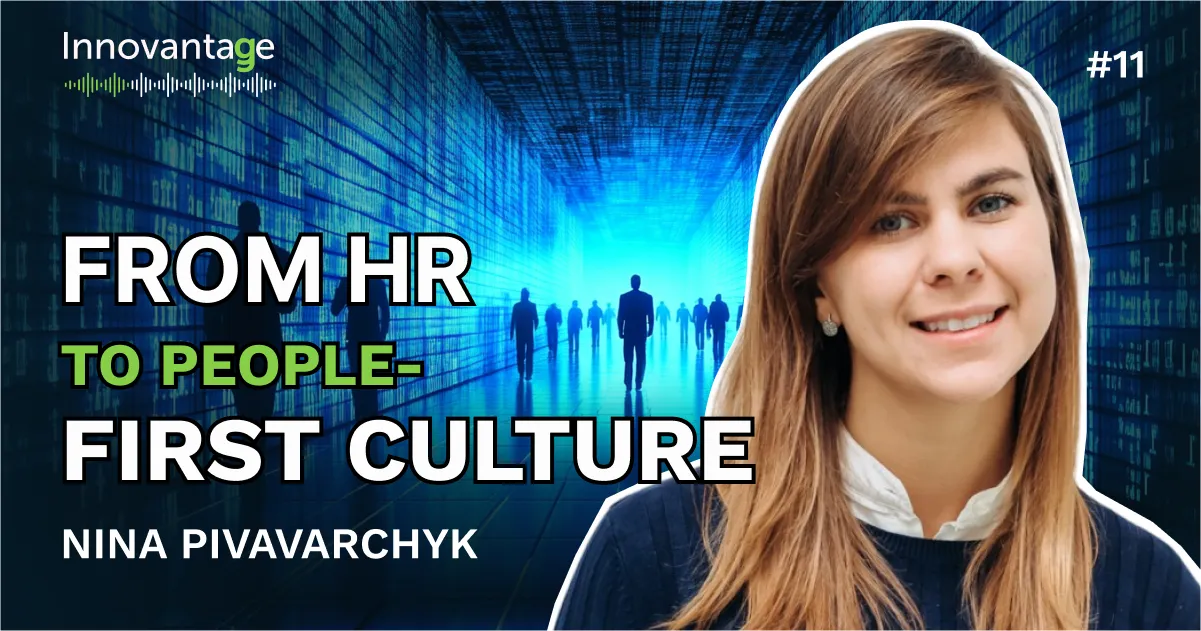
Discover how to build a strong, values-driven company culture with Nina Pivavarchyk, Head of People and Culture at Sigli. In this episode, she shares practical insights on aligning business goals with people’s needs, hiring for culture fit, and why real human connection — not just tech — drives lasting success.

The Innovantage podcast is mainly focused on technology and its importance for businesses. But tech innovation is not the only driving force that helps to achieve new heights. While concentrating too much on digital tools and advanced solutions, quite often we can forget that the core element of any business today is people.This episode of the Innovantage podcasts is quite different from all the previous ones. It is focused not on technology but on people. The host of the podcast Maxim Golikov, who is also the CBDO at Sigli, invited Nina Pivavarchyk to his studio. As the Head of People and Culture at Sigli, Nina has outstanding experience in working with people and communicating business values to them by means of a strong corporate culture.People and Culture: Is that just the same as HR?Today, we can observe a growing trend of introducing People and Culture-related positions at companies across different industries. However, the issue is that many companies do this without a clear understanding of what such positions really mean and try to change their HR into People and culture specialists.In a very broad sense, for the majority of people, HR jobs are about administrative processes, paperwork, and sometimes also about corporate events. HR responsibilities and tasks are focused on supporting businesses and employees in their work.People and culture jobs are about some other things. Such specialists are closer to the business. They need to understand the business goals and values. Their task is to match the goals of the business with people’s goals on the team. Quite often, the hardest (but according to Nina, the most interesting) thing is to find the right balance between these two types of goals.Real-life examplesIf you want to better understand what such positions presuppose and what business culture is, it will be helpful to take a look at successful real-life cases.According to Nina, Patagonia, a US-based retailer of outdoor recreation clothing, equipment, and food, is the most famous example in the People and culture community.The philosophy of this business is described in the book written by Patagonia founder Yvon Chouinard. Its name is “Let my people go surfing” and that’s one of the key principles that the company’s culture is based on.The company advocates sustainable growth and sustainable production of clothes. Its founders want to have people on board who share these ideas, who live active lives, and who use their products. That’s why they are building an environment where people can actually go surfing in the middle of the day at lunch if they want to because they are good at balancing work and life.Apart from this, Patagonia has a kindergarten inside the company’s office so that children can be educated with the right values. What is really interesting is that the company already has a full Patagonian person who was raised in that kindergarten and then became a manager. This person literally grew in the company.Another inspiring project implemented by Patagonia is related to volunteering. If employees want to go in for volunteering somewhere in a third-world country or help animals, this period will be paid for by the company.Why is it important to build a comprehensive business culture?Patagonia is a brilliant example of a business that is building its culture at all the possible layers and at all the stages of possible interaction with their potential team members. And that’s a good example to follow.This approach will help you hire the right people. Of course, it may still happen that some specialists will fall off during the recruitment process because they don’t fit into the culture. That’s completely okay.But if the whole employee experience is built correctly and you get the right people who strongly believe in your product and in your culture. They will feel comfortable and will be highly effective in their positions. This will let your product thrive and your company grow.You may offer a product or a service. Or you may have just a money-oriented company. According to Nina, it doesn’t actually matter for building your culture. You just need to be honest about your values and help people feel a part of your business.One of the negative consequences of not having a well-built culture is micromanagement. When a company doesn’t hire the right people, such people are not passionate or motivated about what they are doing. As a result, all that managers can do is to control their employees at every step.It’s very important to highlight that belief in some values has nothing in common with people’s nationalities. As Max mentioned, people from different nationalities can share your values and you can work with these people highly effectively. At the same time, you can have people from the same nationality but they won’t be able to find common ground because of different values. And that’s where a very hostile work environment can be created.How to find the right people?The process of hiring doesn’t actually start with the resume. It starts with your business brand. Before applying for a job, people usually study your corporate page and social media accounts. If they see that their values do not coincide with yours, it’s highly likely that they will look for other vacancies.Nina said that a part of her job as the Head of People and culture is to make sure that the external brand of the company and internal culture actually match and that the company is not lying about what’s happening out there.It’s vital not to oversell your brand. Otherwise, people will join your company, get disappointed, and leave you. This can cost you really much because you have already invested in recruitment, onboarding, and other related processes.It’s better to invest in your brand and to clearly show people from the very beginning what you believe in and what you are striving for.A resume is just a technical part of hiring. Nina explained that at Sigli, they also focus on a screening process. It includes speaking with candidates about different cases and real-life situations to see how they can react to them. This process helps to reveal people’s values that navigate them in decision-making.The probation period is a two-way street where people and their employers should try to detect whether their values match.Employees should see if they want to grow in the given company or not.At the same time, employers can also make a lot of valuable conclusions. During 3 months of probation, it’s quite impossible to measure the exact value that employees can bring back. But you can analyze how people act in certain situations and define whether they are a good fit for your team.Key elements that make a successful culture workCulture is something that is really hard to measure and explain. But there are a lot of theories about it.Nina mentioned the iceberg model of culture introduced by Edward T. Hall. This model is applicable not only to corporate culture but to culture in general.According to this theory, there are the following layers of any culture:Surface culture. That’s everything that is visible. In a corporate culture, these elements are your branding, office layout, the merch that you give out to partners and employees, your policies, etc.Hidden culture. That’s something that is not seen. But this defines the culture itself. In a corporate culture that is what you write about in your mission statement and your strategy. The values that your mission and vision are based on will have a great impact on what people will do subconsciously and what they will rely their assumptions on.Why does every business need product management?We are accustomed to hearing about product management in the context of software development.However, according to Nina, this concept can be applicable everywhere. In her job, she is also building her product. In this case, it is culture. The users of this product are employees.Building this product is a very long-term story if you really want to affect the business.You need to have metrics that will show you your progress and define any points that can be enhanced. You should be ready to implement several iterations (just like in software development) and even change your projects completely if they are not relevant anymore and your priorities are changed.How can you quantify culture?Let’s be honest, it’s impossible to quantify culture on its own. It can be considered only in relation to people. There are a lot of metrics that can be applied. However, there is no sense in defining just one that will be the most important for everyone because everything depends on your business goals.Quite often, it is said that turnover and retention are very significant indicators as they demonstrate how many people are leaving and how many people are staying.Nevertheless, there are a lot of types of businesses where turnover is okay and it even helps companies to develop their products.Some experts recommend focusing on the so-called revenue per head which shows how much money each employee generates for the company. In this context, it is also necessary to calculate how much you invested in each employee and how fast this money returned to you.Apart from this, there is also a net promoter score. It will help you see the readiness of employees to recommend your business to others. This is a very popular metric but it may not be appropriate for every business.The role of employees in shaping cultureOn the one hand, the culture is initially built by the founders and executives of each company. On the other hand, the role of people shouldn’t be underestimated.It’s vital to understand what your employees think about your company, how they apply your values, and how they act.Surveys, interviews, and simple observations will help you to see whether you are on the right way. Quite often open communication with employees helps managers define the need for changes.Feedback is important for executives to get insights. But it is also important for employees. When you ask for their opinions (and are ready to implement changes based on them), people see that they can be heard and understood correctly.Hiring: Practical tips for companies and candidatesHiring is often a balancing act. It’s quite a common situation when job seekers face rejection after rejection, lowering their expectations with each one. In the end, they are ready to take almost any position.At the same time, companies may also find themselves in urgent hiring situations where values and culture fit take a back seat. The goal to fill the role becomes their priority.This dynamic often leads to mismatched expectations and poor outcomes for both parties.Finding a company that aligns with your personal values and culture requires intentional effort. It’s not just about the job. It is also about understanding what matters to you. And with this knowledge, you need to seek organizations that share those values.The hiring process should not be static. Companies must continuously promote their culture, even when no positions are available. Internal ambassadors can help to share the company’s vision, values, and brand. Thanks to this, when the right position opens, the right candidates will already be familiar with the organization.For many candidates, financial pressures drive the need to prioritize income. However, it’s essential to avoid putting all your time and energy into work. This imbalance can lead to burnout and toxic environments. To reduce such risks, Nina recommended finding something that can help you renew your energy. For some people, it can be communication with family, or some hobbies, or traveling, or just watching Netflix.Wrapping up: Human connection as the highest valueThough building communication with your managers and co-workers is important, Nina highlighted that a company is not a family. Families provide unconditional support, whereas companies are professional environments with business objectives. Knowing when to separate from a role is vital to your personal well-being.At the same time, human connection cannot be underrated. Even if you see that you don’t fit the position but your goals align with it, it is still worth communicating with your potential employer about it. Though it doesn’t always happen, theoretically, positions can be modified or new ones can be created for people who can bring real value to the business.No machine or algorithm can replace the importance of human relationships. The hiring process is about humans connecting with humans and when these people share the same values, it can be the beginning of a very exciting journey for both parties.Yes, as we all know, technology is changing the business world today. But the same can be said about people. We are not only changing this space. We are also shaping it. And our future greatly depends on our decisions today.Want to learn more about the latest innovations that are coming into our lives today? Do not miss the next episodes of the Innovantage podcast where Max Golikov will invite new guests to talk about business, technologies, and people.
AI Development
What you should know about AI and other emerging technologies in 2025
November 19, 2024
10 min read

Have you ever dreamt about your own AI assistant that will know everything about you and will be able to do some tasks instead of you? This can become a reality even in the near future and that’s one of the topics discussed in the 9th episode of the Innovantage podcast. The podcast host and Sigli’s CBDO Maxim Golikov invited to his studio Maarten Verschuere, a data and AI professional with more than 20 years of experience in this sphere.

Have you ever dreamt about your own AI assistant that will know everything about you and will be able to do some tasks instead of you? This can become a reality even in the near future and that’s one of the topics discussed in the 9th episode of the Innovantage podcast. The podcast host and Sigli’s CBDO Maxim Golikov invited to his studio Maarten Verschuere, a data and AI professional with more than 20 years of experience in this sphere.Maarten spoke about his successful project Clever, which was later acquired by Zoovu Ltd, and his new startup MentX.ai. Moreover, he explained the power of emerging technologies and shared practical recommendations for entrepreneurs who are starting their business journeys.In this article, we will mention the key ideas voiced in this insightful conversation. But if you want to get more details, we invite you to our YouTube channel, where you will find the full video version. MentX: Is AI-driven knowledge sharing already here?During his career, Maarten worked in different countries in such spheres as data science and marketing analytics. He had the opportunity to see how these areas were changing and what new approaches were introduced as technologies evolved.In 2015, he founded Clever, a general data science company that later went specifically into chatbots. Why did it happen? Maarten explained that he noticed a serious gap in the market and decided to address it.But now the times are different and they require new solutions. With this idea in mind, Maarten started MentX which will take AI solutions to the next level in creating AI versions of real humans.As humans, we communicate and we spend a lot of our time at work and at home just sharing information with others. Now if somebody is not available for customers or internally, there is an obvious communication gap. People need to get information and when a particular specialist can’t talk to them, they have no other choice but to wait.With AI, such inefficiencies can be eliminated.What the MentX team is going to do is create a full AI version of an existing human. This AI version will have not only the look and voice of that human but also the knowledge and personality of him or her.Will this new version of yourself fully replace you when you are just too tired? Probably not. The first goal of MentX is to serve some specific purposes. For example, this technology can be used to create an AI version of a senior lawyer or consultant who needs to communicate not only with colleagues but also with clients and students or trainees. It’s obvious that these experts can’t be available 24/7. But it will be possible to unlock their knowledge to others and make it available around the clock.In other words, if an assistant needs a piece of advice to get through the first steps of some tasks, an AI version will be highly helpful.This idea sounds quite promising. However, Maarten admitted that the technologies for its realization are not here yet. He and his partners truly believe that they will be able to digitize all the knowledge and the personality of people. But it can’t happen now. According to their estimates, the development of such technologies will take around 2 years.Nevertheless, today, the team can run pilots for some specific components. For example, it is possible to create a video of somebody and then have that video version say anything with the voice of that person.A lot of the components that are required to create people’s AI versions already work within a certain scope. Now, MentX is trying to bring them all together.Can AI truly increase our efficiency and productivity?Of course, our AI versions won’t allow us to live forever or become superhumans. The soul and the creativity that we have can’t be copied. People will still have their unique value as personalities. However, such technologies can greatly save our time and help us (and other people around us) work more efficiently.AI definitely plays a huge role in the growth of our productivity. Nevertheless, that’s not something unique about artificial intelligence. It is absolutely true in relation to any technology you can only think about.Maarten explained that by our nature, we, people, have only basic physical skills. And we need to invent technologies and augment ourselves. For instance, to move faster people started using horses. But to transport themselves faster and go further, they invented cars. Later, they introduced airplanes. Now, businesses are working on inventing space rockets that could become available to a wide audience.AI is a big invention that can transform humankind. Actually, this transformation has already begun. If previously, traditional breweries needed to hire 100 people, now their tasks can be performed by only two specialists. The same tendency can come to offices very soon.With mass AI adoption, we will be able to do the same work at a faster pace and with fewer people.Does it mean that with AI implementation we can just relax and chill while all tasks will be executed by robots?Even if this option may look appealing, Maarten doesn’t think that people will do that. In his opinion, all these changes are just the beginning of another era. People will still be looking for new tasks and new jobs to fill our lives with new interesting projects.“AI will replace you”The name of this section, which coincides with the name of Maarten’s book, may disappoint you. Nevertheless, it’s not the best time to give up. The author of the book has a very clear explanation.Today AI can do a lot of things for us. It can recommend to us what to watch, what to have for dinner, what to buy at the supermarket, when and where to go on vacation, and many other things. These recommendations are based on the experience of the entire world. All the data that is collected by AI systems allows them to create optimized recommendations for everything in our lives. And if we blindly rely on all of them, we will simply become pets of AI.Yes, if people feel very comfortable because of not having the necessity of making decisions themselves, then AI will basically replace them.However, not everyone is ready for that. In his book, Maarten offers an alternative for those who do not want to be replaced. People need to accept the reality and start taking more responsibility for their own future and their own decisions.It’s also important to consider this situation not only from a personal but also a business perspective.If you have a business, you also have a lot of things to think about. Is AI going to become something that will wash over you, and transform your sector and your industry? Or are you going to be the one who is taking charge? If the second option sounds more appropriate, you need to define how AI is going to be used in your company and how you can use it to create value for your customers and employees.In this context, it’s very important to get over the so-called AI anxiety and transform it into an AI opportunity.Emerging technologies and chip developmentMaarten mentioned that we are entering the perfect storm of technologies that are appearing at the same time. The pace of development of new technologies has become absolutely crazy. And this thesis refers not only to digital innovation but also to the physical infrastructure and the hardware.For example, chips produced by Nvidia were critical elements in the growth of OpenAI and ChatGPT. Today, there are huge investments in chip technology as chips really fuel the next wave of innovation.In the conversation with Max, Maarten mentioned that he is greatly impressed by the progress achieved in data science in recent years. But while speaking about emerging technologies, he also highlighted the significance of edge computing. This approach presupposes that computation and data storage should be brought closer to the location where data is really needed. This is done to improve response times and save bandwidth.It means that when you are on Mars, your data shouldn’t be sent back to the cloud on Earth to be processed and then returned to your application on Mars.Of course, AI today differentiates itself from other emerging technologies. It has already started to bring money. That’s why AI is not about hype, it’s about creating value, and a lot of businesses have already realized this idea.Can AI help in solving real business problems?If you pay attention to the new products that appear on the tech market, you will see that a lot of them have AI in their names. But do all of them really rely on AI? Maarten admitted that quite often he notices AI washing cases. Companies just put AI on top of their offerings just to make sure that they are innovative. However, in the back end, we are just still doing the same things.For example, they used to have a database. Now they still have the database but can call it AI.Real innovations should have value and ground to be implemented.20 years ago data was the new oil and it still has value. You need to use your data to create value for your customers and for your business. The same should happen with AI.To better explain his vision, Maarten shared a case from his practice.When he worked at P&G, the company started to realize that they could lose their share in the washing detergent segment. It was necessary to find an approach to retain customers and avoid losing profits.Maarten’s team managed to use data in such a way that allowed them to create a retention model to identify the potential of every customer leaving the brand. By looking at some indicators and retail data, they could see the customers who could leave the brand and understand how it would be possible to retain them.Further analysis revealed that this model helped the company earn a million dollars, while all the investments in its development and implementation were close to $100K.It means that it had a 10x impact.Based on his experience, Maarten insists that for implementing AI, businesses should look for such cases when they could leverage 10x return on investments.However, that is possible only when you are solving real problems, when you define real pains and address them.That’s why while consulting businesses, Maarten prefers to talk not only to IT experts but also to other non-tech specialists, like marketers and HR managers. These professionals work with final solutions and communicate with people. They have a very clear vision of what can be improved.Businesses should focus their attention on how to implement AI to solve problems and to help their employees, instead of replacing them.How to implement AI: Real-life recommendationsYour preparations for AI implementation will greatly depend on the type of business that you have. It’s quite natural that a local bakery will need to deal with fewer tech requirements than a utility provider.But regardless of these differences, all businesses should have at least basic capacities for the introduction of new solutions. If you are going to use AI to make personalized product recommendations, your infrastructure needs to be able to support this functionality.When you rely only on legacy tools that were built 20 years ago, your databases will probably work in silos. It will be a serious obstacle.For implementing AI solutions that will work based on the data about your customers or your operations, your data needs to be in order.Among other tips on how to implement a good AI strategy, Maarten also mentioned the necessity of formulating the exact reasons for introducing AI and getting the right people on board.Another important step is to analyze the complexity of potential solutions. If the complexity of implementation is high, then this is not a project to start with. You should begin with easier initiatives to test your AI implementation potential.It could be also sensible to start with data projects, where your data can be cleaned and prepared for further implementations.Is it challenging to be an entrepreneur?First of all, when answering Max’s question about the challenges of entrepreneurship, Maarten said that he has tremendous respect for all entrepreneurs, regardless of the stage of their business development.Maarten explained that in his opinion being an entrepreneur is super hard.These people are creating something, they need to go from zero to one. This process is painful. It is impossible to follow someone’s instructions. It is necessary to follow your vision and try to make it work.“Don’t become an entrepreneur if you want just to get rich. Don’t become an entrepreneur just to have a cool lifestyle,” Maarten said.Very often entrepreneurs fail. But it doesn’t mean that they give up. However, when you are building your own business, you always have the choice to get out of the game or iterate.It can also be hard to get funds. Investors want to see a potential return on their money. If you have nothing at the moment, you need to make them believe in you and your idea. But when you raise money, you get a whole new set of problems. Now you have to deliver the results. You need to deal with other people’s money. So the pressure to deliver is even higher.The more money and the more customers you get, the more people you have on board, the higher your responsibility is.Though Maarten was talking a lot about difficulties, he also mentioned one more essential thing.In his opinion, having fun is a crucial part of the whole entrepreneurial journey. If a person doesn’t enjoy the process, is it really worth all the effort?Final wordBuilding a new business or transforming an existing one may not be the easiest task. But when you know why you are doing that, everything makes sense. In the Innovantage podcast, its host Maxim communicates with tech and business experts. They share their experience and vision of how AI and other emerging technologies are changing the world around us and how we can benefit from this transformation. If this topic is interesting to you, do not miss the next episode that will become available quite soon.
AI Development
AI in Governance: How Estonia is leading the play
October 8, 2024
10 min read

The Innovantage podcast is continuously expanding its horizons. While the previous episode was devoted to the experience of Lithuania in the AI revolution, this time, podcast host Sigli’s CBDO Max Golikov has invited Dr. Ott Velsberg to talk about the path chosen by Estonia.

The Innovantage podcast is continuously expanding its horizons. While the previous episode was devoted to the experience of Lithuania in the AI revolution, this time, podcast host Sigli’s CBDO Max Golikov has invited Dr. Ott Velsberg to talk about the path chosen by Estonia.For the last 6 years, Dr. Velsberg has been serving as the Government Chief Data Officer of the country, which allowed him to accumulate unique experience in this sphere. Ott has been overseeing such domains as data governance, open data, artificial intelligence, data privacy, and others from both strategic and practical implementation perspectives. This gives him a comprehensive vision of everything that is related to data and AI within the Estonian government. And in his conversation with Max, he shared his insights.Check out the full Innovantage episode with Dr. Ott Velsberg here: https://youtu.be/fxhCXDkrggo?si=SLOXvyd7ohIbtpzjThe role of data and AI in Estonia’s economyEstonia is one of the examples of how digital governance can be run. But it is not going to stop where it is at the moment. One of the country’s priorities for 2030 is to build an AI-powered government.The focus is not necessarily on emerging technologies. The focus is on data itself and its value for the government, businesses, and society in general. Data plays an important role in delivering better services and making more informed decisions at different levels.According to Ott, in the data economy, AI is one of the key pillars in boosting the growth of the economy in general.Today Estonia already has one of the highest data economies in terms of percentage of GDP globally. It occupies the second position, just behind the United States.However, Estonia is the leading implementor of AI in the world, as Ott highlighted, not a developer.What sectors are the largest contributors to the AI economy in Estonia?Of course, such services as information and communication technology as well as connectivity are known for their significant contribution to the development of AI and data economy.But in this context, it is also crucial to mention some other domains, like manufacturing in healthcare, that are currently heavily investing in this field.Dr. Velsberg mentioned one of the studies conducted in Estonia. They evaluated the activities and approaches of companies where at least one-third of the teams were data specialists. Nevertheless, surprisingly, no specific data-driven approaches were detected. The reason is that just the presence of particular experts doesn’t guarantee transformations.At the same time, there are some domains, like agriculture, that do not hire people to solve any data-related tasks. Instead, they are outsourcing such services. In general, a lot of processes can be enhanced with the right application of data. If we are talking about farming, all efforts can become more efficient when farmers have enough valuable information about the characteristics of the soil and fertilizers that should be used. Outsourcing can help to address such tasks. However, with this model, agricultural businesses still do not have people who can continuously drive transformation and create the necessary environment for innovations.New times require new skillsOtt mentioned that today we all need to have elementary data and AI skills. The society we already live in affects literally everyone. It’s impossible to avoid its influence.If we look at the situation with domain experts, like data analysts, data scientists, data engineers, and data stewards, we will see that Estonia currently lacks around 13,000 specialists. Specifically within the government, the country is missing one-third of data analysts.The issue is that today it is not possible to train as many specialists as needed. However, this is not a local problem in Estonia. It is a global trend.Speaking about a wider labor market, Ott noted that new knowledge is required not only for specific data-related roles. Even such experts as project managers need to know, for example, what the difference between a typical IT project and a data science project is, what generative AI is, what an LLM is, what machine learning is, and so on.At the beginning of next year, the government in Estonia will be launching a data literacy campaign across the country.There are plans to introduce various topics related to data science and analytics to young students in schools and universities.The objective is to ensure 80% data literacy by 2030. This cannot be achieved without working with the whole society at different levels at the same time. There are always some elderly people who are not open to innovations. But the more they know about technologies, the less skepticism they will have. Talking about such topics is extremely important.Moreover, it is vital to organize various programs. A row of AI training sessions held by the Estonian government for different social groups gained tremendous popularity. All places for the course aimed at primary school students were filled just within a day.A good understanding of the value of technologies and data is required at the organizational level as well. Today there are a lot of companies at different stages of their maturity that work with data but they do not even understand what type of data they collect, who can access it, where it is stored, and why it is actually needed. Given this, can they efficiently manage this data and fully leverage its value? It’s highly unlikely.New challenges and new solutionsThe same is true about people at the individual level. Many people today have no idea what data about them is collected and how it can be further applied. Moreover, they do not even think about how they can benefit from this data. Max compared this situation with the early adoption of the internet. Users got a powerful tool but they didn’t know what exactly they could do with it.Ott explained that today’s initiatives aimed at the development of basic IT literacy in society are part of the European goals for 2030.Governments need to start talking about data and AI as well. In this context, it is vital to educate people about new services that will appear and that don’t even have non-digital counterparts. Here, it is also necessary to inform citizens about those groups of specialists who might become unemployed before it actually happens. It is important to mention the existing risks, as well as the factors that ensure trustworthiness and transparency.People should have a clear vision of how they can control the use of their data.For example, in Estonia, the government introduced the Data Tracker. Its purpose is to offer citizens access to a full overview of the operations conducted with their data. The country also has a consent service. It enables people to give the state permission to share their personal data with a certain service provider, for example, healthcare organizations.Today, the government is also working on increasing the accessibility of services and has been heavily investing in sign language and real-time speech recognition.Another project of the Estonian government is the development of the digital twin concept, but not in a typical sense. In this case, such digital twins can visualize different real-life situations based on available data and help the government stay proactive. For example, such solutions can be useful for foreseeing the changes in the labor market. The government is always interested in keeping the unemployment rates as low as possible. By getting insights into the possible changes, the government can organize various training courses and provide practical recommendations to those who are likely to lose their jobs in the next 6 months.Are there any risks associated with this? Definitely yes. First of all, people may be rather confused. Not everyone is ready to get such information from the government.Secondly, job losses are often related to the bankruptcy of companies. If the government publishes some info about a company that may go bankrupt in the near future, it can negatively affect its reputation already today.That’s why it is crucial to think not only about how to handle the data but also how to present any information to citizens.How governments should work with dataTrustworthiness is one of the key concerns across society. Ott shares some statistics.Women are more likely to not trust technology itself. Many of them are less active or savvy users than men.As for the generational differences in the Baltic states, the older generation trusts the government less, however, these people trust the private sector. With younger people, the situation is completely opposite. They don’t trust the private sector but they trust the government.The task for the government today is to stay proactive and not to wait for a person to reach out with some questions or issues. People are likely to believe more if they understand how and what the government is actually doing.In Estonia, there are some important initiatives that are designed to increase transparency in the AI and data sectors.Ott also shared that at the time of recording the podcast episode, they were preparing for the launch of the algorithmic transparency standard. Its introduction presupposes that everyone who has carried out an AI project within the public sector needs to openly clarify the goals and the logic behind it, as well as other important details.Moreover, every funded project needs to implement the Data Tracker so that all the information can be available on the government portal.One situation last year brightly demonstrated the interest from the side of citizens in getting access to such information. Around 450,000 Estonians looked for information related to the application of their data included in the population register when there appeared some concerns regarding the ethical side of its use.Estonian approach: Keep it simpleWhen asked about any specific approaches to building the data economy in Estonia, Ott stated that the main idea is to keep everything as simple and small as possible. Instead of large-scale projects, it’s better to start with small ones that address some specific problems.Dr. Velsberg warned: “Don’t overanalyze. Don’t overanalyze.”It’s necessary to listen to end customers, detect their pains, and offer solutions to them.According to him, that’s exactly what Estonia is doing. The country’s approach can be described as problem-focused, rather than tech-focused.There is no need to implement AI just because it is AI. It is necessary to identify the processes that can be changed and do this.A lot of AI projects today can cost between 60,000 and 70,000 Euros and their implementation may take just around a couple of weeks. But they can save hundreds of hours of people’s time.Countries are ready to invest millions of euros to analyze some technologies. But quite often it’s more efficient and feasible just to take action than to conduct endless research.EU’s AI Act: Will we benefit from it?Of course, the introduction of a regulatory framework has some pitfalls and controversies. Should AI have separate legal entity status? Who is responsible for its decisions when it misbehaves?But without any doubt, the legal framework for the use of AI and data is critical. It’s vital to control how data is collected and used, as well as to protect people’s rights.Nevertheless, the Estonian government has made a decision that they won’t regulate AI nationally and will rely only on European laws.One of the advantages of this is that the EU has a large global market and if companies that adhere to its regulations decide to enter other markets, they will have a great potential for this.Moreover, quite often, EU-wide regulation can also push countries to the introduction of a basic standard that will be applicable to everyone across all member states. It could bring benefits not only locally but also on the international level as well.Ott admitted that when he read the first version of the EU’s AI Act, he was extremely skeptical. The document included a lot of unrealistic requirements. The latest version has been greatly updated. It offers a lot of best practices and seems to be much closer to reality.Ott hopes that the Act won’t undergo changes in the next few years. Time is needed to understand how the rules work and whether it is possible to improve them.The AI Act has already downplayed or eliminated a lot of risks related to the use of AI. In some potentially dangerous situations, AI can’t be implemented at all (like social scoring which is a rather popular use case shown in many films). There are no reasons to be worried.The value of personalized servicesGovernments today are interested in using AI to deliver better services to citizens and facilitate a lot of processes for them. In Estonia, a lot is done to introduce proactive and personalized services.For example, even before a baby is born, parents can solve a lot of questions. For example, they can already give a name to their son or daughter, re-register a child to kindergarten, and get full information about the social benefits related to the birth. All this helps to save people’s time because time is the most valuable resource.The same approaches can be applied to various aspects of people’s lives, including military service and car registration.The government should understand the needs of people and adjust all the services to them.Very similar rules work in the business world as well.If you are able to provide services that your client actually needs in a personalized manner you are going to be more successful than those who provide something that people don’t actually care about.AI and data can bring a lot of benefits at different levels of our society. But only when they are properly used with the right goals. And that’s one of the key topics discussed with experts in the Innovantage podcast. If you want to learn more about it, do not miss the next episodes.
AI Development
Lithuania and AI era: How the country is leading innovation
September 24, 2024
10 min read

This episode of the Innovantage podcast is devoted to the way chosen by Lithuania and its achievements in the ongoing AI revolution. To talk about this topic, Sigli’s CBDO Max Golikov invited Dr. Linas Petkevičius to his studio.

Today, when the whole world seems to be quite globalized, each country still has the possibility to build its own approach to various aspects of its development. And digital transformation is one of them.This episode of the Innovantage podcast is devoted to the way chosen by Lithuania and its achievements in the ongoing AI revolution. To talk about this topic, Sigli’s CBDO Max Golikov invited Dr. Linas Petkevičius to his studio.Check out the full Innovantage episode with Dr. Linas Petkevičius here: https://www.youtube.com/watch?v=-Jn98Bb_9iAAI ecosystem in LithuaniaLinas is the general manager for the Artificial Intelligence Association of Lithuania and an associate professor at Vilnius University with a focus on AI, deep learning (DL), and other technologies connected to it.The idea of combining these two spheres of professional activities may sound too challenging. Nevertheless, Dr. Petkevičius noted that he sees a lot of perks of this duo. As a researcher and lecturer, he needs to plan courses and supervise students who are writing the Bachelor’s theses in various applications, monitor the freshest research publications to get access to new ideas and techniques.From the side of the AI Association and his NGO-related activities, Linas needs to communicate with ecosystem stakeholders and bring them together through discussions and consultations.But all these things have a common ground. And that’s AI. It means that Linas not only can stay tuned with the research from the perspective of the academia but also from the perspective of businesses. Thanks to this, he has a full picture of the Lithuanian AI ecosystem.Lithuania is a small country. However, it successfully unites under one umbrella all the contributors to the AI domain, including academia, companies, startups, professionals, and enthusiasts. Today, a lot is being done to support innovations and expand the tech ecosystem. There are numerous engagement events, like hackathons and meetings, that help new ideas be heard.Linas mentioned that today Lithuania looks quite attractive to both local startups and international investments. Moreover, the country is interested in welcoming new projects and talents. It also invites alumni to come back after studying abroad. According to Dr. Petkevičius, given the ongoing conditions in the tech space, it is a good time to do this.How AI is perceived by the publicAI is changing what we can touch and see each day. But it is also changing a lot of fundamental things in how the world is functioning. Previously, it was governed by a capitalistic approach. If you had labor, you could create value by establishing a call center and it was your market advantage. If you had capital, you could build and operate factories and it was your way to create value.Now everything doesn’t look this way. AI has arrived. And now one programmer with a laptop can replace thousands of jobs by creating automation tools.This approach doesn’t fall into the categories of labor or capital. It is a completely new idea that we are not accustomed to.What is deep learning?Deep learning is known to be a subset of machine learning that relies on artificial neural networks to learn from data.According to Dr. Petkevičius, deep learning helps us modify some data, like images, text, or speech, and transform it into new dimensions in order to make it more informative.For example, such models can analyze an image and describe what is shown in what, what its general mood is, and whether it is blurred or not. Similar operations can be made with text. A DL model can read a paragraph and provide such info as the names of the companies mentioned in it, the key semantic information presented, the style of the text, the general context, etc.These applications can be highly valuable for businesses now. If they have an image, they can get its description which can serve different purposes.Key boosters and barriers for AI and DL researchDr. Petkevičius shared his own observations regarding how the interest in deep learning research from the side of students has been changing over the recent years.For example, 5 years ago, when students chose deep learning as a topic for their Bachelor’s theses, they needed to code a lot and had many other tech things.Today, this process is less complicated. Now they have access to ChatGPT and a lot of new products can be successfully built on its base.Thanks to this, it is not only easier but also significantly faster to test and implement new ideas. That’s why the level of students’ research projects is much higher now than it was 5 or 10 years ago.The models delivered by students can be really nice and clear for the general public. They may have real value and interesting use cases. But they are not reproducing the fundamental new knowledge, they are not based on the latest research. In this context, Linas mentioned the necessity to invite them to work with fundamental topics and experiment with them.However, sometimes such experiments can be quite depressing, especially for students. To get one successful model, sometimes you need to try a lot of things, test hundreds of combinations, but all these efforts will stay invisible. It’s impossible to create an excellent model for business or academic purposes from the first trial.Another barrier that may discourage students from DL research is that we all want to have one big model for everything. But at least at the moment, it doesn’t seem realistic.It is much more sensible to have smaller models designed to deal with a limited number of tasks.The gap between academia and real-life projectsWe had a spike in technology breakthroughs in 2015 when various image recognition models were developed. There were significant advancements in different generative tools in 2017. Today, we also have the language models which became really innovative after they started to produce interesting results in 2018.At that time, the only problem was that all those technologies and all those breakthroughs were in academia, in R&D. The general public didn’t have the final product to touch it and to understand its possibilities.Nevertheless, this issue is not a new one. For centuries, academia has been leading the introduction of fundamental models and theories. When innovators were looking for ideas that could be applicable in practice, they could take some academic research and start working on real products that would be later available to customers. This process could take 5 or 10 years. And nobody could be initially confident in its success.The same is happening now. From the applicational point of view, academia and businesses are joined. A lot of companies have AI teams that work with academia to test and implement new ideas faster and reduce the time gap between research and production.Changing habitsIt’s breathtaking to analyze how the adoption of technologies is related to what we are accustomed to.Today, there is an opinion that computer literacy classes can be useless for modern children. They actively interact with smartphones, while using traditional computer mouses and typing requests with a button keyboard look quite archaic for them.Linas mentioned an interesting example. He can observe that young students quite often use their smartphones to google something, even when they are sitting in front of computers during programming classes. That’s the power of habit.Have you noticed that today for many people it is much more convenient to write messages instead of making voice calls, especially when they are somewhere outdoors? It happens because this already seems more natural today. And it explains why some technologies are still not widely adopted, despite their potential value.For instance, speech-to-text models produce reasonably good accuracy these days. They can be very useful for a very wide audience. Even while driving, a person can just talk to AI and get a full, well-formatted document as a result. Nevertheless, for the majority of people, it is still easier to type their texts.Though the use of VR glasses, like Apple Vision Pro, could help us collect a lot of necessary information about objects and processes, their adoption is slowed down for the same reasons.To implement some innovations in our lives, we should change our behavior first.How to choose the best ideasIn his dialogue with Linas, Max asked him about the ways to decide on whether new technology is good or which startups are interesting enough to support. Unfortunately, unless you know the future, without testing, you wouldn’t be able to guess with 100% accuracy which idea will be a successful one.According to Linas, at the AI Association, they organize regular AI meetups which allows them to invite as many new ideas and new speakers to talk about their startups as possible. As a result, the community can get a lot of valuable and diverse information delivered by different people with different backgrounds.Linas noted that the more ideas are voiced, the better. If we have just one or a few options for services, we just get accustomed to them and do not want to have changes any more.But if we have a new app every week, we try it, we start searching for a better one. This fosters new developments and helps to achieve better results.Education for the public is also very important in building and adopting new ideas and products.AI in healthcare: Do we really need it?Dr. Petkevičius noted that there are many tasks in healthcare that are really suitable for automatization. For example, it is possible to introduce very efficient algorithms that could analyze various images, like CR or X-ray scans, and quickly provide feedback regarding any anomalies or potential health risks. Here we have a huge time-related benefit. If a radiologist needs around 10 minutes to analyze a scan and make a conclusion, AI will do it in milliseconds.Moreover, AI models can greatly help with such complex domains as tissue and cancer recognition. Nevertheless, in the end, it all comes down to the amount of data.The more high-quality data you have, the more complex and efficient models you can create. Some big hospitals in the United States have 100x more patients than any hospital or lab in a small country. As a result, they have 100x more data for validation and further use.But can we expect to have fully automated medical consultations soon? On one hand, it may seem that with the introduction of AI apps, we will greatly boost the efficiency of many processes. AI can’t get frustrated when it needs to repeat the same things again and again. It doesn’t have emotions and the quality of its consultations can’t be worse because of its tiredness.On the other hand, it can hallucinate, it means it can provide information that is factually incorrect or misleading. This makes it obvious that for final decisions, the human touch is still needed. While AI can work with data, doctors have their own real-life, continuously evolving experiences. They have the latest information about how medications work with different symptoms and often can analyze many more factors simultaneously than AI can.However, in many countries, there is a problem with making appointments with specialist doctors. Given this, AI-powered apps that can provide at least preliminary diagnoses and recommendations to people can be of great help.Urban planning and generative AIUrban planning can be named among the spheres that can enjoy the biggest benefits from AI implementation. In this domain, AI tools are absolutely not harmful and the risks related to their use are the lowest. Thanks to Generative AI, you can easily get around 100 possible demos of how you need to reconstruct a park, for example.You can select different options and modify them. That’s why Linas highlighted that urban planning can be a very good area for experimentation with AI.AI regulation: Good or bad?Currently, AI regulation is a sphere that is full of uncertainty. For instance, in the US, there is still no comprehensive federal legislation that governs the creation of AI tools and specifically prohibits or restricts their use.The European AI act entered into force on August 1, 2024 (Please note that the Innovantage podcast episode with Dr. Linas Petkevičius was recorded before that date. Nevertheless, the core principles and ideas proclaimed by this document were already known). This marked a crucial step towards forming a comprehensive and ethical framework for AI in the region.According to the chosen line of AI regulation, there is a classification of applications of this technology based on how they affect us as a society. For example, some of them do not have a direct impact on people. That’s why, it is not needed to introduce any specific rules to regulate them. Some applications should be completely forbidden due to their damaging power.There are also some cases of AI usage that have the possibility to impact us and/or we could get hurt after their implication. In other words, such cases are associated with high risks (for example, like all applications of AI in healthcare). They should be strictly regulated and there should be requirements for their testing. Without any doubt, such types of AI products should be monitored. But without a clear vision of how they should be tested, how they should be certified, all this leads to a lot of controversies.The implementation of AI regulation also results in additional bureaucracy and expenses for startups and companies that do research in high-risk domains.Today, we can watch how competition between the largest US AI companies, like Meta and OpenAI, is gaining momentum. They are continuously improving their models so that they can demonstrate better and better results.As for the European region, at the moment, there aren’t any large A-tier AI firms. And an additional burden of regulation won’t create favorable conditions for new projects.Today, it can be very expensive and risky to create new models from scratch. That’s why in spite of all the benefits that regulation can bring to the space, it can also freeze innovation. Just imagine, how many ideas won’t be transformed into real projects, if it is prohibited to keep personal data online.Bottom lineToday it has become absolutely obvious that AI is much more than just a buzzword. It has real-life applications and its value for various domains is continuously growing. While different experts may have different opinions regarding the development of this technology and approach to working with it, the majority of them agree that only in cooperation with each other and with communities, academia and business can conquer the highest peaks. The same idea was highlighted by Dr. Linas Petkevičius. And Lithuania is a great example of the country where this approach works well.Want to learn more about how AI is transforming the business world? Follow us in order not to miss the next episodes of the Innovantage podcast.
MVPs
Why can AI become a good choice for venture capitalists?
September 10, 2024
11 min read

In the Innovantage podcast, Sigli’s CBDO Max Golikov talks to tech experts and entrepreneurs about their vision of how artificial intelligence is transforming the world. The 4th episode covers much more than that. Leesa Soulodre, who was the podcast guest, explained not only the role of technology in modern society but also the role of society in tech progress.

In the Innovantage podcast, Sigli’s CBDO Max Golikov talks to tech experts and entrepreneurs about their vision of how artificial intelligence is transforming the world. The 4th episode covers much more than that. Leesa Soulodre, who was the podcast guest, explained not only the role of technology in modern society but also the role of society in tech progress.Check out the full Innovantage episode with Leesa Soulodre here: https://www.youtube.com/watch?v=D5oANROV8X4&t=1373sLeesa is the founder of R3i Group and the Managing General Partner at R3i Capital, a deep-tech cross-border venture capital firm that focuses on AI and sustainable development.Deep-tech startups: Key pitfalls on their wayLeesa’s firm helps projects connect to capital, customers, and non-dilutive financing that lets startup founders keep full ownership of their companies.Today, founders who work in deep tech (or in other words, who build projects that are based on high-tech innovation or significant scientific advances) traditionally face three main challenges.A commercial challenge, or commercial Valley of Death. That’s the period when a startup has already begun operations but hasn’t generated revenue yet. Founders need to get over this period to make sure that their product does what it says on the tin and has value.A technical challenge. It’s important to demonstrate that a product is capable of consistently performing in the same way every time so that it can be safe for the person to use it.An ethical challenge. This challenge is related to the fact that everything that we use today almost always doesn’t have a kill switch. Therefore, inherently a product needs to be safe in its provision.How to make sure that AI developments are safeWhile talking about the safety of using AI products, Leesa recollected some other well-known cases. The proliferation of Airbnb made everybody’s homes available to guests. This led to the need for the implementation of trust and safety teams. With the growing popularity of taxi services, everybody’s car can be used as a taxi. This again highlighted the demand for such trust and safety teams.What do we have to deal with in the case of AI? The situation may look rather alarming. In fact, deep neural network compression technology could be used to kill more people faster and with less energy than other technologies.And if you consider that every AI product can be used for such a purpose, it becomes obvious that we need to maintain this notion of trust and safety teams. This is vital to make sure that our technologies are not misused for unintended purposes.Any AI organization with as much influence as OpenAI has that is not going to invest in trust and safety teams will face significant legal and regulatory hurdles. Moreover, such companies will have even more issues with further growth and innovation in the future if they don’t gain implicit trust from their user base.Regulation in the AI spaceWhen it comes to the regulation of tech companies, there always have been some controversies. One of the main reasons for this is that regulations don’t tend to catch up fast enough with what tech companies are doing.In the discussion of this aspect with Max, Leesa mentioned that she sits on the board of the AI Asia-Pacific Institute. She communicates with representatives of the governments in the region. The governments want to build safety rails for technologies, and AI in particular. But there is a significant barrier.Let’s take Singapore as an example. The absolute majority of the registered Generative AI companies are just starting their business journeys. They are at their seed or pre-series A stages. This means that quite often they do not even know what they have on the tin. They do not know the value of their products. That’s why it’s natural that they are not ready to invest in regulatory oversight. Given this, there is no sense asking them to do that.Leesa believes that it will be more sensible to build guard rails into the fabric of the major technologies that underpin new products and solutions created by startups.For example, many GenAI companies are building their tools on the back of the technologies developed by OpenAI, Microsoft, or Amazon. So it makes more sense to start with these tech giants. They need to comply with regulations first.Is the use of popular LLMs the key to success?While talking about mature AI technologies that startups can rely on, as an example, Leesa mentioned Hugging Face. It is a versatile platform that is widely recognized for its open-source repository of multiple large language models (LLMs).Leesa’s VC firm works a lot with startups. Around 2,000 projects claimed that they were using Hugging Face. At a close investigation, it was revealed that only 200 were truly using it. And only 16 were fundable in the opinion of R3i’s experts.Today there are a lot of players with similar offers. Leesa noted that both open-source and commercial models, like ChatGPT, can be a good option for new technologies. But here, it’s vital to understand that they serve different purposes. For example, ChatGPT is perfect for converting high volumes of always the same automation tasks.As an investor and technologist, Leesa is interested in finding technologies that will work as efficiently and safely as possible and bring the highest value.She said that she doesn’t invest in ChatGPT-like solutions. She looks for applied AI technologies around critical infrastructure and highly regulated industries. The projects that are the most interesting to her are those that can bring tangible results. They can power transformation from point A to point B in such domains as smart cities, energy, healthcare, industrial manufacturing, water management, agriculture, mobility, space safety, security, surveillance,For instance, she mentioned that her VC firm often invests in technologies for renewable energy. Already now, it is a highly regulated sector, despite being comparatively new.Deep tech investing: When is it a good idea to support an AI project?In the discussion with Max, Leesa mentioned that today there are a lot of AI-related projects that may look quite appealing for investors. But in reality, they may turn out to be a mouse trap.Working with the deep tech industry, Leesa prefers to invest only in those projects that have deep scientific research and technological invention behind them, which can be proved by a patent pool or a data mode. And if a project has a data mode, it should be its own, not the one that Microsoft or OpenAI possesses.But what are these things? And why do they matter?Leesa explained this with real-life examples. When scientists at the university invent something, they need to protect this from being copied or misused. Almost always in such cases, they can apply for a patent that will protect an idea or an innovation. If somebody else wants to use this innovation, they will need to obtain a license.However, Leesa warns about one serious challenge related to patents. When you publish a patent, everyone can learn what it is about. Unfortunately, at the moment, patents, especially in the software development industry, are not protected well enough.Patents themselves can be viewed as assets. Even if a project fails or the development of the technology is frozen, founders will still have a patent that can be further sold.As for data, it also can be monetized. If your company is carefully collecting, identifying, classifying, and tagging data, you (or somebody else, who will get access to it) can use it to create new products or power the existing ones.Generative AI for patents: Can we trust it?While talking about the capabilities of generative AI, Leesa stated that it is fantastic for ideation, and especially brainstorming. Nevertheless, it’s vital to understand that such models are hallucinogenic. It means that they can provide wrong or irrelevant answers. It may happen because the training data was incomplete or biased. And that is just a bright demonstration of the “Garbage in, garbage out” principle. Moreover, hallucinations may happen because AI models often lack constraints that can limit possible outcomes.That’s why we can make the following conclusions from such a situation. First of all, we always should be very careful and attentively check whether the received information is true. And secondly, despite the advancements in GenAI, we still need human creativity, empathy, and ingenuity. That’s what AI can’t ensure at the moment.Innovation timing: Cinderella effectIt’s not a good idea to come to the ball too early, as nobody will turn up at that time. But you also shouldn’t come too late as you will miss all the fun. You should be just in time. That’s why before introducing a new technology, it is necessary to analyze whether the market is ready to receive it as well as to consider the key barriers to its adoption. The psychosocial aspect is important. People should trust you and your solution.It’s vital to listen to different opinions to detect possible unintended consequences that may stay unnoticed for founders. When a team is working on a new product, they have only one perspective. But when you are building something new for a community, you should know what impact your innovation will have on it. It’s also worth mentioning that the impact on one community may differ from the impact on another one.It may sound surprising but in many cases, it will be very sensible to listen to children as well. Today, there are even some tech events for kids. And that is a very good trend. One day they will become active users of technology. That’s why their voices, their questions, and their doubts also have value.Speaking about the technologies that Leesa has invested in, she mentioned a couple of examples. She described them as absolutely revolutionary from the perspective of activation and implementation.Quantum Brilliance. The company works on room-temperature diamond-powered quantum computing. In other words, thanks to the use of synthetic diamonds, quantum accelerators will be able to work at room temperature. Though the history of this project is just beginning, it promises to bring quantum computing to a wide audience and make it everyday technology. This approach will be able to revolutionize every facet of a smart city, including security, drug discovery, material science, data operations, etc.ViewMind. That’s a brain health company. Its technology can look into your eye and capture millions of eye movements in a single view over 10 minutes. Based on this, it can determine with a very high degree of accuracy what level of degeneration you have or are likely to have in your brain. Such examination can help to manage diseases like Alzheimer’s, dementia, multiple sclerosis, Parkinson’s, or even post-traumatic stress for a soldier. This technology can demonstrate which area in the brain is affected and help to deliver personalized treatment. These types of technologies can absolutely change our lives for the better. They can move us from what we call treatment to the prevention and prediction of diseases. In the case of healthcare, such an approach is of great value.The most promising, value-based technologies should do something at least slightly better than it is done today and can greatly change the way we perceive something. For example, massive carbon emission reduction technologies change the way we think about the use of energy and water.What is the greatest threat to economic growth?While talking about new technologies and economic prosperity, Leesa said that one of the biggest concerns is piracy, both physical and digital.Piracy is one of the factors that can affect supply chains, steal jobs, and put economic development under threat. For example, when digital versions of books are provided for free, people who contributed to their creation lose their wages.Nevertheless, despite a huge negative effect, sometimes it is possible to detect some positive sides. This way of distribution can play an important role in the digital preservation of some media that no longer generates profit but could still be valuable in terms of history, art, or culture. Moreover, this can open new opportunities for those who have limited access to legal distribution infrastructure.How to decide where to investDifferent investors may apply their own methodologies to their decision-making process. Leesa shared that at R3i Capital they also have their own philosophy when it comes to choosing projects. One of the most important things that they pay attention to is the team.To avoid unconscious bias, R3i Capital relies on an AI engine built in cooperation with Hatcher. As a result, every team goes through the same filters and the result of such evaluation is as objective as possible.Thanks to this approach, absolutely everyone has the same chances. Such a system allows the VC firm to give voice even to those groups that are often ignored, like women and minorities.Moreover, it’s very important to analyze how fundable the company is and what its likely impact is. According to Leesa, while doing this, it’s highly required to keep 100% transparency. This will ensure the desired trust between founders and capitalAfter all, capital markets do not need to be brutal. They should be fair instead. This will help to achieve a win-win interaction.Why does sustainability matter?Leesa explained that with its investments, R3i supports tech companies with a tangible ESG product impact. In other words, they focus on products that prioritize environmental issues, social issues, and corporate governance.However, investors sometimes say that they do not care about the environment and sustainability, they care about money.But how can a healthcare product not improve patients’ lives if it is a good healthcare product? The same is true about energy, cybersecurity, mobility, and other industries.Becoming more sustainable, environmentally friendly, and socially valuable doesn’t mean getting less money. In fact, often, it can even mean more money. This can be explained by people’s willingness to pay for the things that can enhance the quality of their living.If an offered product harms people or has massive negative consequences, society won’t trust it.As venture capital firms are interested in long-run outcomes, they try to make bets on winning technologies. Sustainability businesses that focus on social and environmental effects are definitely among them.Winning together, not aloneAt the end of this discussion with Max, Leesa shared her thoughts about the role of society in innovations. One of the key recommendations that she can give to everyone is to be more empathetic to each other and common problems.Sometimes when founders can’t get financial support from governments or corporations, they can receive help from other people who care about solving the problems addressed by their projects.To achieve success, it’s very important to take the next first step. And we can’t do it alone.At Sigli, we share this vision and that’s one of the reasons why we create the Innovantage podcast episodes.If you are also fascinated with the capacities of AI and other emerging technologies, as well as their power to change the world, stay with us. New inspiring ideas are coming soon!
software development agency
Rapid PoC for tech product UK

suBscribe

to our blog

Subscribe
MVP consulting firm UK
Thank you, we'll send you a new post soon!
Oops! Something went wrong while submitting the form.