


Business Strategy & Growth

July 8, 2026

9 min read
.webp)
Every year, enterprise organizations and scale-ups pour millions of dollars into custom software applications that ultimately stall, exceed budgets, or fail to deliver a clear return on investment. When these projects collapse, the blame is typically assigned to technical execution: bad code, missed milestones, or poor engineering performance.
However, looking beneath the surface reveals a different reality. The most expensive mistakes are almost always made before a single line of code is written.
The root cause of technical failure is rarely execution; it is strategy. Without a rigorous, objective project risk assessment, leadership teams frequently greenlight massive initiatives based on internal momentum rather than empirical data. They leap directly into choosing how to build a solution before properly validating if they should build it at all.
When an organization bypasses early-stage validation, they default to highly risky assumptions. Launching into development without an objective framework sets off a costly domino effect: misallocated capital, distracted engineering teams, and missed market opportunities. To avoid these traps, decision-makers must treat technology acquisition not just as an engineering task, but as a core financial and strategic risk management exercise.
There is a powerful, persistent trap in modern business operations: the default assumption that a unique organizational challenge requires a custom-coded software application. It is easy to see why this mindset prevails. Custom software feels bespoke, highly tailored, and prestigious. It signals innovation to stakeholders and promises total control over functionality.
However, jumping straight to a custom build introduces massive, long-term hidden costs that rarely appear on an initial proposal. When you choose to design, engineer, and deploy software from scratch, you aren't just paying for the upfront development hours. You are committing your organization to a permanent lifecycle of software ownership. This includes continuous technical maintenance, security patches, compliance updates, and a constant drain on internal engineering resources.
Before committing an internal or external engineering team to an extensive roadmap, leadership must ask a fundamental question: Does this application deliver a genuine, defensible competitive advantage, or are we simply reinventing a wheel that already exists? As we often emphasize when assessing early technical roadmaps, learning why saying no is sometimes the best service can save an organization hundreds of thousands of dollars in unneeded development.
Building proprietary software is the correct strategic path when the technology itself is your primary competitive advantage. If your business model relies on a highly proprietary operational workflow, a unique algorithm, or a core customer-facing product offering that simply does not exist anywhere else in the market, then the decision to build or buy software leans heavily toward a custom build.
When these conditions are met, the long-term total cost of ownership is justified by the immense market value and defensibility the software creates.
You do not need to design and manufacture a custom engine when a perfectly optimized, road-tested one is already sitting on the lot. At Sigli, we advocate for the smartest, most capital-efficient path forward, and frequently, our independent evaluation leads us to advise clients not to build custom software.
Buying commercial off-the-shelf (COTS) software or subscribing to an established Software-as-a-Service (SaaS) platform is the ideal choice for standardized business functions. Operational utilities like human resource management, standard CRM pipelines, general ledger accounting, and baseline communication tools rarely need to be built internally.
In many instances, the optimal solution isn't acquiring a new, complex piece of software, but rather optimizing and linking the capabilities you already possess. Modern automation allows businesses to eliminate inefficiencies without shifting their entire technology infrastructure.
For instance, leveraging custom integrations or specialized AI agents for real-world operations offers a practical guide to scaling capabilities without undertaking a massive software redesign. Positioning automation as your primary path is highly practical because it bypasses the friction, retraining costs, and structural risks associated with deploying massive software architectures.
Before signing a contract for a new SaaS application or reviewing an engineering proposal for code development, take a critical look at your existing technology stack. A significant portion of corporate friction doesn't stem from a lack of software, but rather from "software silos", isolated platforms that hold valuable data but refuse to communicate with one another.
Instead of engineering a brand-new application to act as a single source of truth, the most elegant, cost-effective strategic pillar is often system integration. Utilizing APIs, webhooks, or dedicated middleware to bridge the gap between your existing ERP, CRM, legacy databases, and communication channels can unlock the exact operational capabilities you need at a fraction of the budget.
If an initial project plan feels ambiguous, if requirements fluctuate week-to-week, or if key internal stakeholders cannot clearly articulate what an absolute success looks like, it is time to hit the brakes. Proceeding straight into procurement or engineering under these conditions means your entire technical framework is built on unverified project assumptions rather than concrete business realities.
Taking a step back to clarify or completely rethink your approach is not a failure; it is a vital, risk-mitigating strategic pause. This is particularly true for hype-driven tech initiatives; understanding when AI is the wrong answer highlights exactly what businesses should focus on fixing internally before investing in complex new solutions.
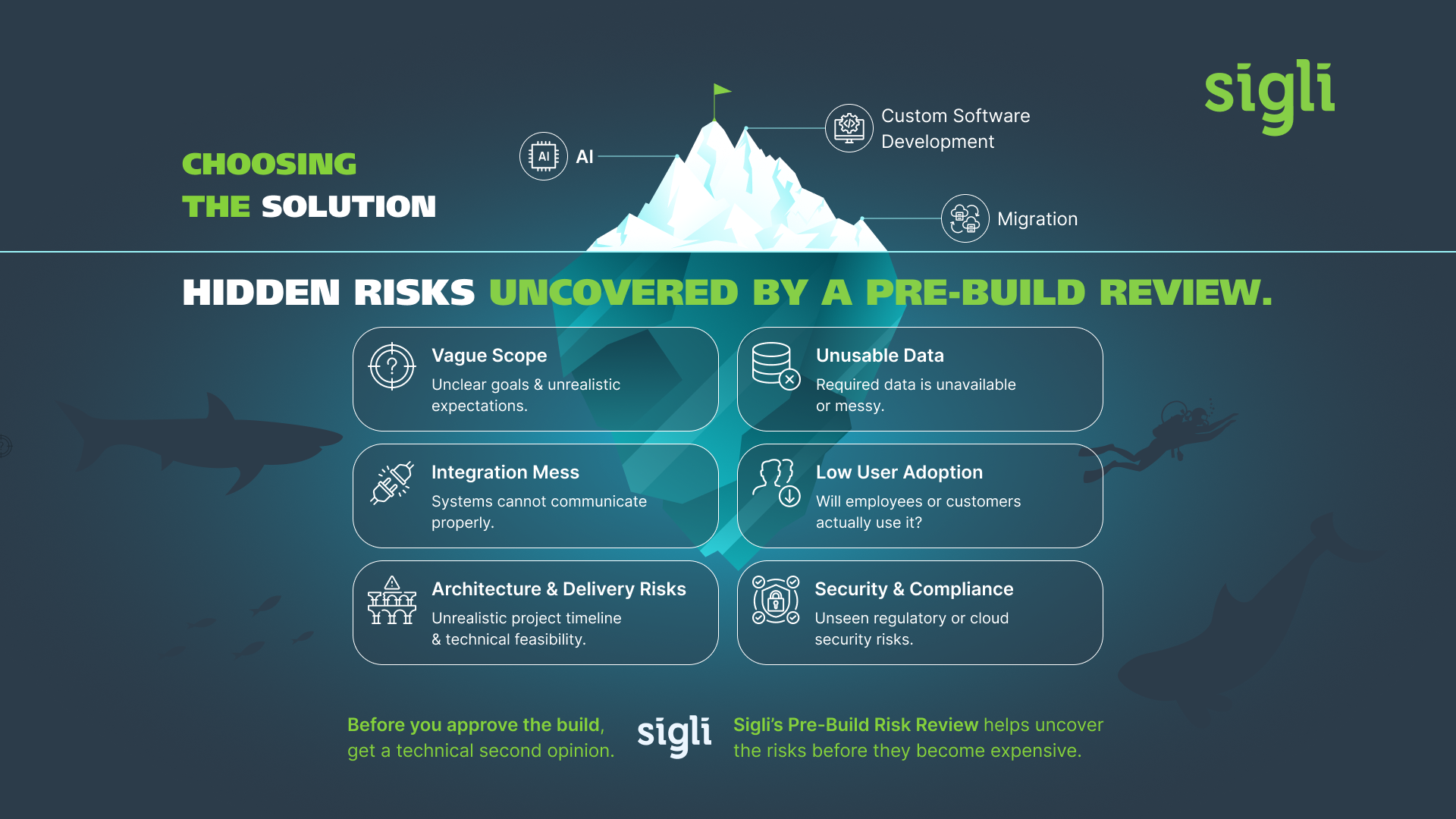
To ensure your leadership team does not fall victim to a misaligned, overly expensive technology strategy, run your next proposed initiative through this practical technology risk assessment checklist before signing off on the budget.

Navigating these technical pathways objectively can be incredibly challenging from inside an organization, especially when internal biases, personal preferences, or development momentum push for a specific custom outcome. That is exactly where Sigli steps in. We act as your independent technology partner, providing an unbiased software project audit to thoroughly stress-test your ideas before you commit substantial capital.
We do not operate with a default bias toward pushing custom builds. Whether your ideal roadmap involves tailored software development, advanced business process automation, strategic AI implementation, or modernizing legacy tools through seamless system integration, our singular priority is safeguarding your technology investments. We help you navigate the complex question of how to choose a software development partner by utilizing an upfront Discovery Service to ensure you are solving the right problem with the right framework.
Unsure whether your next organizational move should be to build, buy, automate, or completely rethink your software plan? Avoid the catastrophic pitfalls of unvalidated development pipelines and turn early-stage uncertainty into a clear, highly actionable, risk-mitigated technical roadmap.
Before you sign off on the proposal or approve the build, ensure your architecture, strategy, and budget are completely bulletproof.
The biggest risks include misjudging the total cost of ownership (TCO) and falling victim to unverified project assumptions. While the initial development budget might seem manageable, organizations often fail to account for the long-term capital required for security compliance, hosting infrastructure, continuous bug fixes, and regular updates to third-party APIs. If the software doesn't provide a core competitive advantage, building from scratch introduces unnecessary financial and operational risk.
You should buy an existing tool if the business problem you are trying to solve is a commodity shared by other companies (such as standard HR processes, baseline accounting, or traditional CRM pipelines). If a commercial off-the-shelf (COTS) platform can solve 80% or more of your operational bottleneck out of the box, buying is almost always the faster, more cost-effective, and lower-risk technology path.
Automation via workflow tools, custom integrations, or modern AI agents is the ideal path when your primary bottleneck is manual human labor handling predictable, rule-based tasks. Instead of engineering entirely new software architectures, you can connect your existing tech stack to sync data or auto-generate reports. This provides rapid, high-ROI wins in a matter of weeks without disrupting your day-to-day operations.
A comprehensive software project audit or technology risk assessment acts as an insurance policy for your budget. It brings in an independent, objective perspective to stress-test your roadmap, validate your technical assumptions against actual end-user needs, and ensure you aren't over-engineering a solution. Catching a strategic misalignment before coding begins saves companies months of wasted development time.
When evaluating how to choose a software development partner, look for an ally that doesn't just act as an "order taker" defaulting to a custom build. A true strategic partner will challenge your assumptions, run an upfront project risk assessment, and guide you toward the most efficient technology path, even if that means advising you to integrate or buy an existing tool rather than writing code from scratch.



.svg)
.svg)
.svg)
.svg)


.svg)

.svg)
.svg)
.svg)
.svg)
.svg)
.webp)


.webp)


.webp)
.webp)