


Business Strategy & Growth

April 6, 2026

11 min read
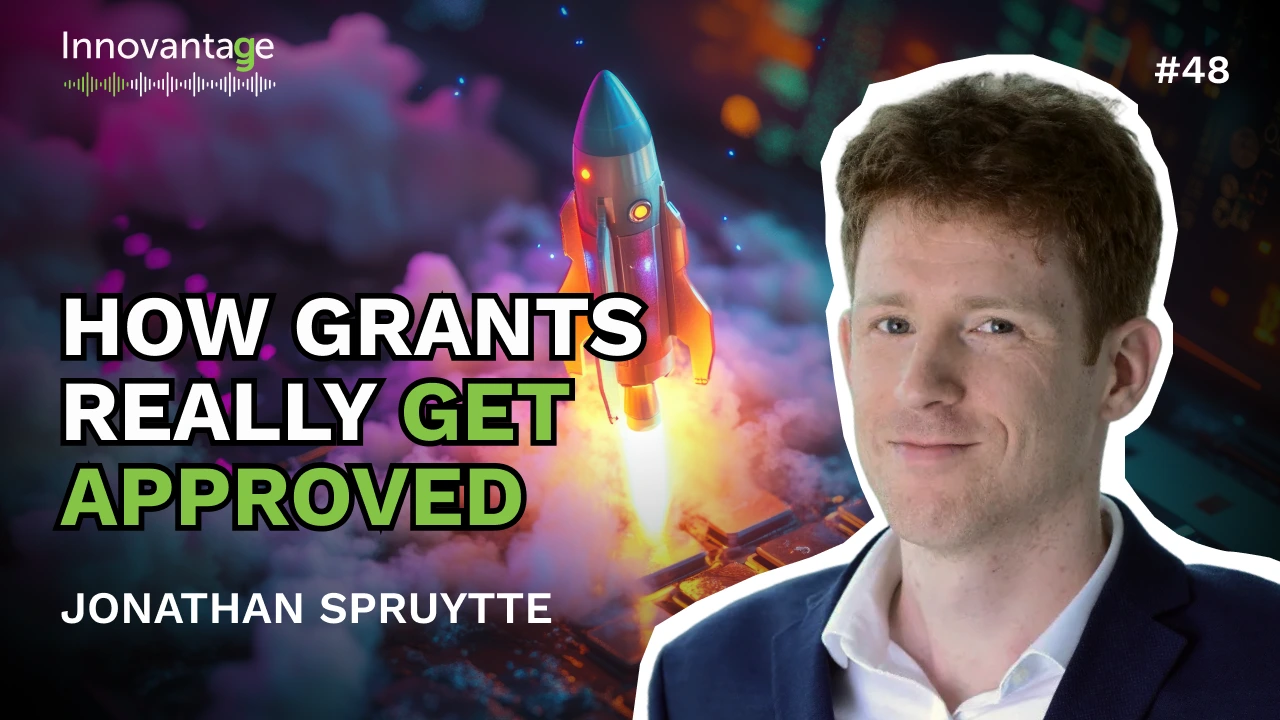
Many founders think that grants are just about paperwork. Nevertheless, in reality, they are more about positioning and execution. In this episode of the Innovantage podcast, its host and Sigli’s CBDO, Max Golikov, speaks with Jonathan Spruytte, Grants & Incentives Senior Manager at KPMG Belgium.
With prior experience at EY and a research background from Ghent University, Jonathan helps organizations secure Belgian and EU funding through a structured grant strategy and writing.
He has a rich background in tech and academic spheres. During his PhD studies in computer science, Jonathan explored the impact of European legislation on technology. His research included feasibility studies on initiatives like EU-wide roaming and emerging technologies such as 5G on trains. So he focused on both technical performance and economic consequences.
Initially, Jonathan considered an academic career. But later, he transitioned into grant writing, which now allows him to apply his analytical skills to a variety of industries and technologies.
Consultancies offer a wide range of services to companies of all sizes, from multinationals to small startups. Firms like the Big Four are best known for audit, tax, and legal services. But their expertise spans far beyond those areas.
They aim to help companies innovate and remain competitive in the market. This can involve anything from strategic advice and operational optimization to specialized projects like grant writing.
Within consultancies like KPMG, there are specialized technical teams with deep expertise across a range of technologies. In Belgium, for example, these teams often work with platforms like Microsoft and O2. And they help companies implement existing solutions effectively. They can efficiently guide clients in selecting the right technologies to address specific business challenges.
Consultancies do not typically engage in fundamental research or in product development. They focus on bringing proven technological solutions to companies and tailoring them to practical needs.
Grant writing at consultancies involves far more than simply filling out forms. The process begins with understanding the client. It is vital to listen to the company’s planned activities, identify challenges, and map how grant support can help overcome them.
The next step is the actual grant preparation. It includes selecting the appropriate funding program, gathering necessary information, drafting the application, and submitting it. Beyond submission, consultancies also assist with reporting and ongoing compliance.
Consultancies work with companies of all sizes. Smaller teams and startups benefit from close collaboration with founders. Meanwhile, larger companies, including multinationals, typically receive assistance in specialized areas or niche topics.
To determine whether a company is ready for grants, it is necessary to understand its near-term plans (typically over the next six to twenty-four months). The focus is on identifying key challenges the company faces and assessing whether grants can help overcome them.
Of course, it is also possible to start by looking at available grants and then seek projects to match them. This approach often leads companies to pursue opportunities outside their core focus. However, it is a risky strategy for startups that need to stay aligned with their trajectory. Larger companies may have more flexibility. But startups must prioritize their own strategic goals.
Grant readiness also depends on the company’s needs and context. For example, in research and development, a company should consider whether it has specific projects planned in the coming years and whether external funding is necessary.
If a company has recently raised substantial capital, the time and effort required for grant applications may not be justified.
The relationship between innovation and funding can go both ways.
For regional grants, the approach is usually company-driven: businesses identify their challenges and seek grants that can help overcome them. In these cases, innovation typically comes first. At the same time, grants serve as a tool to support existing plans and projects.
For European-level funding, the dynamic is often reversed. Programs set by the European Commission define priority areas (for instance, cybersecurity, defense technologies, or sustainability initiatives) and provide grants to encourage companies to consider these strategic goals.
The development of the grant strategy usually begins with initial discussions to clarify objectives. Then, there should be interactive workshops or interviews that are required for collecting the detailed information needed for an application submission.
The first meeting usually focuses on understanding the company at a high level (its origins, goals, and market context).
Subsequent meetings dive deeper into specific aspects of the business. One session explores the commercial side (pricing, market strategy, and sales approach), while another focuses on the technical side, detailing what the company intends to develop and how it plans to do so.
After these meetings, the grant team begins drafting the proposal. During this phase, the company may receive periodic status updates.
Once a draft is nearly complete (around 90% or 95% finished), founders review it in detail and can provide feedback on content or emphasis. This helps ensure that the final document accurately represents the company’s vision and strategy.
In total, the founder’s time commitment is usually around 20 hours. Meanwhile, the consultancy often invests ten times that effort behind the scenes to produce a submission-ready proposal.
For typical development projects, the writing phase takes about three months on average. Moreover, you should bear in mind that the evaluation phase adds a similar amount of time. From start to finish, the full process generally requires five to six months.
Working with experienced consultants significantly increases success rates. These rates often reach even 95% when projects are handled on a success-fee basis, where payment is contingent on grant approval.
Companies that try to write grants themselves frequently face longer timelines (up to nine months) and lower chances of success.
Successful grant projects often combine innovative ideas with the right mix of skills and execution capabilities. Some prominent examples include:
Each of these projects showcased unique innovation, but their success depended equally on the founders’ ability to bring the idea to market.
Grants are most effective when the project team has the necessary expertise and connections. For instance, a robotic surgery project requires not only IT knowledge but also access to medical expertise and hospital networks.
Not every project that appears promising at first glance will succeed. Experienced grant consultants can detect whether a company truly understands its problem or is only pursuing a great idea without full context. Early conversations often reveal whether the project team has validated the problem with potential clients and assembled the right expertise.
Consultants ask detailed, sometimes challenging questions to understand the company and its project thoroughly. Building trust is essential. Founders must feel comfortable sharing sensitive details and responding to in-depth inquiries.
This personal dimension also impacts grant success during evaluation. Companies presenting their projects to evaluators must communicate convincingly, particularly for high-risk European grants where pitching skills can determine whether a project advances.
As Jonathan noted, companies that consistently secure grants and achieve success typically share four key traits:
On the one hand, it may seem that grant writing is a simple task, and practically everyone who likes writing can successfully cope with it. However, this task has its peculiarities that require a particular approach.
Grants come with complex regulations, specific criteria, and nuanced requirements. Experienced consultants know these rules, can navigate open questions efficiently, and provide guidance based on daily practice.
Moreover, writing a strong grant application is time-consuming. Thanks to outsourcing, founders can pay more attention to their core business activities.
According to Jonathan, a successful grant writing team is always strengthened by the curiosity and problem-solving mindset of its members. Experts often come from diverse backgrounds, including technical fields, economics, business, and others.
Effective grant writing involves taking difficult concepts, analyzing them, and translating them into understandable content for a broader audience. Writing skills are essential. But the same is true about the ability to grasp a wide range of topics. At the same time, we shouldn’t ignore the importance of understanding the economics of a project and presenting a strong business case.
Many team members come from academia. However, the work is distinct from typical academic writing and requires the skill to communicate technical ideas in a way that convinces evaluators.
Artificial intelligence has become a practical tool in the grant writing process. Nevertheless, it can’t be viewed as a replacement for human expertise. AI helps streamline workflow and improve efficiency. This allows consultants to deliver high-quality proposals faster while keeping costs manageable.
Now, it is primarily used as a process tool. It assists in structuring information, identifying key objectives, and analyzing technical challenges. AI doesn’t simply generate text for proposals. It can perform the role of a discussion partner as it helps the team scope problems and clarify the storyline for the grant.
Jonathan explained that at their organization, AI-generated drafts are never used without review. Every piece is rewritten and refined by the team. Typically, each proposal is reviewed by at least two team members.
But acceleration of the grant writing process is not the only use case where AI can be present in this field.
In recent years, many clients have started bringing AI-generated documentation. While some of these documents provide useful starting points, they often lack the specificity and clarity that are required for a successful proposal.
This can make initial meetings less productive, as the team needs to invest more time and effort to uncover what is actually planned.
There are also situations where AI-generated content can misrepresent the project. For example, a client might submit a draft with functionalities or objectives that were suggested by AI, but they may differ from the company’s intentions.
Even with AI-generated content, human judgment remains essential. Consultants can often detect when a document was prepared by AI. Startups rarely produce multi-page responses on their own. Long documents often indicate AI assistance.
AI can’t replace the nuanced understanding of a client’s goals and uncertainties. The ultimate responsibility for accuracy lies with the company and its founders. Grant consultants translate a problem into a proposal. But they rely heavily on the client’s expertise, particularly in specialized fields. For instance, consultants may understand IT or general processes, but in sectors like food production, the team must trust the founder’s knowledge of industrial practices.
This reliance creates a potential risk. AI-generated or even client-prepared content may include subtle inaccuracies. Consultants verify information whenever possible, but some details can still slip through.
The challenge is compounded in innovative projects. By their nature, these projects tackle new problems. Because there is no precedent, evaluating feasibility is inherently uncertain.
AI is increasingly part of grant-related projects, but it is rarely the core innovation. Very often, it is a tool to solve a specific problem.
Jonathan noted that over the past few years, the focus has shifted from developing AI models from scratch to applying existing architectures in practical use cases. The real innovation often lies in how companies structure and manage data, integrate AI into workflows, and design solutions that leverage these tools effectively.
The AI model itself is just one component of a broader system.
Meanwhile, as AI automates certain tasks, companies still need skilled personnel to manage models, ensure data quality, and intervene when issues arise.
Future AI-driven workflows are likely to combine automation with human-in-the-loop systems. This will create new roles to manage and interpret AI outputs.
Innovation is thriving across almost every sector, from medical technology and biosciences to food, logistics, and manufacturing. According to Jonathan, no industry appears to be slowing down, and the influx of AI-driven solutions is accelerating the pace.
New problems and new opportunities build a good ground for startups and established companies. We can observe the constant emergence of novel challenges. This ensures that new roles, products, and projects continue to be created.
Curious to learn more? Stay tuned for more insights from industry experts. Don’t miss the next episodes of the Innovantage podcast, where we continue to explore innovation and the trends shaping the future of technology and business.
No. While there is a significant administrative component, successful grant writing is primarily about positioning and execution. It requires aligning your company’s near-term goals with the right funding programs and demonstrating a clear path to market viability.
Grant readiness is determined by your plans for the next 6 to 24 months. You are likely ready if you have specific R&D challenges to overcome and a clear strategic trajectory. However, if you have recently raised substantial capital, the time required for an application might not outweigh the financial benefit.
This is a risky strategy, especially for startups. Pursuing grants outside your core focus can pull you off your intended trajectory. It is generally better to let your innovation drive the search for funding (the "innovation-first" approach).
The full process generally takes 5 to 6 months. This includes approximately three months for the drafting phase and another three months for the evaluation phase.
While a consultancy might spend hundreds of hours behind the scenes, a founder typically needs to invest about 20 hours. This time is spent in deep-dive interviews regarding the technical and commercial aspects of the business and reviewing final drafts.
Regional Grants: Usually company-driven. You identify a challenge and seek a grant to support your existing plan.
European Grants: Usually mission-driven. The European Commission defines priority areas (like cybersecurity or sustainability), and you must align your project with these strategic goals.
Grants involve complex regulations and nuanced criteria. Consultants bring daily practice and specialized knowledge that increases success rates, often up to 95% when working on a success-fee basis. Doing it yourself often leads to longer timelines (up to 9 months) and a lower chance of approval.
Yes, but as a process tool, not a replacement for humans. AI helps structure information, identify objectives, and analyze challenges. However, human experts must review and refine every draft to ensure specificity, clarity, and accuracy.



.svg)
.svg)
.svg)
.svg)


.svg)

.svg)
.svg)
.svg)
.svg)
.svg)
.webp)


.webp)


.webp)
%20(1).webp)