


Business Strategy & Growth

December 1, 2025

10 min read
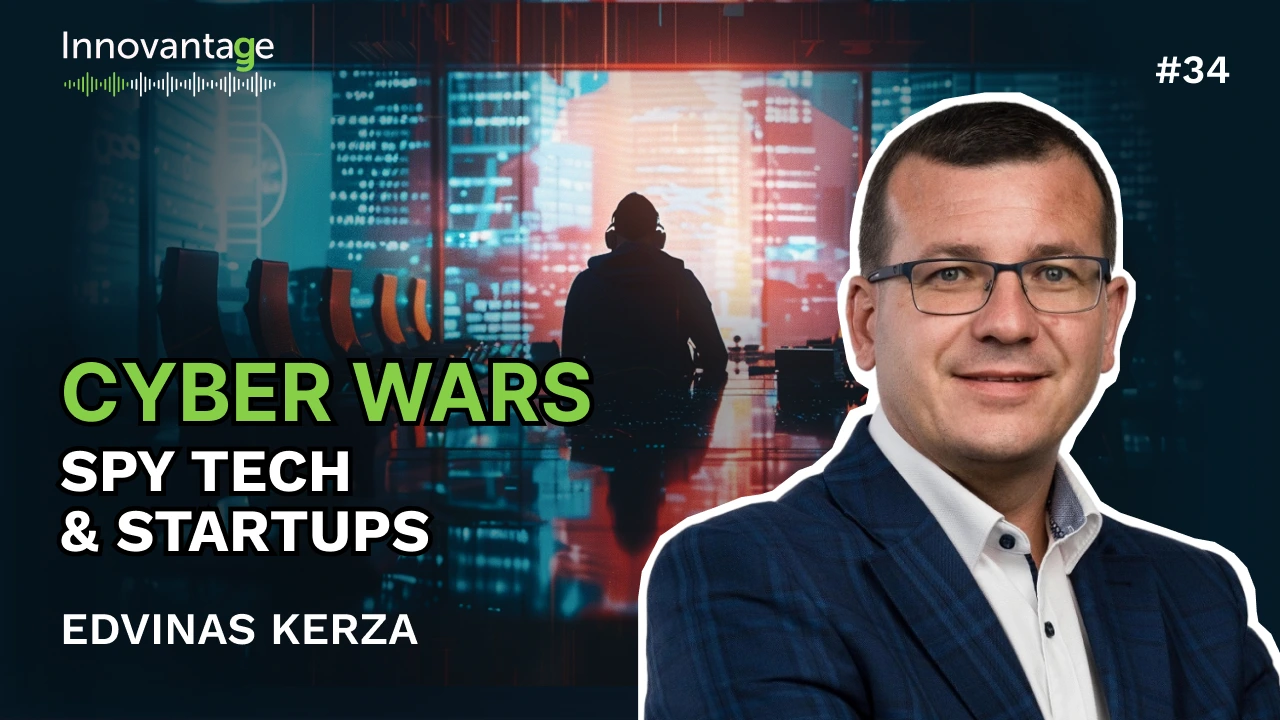
Throughout its existence, the Innovantage podcast has offered diverse perspectives and insights on technology and its role in business, education, and everyday life. In this episode, you can look at innovation through the lens of defense and security.
To discuss this topic, the podcast host and Sigli’s CBDO, Max Golikov, invited Edvinas Kerza to his studio.
Edvinas is a Managing Partner at ScaleWolf and a former Vice Minister of Defense of Lithuania. This career path has allowed him to accumulate extensive expertise in cybersecurity, defense strategy, and innovation.
He was born during Lithuania’s occupation. This experience shaped his lifelong drive for freedom and independence. From a young age, he was drawn to technology. He has always believed that tech development could be a powerful way to contribute to his country’s security and progress.
He began his career at the Ministry of Foreign Affairs at a time when Lithuania had not yet joined NATO or the EU. As the country moved toward integration, Edvinas was among those who were sent to secret military bases to study cybersecurity, defense, hacking, and information leaks. Later, he contributed to building secure communication networks across Lithuania and its diplomatic missions.
His expertise led him to Brussels, where he represented Lithuania during its first EU presidency in 2013. Later, as Vice Minister of Defense, he oversaw cybersecurity and defense planning. In that role, Edvinas gained a deeper understanding of modern threats and the importance of strengthening national resilience against those who challenge freedom.
Edvinas recalled that the 2014 annexation of Crimea was a wake-up call for Lithuania. It became clear that traditional views of military and technological strength were no longer enough.
At that time, Russia began financing hacker and criminal groups capable of developing sophisticated cyber tools. And even commercial antivirus systems couldn’t detect them. Recognizing this gap, Edvinas and his colleagues sought out scientists and experts who could help build effective defenses. Although Lithuania lacked experience, its determination to adapt led it to learn from allies such as Israel, the United States, and the United Kingdom.
After World War II, many nations fell into a comfort zone. They focused on innovations that made life easier and more productive. Technologies like the internet and critical infrastructure systems were designed for efficiency, but not for security. When many of such systems were later connected online, they became vulnerable to exploitation.
The conflicts near Lithuania’s borders served as a stark reminder that threats are not abstract. They are ongoing. This reinforced the urgent need for Baltic nations to take proactive steps in strengthening cybersecurity and national resilience.
After achieving his goals in public service, Edvinas decided to enter the private sector and gain a deeper understanding of how business and critical infrastructure operate. He joined the Ignitis Group, which is the largest energy company in the region. After that, he worked in the railway sector. He helped to modernize systems that still relied on outdated Soviet-era technologies.
According to Edvinas, most civilians never encounter how much needs to be done to secure Lithuania’s future. Moreover, a connection between defense and innovation is much closer than many of us think. Many technologies that define modern life, like the internet, microwaves, or even super glue, originated from military research.
This idea inspired him to help build a sustainable defense technology ecosystem in Lithuania that can attract talent, investment, and innovation from both local and international partners.
Now, Edvinas works at a venture capital fund and accelerator ScaleWolf. It supports startups focusing on innovation in dual-use technology.
Max asked Edvinas about the reasons behind his desire to focus on startups. When explaining his position, he mentioned two key lessons from his time at the Ministry of Defense.
First of all, launching an innovation project isn’t just about proving a concept. It is also about building an ecosystem that allows ideas to grow. Grants and small research projects might demonstrate what is possible. But they rarely lead to sustainable businesses. Real progress requires talent and mentorship.
Given all this, Edvinas decided to develop a hybrid model that combines acceleration programs with defense-sector expertise and access to capital. In this model, startups are educated about the defense industry, which operates very differently from civilian markets. But also, they gain insights from military professionals with real-world experience in conflict zones.
The second important element is capital. Once a product shows promise, startups need funding to refine it and meet client needs. Traditional banks rarely lend to early-stage ventures. That’s where venture capital plays a crucial role. They provide the risk capital required to scale innovations.
When Edvinas and his team began building their defense-focused investment fund, the idea was far from mainstream. At that time, investing in defense technology was often viewed with skepticism.
One of the first crucial steps was securing government support. The Lithuanian government and the Ministry of Defense recognized the fund’s potential as a national security asset and agreed to participate.
Given the sensitivity of the defense sector, strict due diligence is a must. To mitigate risks such as foreign influence or illicit financing, the fund works closely with government and intelligence agencies to verify the financial integrity of all startups and investors.
Edvinas explained that the selection process starts with pre-acceleration activities. Teams are assessed not only on their technical abilities and ideas but also on their mindset.
Once startups demonstrate market fit and receive positive feedback from potential clients, they become candidates for investment. However, before any capital is deployed, a comprehensive security screening is performed. Company ownership, investor background, partnerships, and even personal connections should be carefully checked.
Reputation is everything in defense innovation. A single security breach or questionable association can permanently disqualify a company from working with classified information or participating in government tenders. According to Edvinas, in defense, there is no second chance.
Startups that want to enter the defense sector typically have two main pathways. The first is through grants and innovation programs. These grants help young startups prove their concepts before moving on to commercialization.
The second route involves partnering with major defense corporations such as Rheinmetall, Lockheed Martin, Airbus, or Kongsberg. These connections with established players allow startups to become part of larger projects. Partnerships of this kind are vital, as defense giants increasingly rely on agile innovators to meet growing demand amid rising defense budgets worldwide.
Today, there are a lot of defense innovations emerging from Lithuania. Their range includes drones, cybersecurity tools, and advanced laser systems. One standout example is a company developing compact laser targeting systems for drones. They enable precise strikes without the need for expensive, easily detectable jets.
In software, Lithuanian engineers contribute to space operations management as they develop simulation tools that reduce the cost of testing missions.
Beyond battlefield technology, ScaleWolf has also supported startups focused on soldier well-being and medical innovation. These companies create tools to help troops manage stress and access rapid medical care in the field.
Another promising area is mine detection. Startups use advanced sensors and imaging to map underground environments and distinguish between different types of mines. These technologies can also be used in archaeology and industrial exploration.
Edvinas also mentioned advancements in neural chip technology. Lithuanian startups are building “neuron” processors that consume up to ten times less energy than conventional chips. Such processors could power the next generation of European AI data centers.
Nevertheless, Edvinas believes that Europe has lost part of its competitive edge when it started to outsource manufacturing and high-tech production to third countries. Initially, this step seemed cost-effective. But it left nations dependent on external suppliers.
Due to this, European nations became buyers, not creators, which can pose potential security threats and weaken economies.
According to the expert, restoring technological independence is a pressing need today.
Most modern defense technologies are inherently dual-use, which means that they are designed for both military and civilian applications. The development of such adaptable technologies helps diversify markets and ensures long-term sustainability.
Drones are a very good example. Originally, they were built for civilian photography and entertainment. Later, they evolved into sophisticated defense tools capable of autonomous flight and target detection. The same can be said about AI and navigation systems that are now being repurposed for infrastructure monitoring. For example, they help energy companies inspect pipelines and power lines in remote areas after storms or snowfalls.
In defense technology, data is a highly valuable asset. It fuels AI models, powers simulations, and enables systems to learn before they are deployed in real-world scenarios. But, according to Edvinas, for early-stage startups, not data and not even an idea matter the most. That’s a team that defines everything.
That’s why Edbinas and his colleagues first of all look at the people. A strong, adaptable team is essential for long-term success.
ScaleWolf’s pre-acceleration phase focuses heavily on teamwork. Most sessions are in person, like workshops and debates.
Once a team is solid, they turn to problem selection. At this step, real defense and government challenges that are worth solving should be chosen.
Nevertheless, such a factor as timing shouldn’t be ignored as well. Even a groundbreaking technology can fail if the market or the military isn’t ready to adopt it.
As Edvinas explained, there is no single formula for building the perfect defense startup team. Every case is different. Every member can bring unique strengths. However, it is possible to notice certain patterns among successful teams.
Defense startups often attract more experienced professionals rather than recent graduates. Many team members come from established companies or government roles and already understand how organizations operate. This maturity often gives them an edge in navigating complex defense markets.
However, technical expertise is still fundamental. A strong CTO will always play a crucial role since most defense products involve hardware. In modern systems, hardware is inseparable from software. Teams must have specialists who can integrate connected technologies.
Someone who can raise capital and communicate the company’s vision is equally important. Many engineers struggle to understand the nuances of venture capital. Given this, a member who can translate this financial language for the team is vital.
As startups grow, scaling becomes the next major challenge. Teams need to learn how to evolve. A small group of five may quickly expand to fifty or a hundred people. At that step, structure, leadership, and HR processes become essential.
Edvinas noted that defense startups must find a good balance between focus and flexibility. Some teams thrive when they concentrate on a single niche and refine one technology until it excels. But in defense, this strategy carries risk. In this case, a company is often dependent on a few key clients. If a contract ends, such businesses can lose everything.
That’s why ScaleWolf encourages startups to develop dual-use strategies. With this approach, they can keep their core technology but adapt it for both defense and civilian markets. Edvinas mentioned Pulsetto, a company that originally built wearable devices to help people manage stress through vagus nerve stimulation. A lot of athletes liked this innovation. The same technology was later adapted for soldiers to help them cope with extreme battlefield stress and post-combat recovery.
As you can see, the innovation itself wasn’t changed. But it was applied where it was needed most.
ScaleWolf was the first accelerator program in the region dedicated to defense startups. Its success prompted the Lithuanian government to make the required legislative changes that would support the development of the defense tech ecosystems in the country.
These reforms have opened the door for entrepreneurs. They have simplified licensing and introduced tax incentives and cashback mechanisms for investors. The system is now also more welcoming to foreign specialists.
In just a few years, the ecosystem has become significantly more open and globally connected. ScaleWolf’s most recent accelerator cohort attracted startups from Canada, the US, Germany, Ukraine, Latvia, and Estonia. All of them received training, funding, and local support to establish companies in Vilnius.
Starting a business journey in the defense sector is a deeply personal challenge. Founders must ask themselves whether they are truly ready for the environment and whether they can handle the pressures and realities of working in defense (such as testing technologies under extreme conditions).
Many teams fail because they underestimate this aspect. A product may work well in a lab, but if it cannot withstand real battlefield conditions, it will not be adopted by military units.
ScaleWolf addresses this challenge through its accelerator program, which quickly immerses teams in defense realities. Mentors, often active military personnel, provide firsthand knowledge, share operational insights, and answer critical questions.
Edvinas emphasized that competition drives innovation in the defense sector. The recent surge of Ukrainian startups is a clear example. Over the past three and a half years, these companies have been closely integrated with the military. They can receive rapid feedback on their solutions. Even with limited capital, they have developed battle-tested technologies. Some products may lack polish initially, but their operational reliability is unmatched. With additional funding, these solutions can be enhanced for broader markets.
Moreover, in the case of Ukrainian companies, a unique motivation drives these innovations. Many teams are working not primarily for profit. Their key aim is to protect their country, and they want to contribute to independence and survival.
The defense ecosystem in Europe, particularly in the Baltic and Nordic regions, is undergoing a period of rapid growth and innovation. Countries such as Lithuania, Poland, Latvia, Estonia, Finland, Sweden, and Denmark are increasingly supporting startups and young companies. Over the next few years, this support is expected to produce new, influential companies.
Such businesses are likely to offer well-paid jobs and drive technological innovation for military and civilian applications. While their initial focus may be defense, many may eventually diversify into civilian markets.
AI and automation are also poised to play a transformative role. While they optimize processes and reduce the need for manual labor, they simultaneously create demand for new skills. For example, they require experts capable of managing AI systems and modeling processes.
Edvinas highlighted that AI dominates the current tech landscape. However, emerging fields such as quantum computing are poised to become the next frontier. Investment in these areas should be urgent. The support can be provided through scientific programs at universities, international collaboration, and the development of skilled research communities.
Equally critical is maintaining domestic manufacturing capabilities. Dependence on foreign production, particularly in key sectors like batteries, limits Europe’s competitiveness on the global arena.
At the end of his conversation with Max, Edvinas also stressed the importance of healthy competition. It helps build businesses, define better approaches to innovation, and find new ways of living and protecting our security.
Want to learn more about other domains, where the role of technology and innovation is undeniable? That’s what you can find in the next episodes of the Innovantage podcast. Stay tuned!
Defense tech startups are young companies developing technologies for defense, security, and national resilience. Many build dual-use solutions that can be applied both in the military and in civilian sectors like energy, transport, or healthcare.
For Lithuania, defense tech startups strengthen national security, reduce technological dependence on third countries, and create high-value jobs. They also help turn the country into a regional hub for defense innovation in the Baltic and Nordic region.
ScaleWolf combines an accelerator program with a venture capital fund focused on defense tech startups. It offers education about the defense market, mentorship from military experts, access to tenders and corporates, and capital to scale validated technologies.
The selection starts with pre-acceleration, where teams are evaluated on mindset, teamwork, and technical potential. Only after they show market fit and pass strict security and ownership checks do they become candidates for investment.
Dual-use means technologies that serve both military and civilian applications. For defense tech startups, this approach reduces dependency on a few defense contracts and opens additional markets in sectors like energy, logistics, or healthcare.
They usually follow two main paths: grants and innovation programs to prove their concepts, and partnerships or investments from major defense companies and specialized VC funds. A strong team, clear problem, and security compliance are essential to secure funding.
Successful defense tech startup teams often include experienced professionals from industry or government, a strong technical leader (CTO), and someone who understands capital and sales. As they grow, they need solid leadership, structure, and HR to scale from a small group to a larger organization.
Key areas include AI, cybersecurity, unmanned systems (like drones), advanced sensors, and energy-efficient chips. In Europe, rebuilding local manufacturing and investing in emerging fields such as quantum computing are also critical for long-term competitiveness.



.svg)
.svg)
.svg)
.svg)


.svg)

.svg)
.svg)
.svg)
.svg)
.svg)
.webp)


.webp)





.webp)