


Business Strategy & Growth

May 11, 2026

11 min read
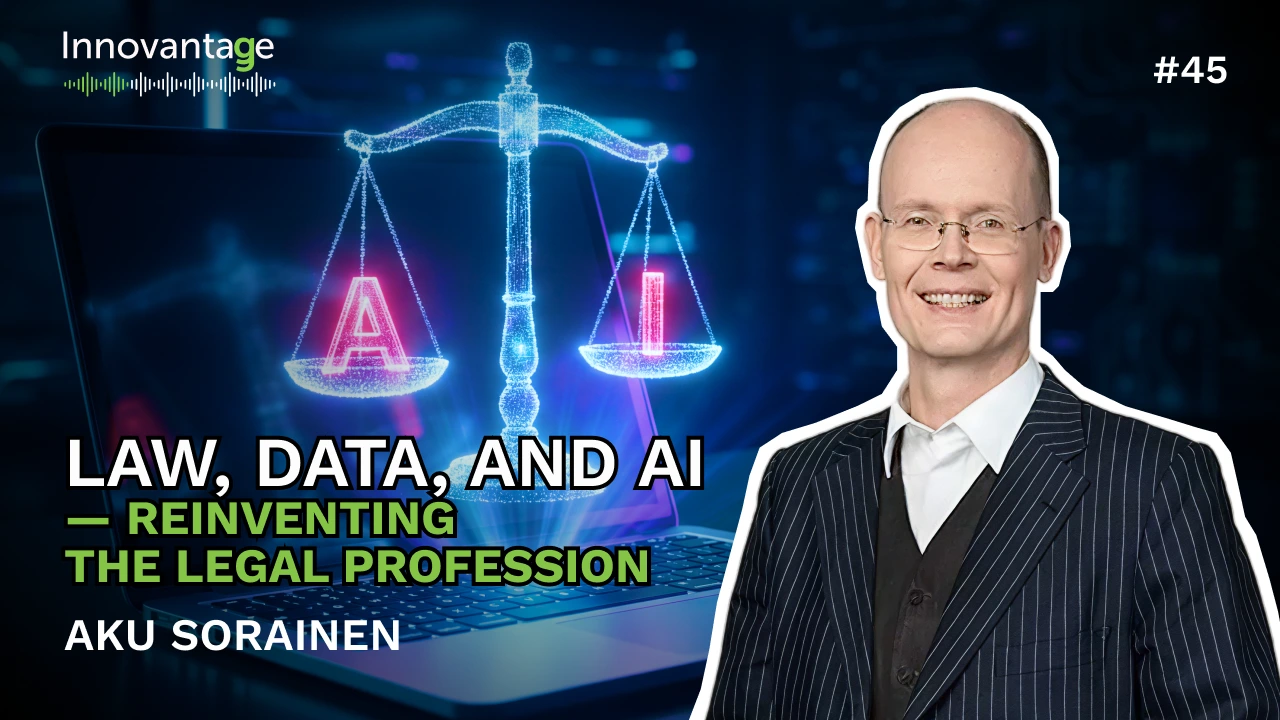
Today, there is no doubt that AI has enormous potential and the power to transform many industries. However, to truly understand its impact, it helps to look at real-life examples in specific sectors. In this episode of the Innovantage podcast, hosted by Sigli’s CBDO Max Golikov, we can take a closer look at how AI is reshaping the legal profession.
Max invited Aku Sorainen, Founder and Senior Partner at Sorainen and Chairman at Crespect, to his studio to speak about the challenges and opportunities AI brings to law firms. They discussed how technology is changing the way lawyers work and why automation and critical thinking are becoming essential skills for legal professionals today.
Aku is from Finland and studied at the university in the early 90s. At that time, the Baltic countries had just regained independence. These countries were close to Finland, yet very little was known about them.
In his studies, Aku chose to focus on their business laws. He wrote his thesis on the legal systems of all three Baltic states. Large Finnish companies supported his work, as they also lacked knowledge about these markets.
After he finished his thesis, those companies began contacting him. That’s when he saw the business potential. He moved to Estonia and helped open an office for a Finnish law firm. Two years later, he started his own firm, Sorainen.
At the start, he had little experience in running a law firm. Managing an international firm was even more new to him. Still, the firm expanded quickly. It opened in Tallinn in 1995, then in Latvia, and later in Lithuania. By 1999, it was already active in three countries.
The firm was a true startup. There were no legacy systems and little operational experience.
So his team needed to build everything from scratch. They created an ISO-certified quality system and developed their own legal practice software.
The goal of this solution was simple. At Sorainen, they wanted to see what each of the company’s offices was doing and to implement software that would support their processes.
This approach became the foundation of their work for the next 25 years.
Aku’s company is a pure business law firm. They advise clients across all business sectors. In recent years, their work has expanded.
They have built a growing corporate crime practice. However, everything they do still links back to business law. They do not handle traditional criminal cases.
Their focus may seem narrow, but it is deliberate. From the start, they followed two guiding principles.
For Aku, the Finnish way comes from his upbringing. It is based on simple values.
These values shaped how he works and leads.
Sorainen operates as one partnership. Today, it has 51 partners. Profits are shared across the whole firm, not by office or country. Nevertheless, full integration is not easy. Many people still think in terms of their own country.
At the same time, most of the work is similar across the Baltics. Around 90% is standard business law. It includes contracts and common transaction practices. Though only about 10% is local law, this small part often feels bigger than it really is.
Where the firm is highly integrated is in its internal operations. Business services are fully shared. Systems work across all offices. T is led from Estonia. The COO is based in Lithuania. Risk and compliance sit in Latvia. Revenue management is also in Latvia. HR is managed from Estonia. This setup supports one unified firm, despite the fact that offices are based in different countries.
It’s interesting to mention that Aku’s firm has no headquarters. It operates as a flat organization. Talent is hired across the whole region, not tied to one country. If they need someone, they find the best person and build the role around them.
Mewanhile, technology has been part of Sorainen from the very beginning. Early on, they realized they needed a central system to run the business. Almost by accident, they chose a CRM tool, which came from a small company next door. It seemed useful, so they adopted it.
Then something important happened. One of their lawyers was also passionate about tech. He started coding in his free time and helped to build a full practice management system that became the backbone of the firm.
Years later, that system started feeling outdated. The company’s management decided not to build again and started looking for the best tools on the market.
But the result seemed surprising. None of the systems fit their needs. Most were built around financial management. Their own system was different. It focused on the client journey first. Financials were just the end result.
This was a key insight. They realized they had created something unique. So they chose to rebuild their system from scratch. This time, it was cloud-based.
The system worked well across multiple countries. Seeing success, they started thinking bigger. Could this system work for other law firms as well?
They decided to turn it into a product. The first cloud version was built on a low-code platform. But it was too expensive and not scalable. So once again, they rebuilt everything from scratch.
It took two to three more years. It has been a long journey. But it shows one thing clearly. Good legal work is not enough today. Strong systems and the right use of technology make the real difference.
Law firms have always been conservative. Many firms followed the same approach for decades and stayed highly profitable. That made change difficult. As some say in the UK, it is hard to tell millionaires that their business model is broken.
AI has started to shift this mindset. Over the past year and a half, even the most traditional firms have begun to pay attention. Many are now testing new tools and trying to understand their value.
Today, most firms already use tools like Microsoft Copilot. Many lawyers also use ChatGPT, sometimes privately, sometimes through secure business versions. On top of that, new legal AI platforms like Harvey and Legora have gained attention. These tools are designed to analyze legal documents. This is where AI works best right now.
Many firms use it for research and document review. At first, there was a lot of excitement about drafting. You could press a button and get a perfect contract or memo.
In reality, it is not that easy. AI can produce a lot of text, but the quality is often inconsistent. Some lawyers relied on it too much. In a few cases in the US and the UK, lawyers submitted AI-generated content without proper review, which led to fines and court issues.
Recently, usage patterns have started to change. More companies now use AI for analysis and research. At the same time, they use it less for drafting than before.
One key problem is data quality. Many law firms have large databases, but the data is unstructured. For example, one firm may have tens of millions of documents. But only a small portion is truly useful. Over time, systems allowed too many versions and duplicates.
The issue is no longer access to data, but finding the right data. This is where real value lies today: not in generating text, but in organizing and structuring data so AI can actually work effectively.
One proven way to structure data is document automation. This is not new, as it has existed for over 25 years. But many firms still overlook it.
The idea is simple. You gather all your firm’s knowledge into one master template that holds best practices and experience. From there, you adapt it to each specific case.
Automation makes this process efficient. Lawyers answer questions, tick boxes, and make choices. Each step guides the next. In the end, you get a solid first draft.
But without structure, AI cannot deliver quality. First, you need order and clean data. That takes time, effort, and discipline.
At Sorainen, they have automated hundreds of templates. The most common documents are already systematized. This allows lawyers to produce high-quality documents quickly.
However, one challenge remains. This approach can improve efficiency, but not necessarily revenue.
Aku shared that he personally relies on tools like ChatGPT, Copilot, and Gemini on a daily basis. But their usage is different. For quick answers, he turns to Gemini. For deeper work, he uses ChatGPT. He has even adjusted the settings so the tool challenges his prompts and asks follow-up questions. This helps him think more clearly and get better results.
This shift has influenced how he works with junior lawyers. He now relies less on them for basic research. Tasks that once required junior support can now be done faster with AI.
But this does not mean juniors are no longer needed. It changes what is expected from them.
There are several key issues.
The first is critical thinking. AI can produce answers, but not always correct ones. Sometimes it creates false or misleading information. If juniors accept these outputs without checking, it becomes a serious problem. So the ability to question and verify information is now essential. Some people naturally have this skill. Others struggle with it. AI makes this difference more visible.
The second issue is training. In many fields, constant training is normal. Athletes train every day. Special forces train constantly. But lawyers often do not. They focus on work, not practice. In the US, some law firms even build mock courtrooms inside their offices. They run practice trials before real cases. This kind of training is still rare in Europe.
Lawyers value independence. They prefer freedom and flexibility. Many resist mandatory training, as they do not like being told how or when to learn.
With AI changing the profession, training becomes even more important. Lawyers need to learn how to use these tools properly.
Today, Aku believes the future will leave less room for mediocre lawyers. Routine tasks are disappearing. There is less need for people who only review documents or draft simple texts.
But he highlighted his belief that AI wouldn’t replace lawyers entirely. He compared it to what happened with Google. When people first started searching for medical advice online, many thought doctors would become obsolete. That did not happen.
People still use Google for health questions. Now they also use AI for more detailed answers. Nevertheless, doctors are still essential.
He sees a similar pattern in law. Legal work is often rule-based, which makes it suitable for technology. Large amounts of legal data can be stored and processed. But that does not remove the need for human judgment.
In their conversation with Aku, Max points out another important aspect of using AI. Artificial intelligence can draft a document, but who is responsible if it’s wrong?
If it references cases that don’t exist, someone will face the consequences. AI cannot take responsibility. Lawyers and firms still must.
Responsibility becomes even more critical as the stakes rise. For small matters, a person might experiment with AI. But when the risk grows and reaches €100,000 or more, trusting AI alone becomes too dangerous.
That’s one more argument that proves that AI should be perceived as a tool, not a replacement. It can make work faster and more efficient. It can handle routine or boring tasks, freeing lawyers to focus on what truly matters.
Another big question is trust. Can law firms rely on AI with confidential client data? Using AI may risk feeding sensitive information into a general large language model, potentially breaching confidentiality. This concern is not unique to law, as it affects many other industries.
Ethics also extends to copyright. For example, some companies have sued AI developers for training models on their photo libraries. Similar debates exist in art. AI generates work based on millions of existing pieces. However, it’s vital to remember that historically, artists also studied others’ work to develop their style. The clear answers are still hard to define.
A more direct ethical concern arises in legal practice. What if someone used AI to figure out how to mislead a judge without being caught? That crosses a personal and professional line.
Clients are using AI more than ever, and it changes how law firms interact with them. The expectation for more work at lower cost, seen since the 2008 financial crisis, hasn’t disappeared. AI doesn’t change that. Instead, such tech tools may even reinforce it.
Sometimes clients run the firm’s legal documents through their own AI systems before sending feedback. Often, the comments are unhelpful.
AI can also complicate communication. For example, it may generate long emails, while lawyers prefer concise messages. The recipient may then need another AI tool just to reduce it back to a one-liner. It’s a funny cycle and not very energy-efficient.
As Aku explained, in the future, some law firms may start to resemble tech companies, especially those handling routine, lower-value work. Technology allows these firms to scale without adding more lawyers.
Other firms, dealing with complex cases, may need fewer junior lawyers and more senior experts. The focus shifts to experienced lawyers, while routine tasks are automated. The number of partners could increase, but the structure of the firm may change.
At Sorainen, they are using AI in a different way. Instead of just automating documents, they focus on capturing soft operational and client data. This includes lessons learned, client expectations, debriefing notes, and CRM information.
Once this data is structured and put into AI tools, the firm gains powerful insights. Lawyers can better understand their client base, spot opportunities, and prioritize work. AI highlights emerging leads that might otherwise go unnoticed.
But with all these benefits, AI doesn’t replace lawyers. Instead, it amplifies their ability to understand clients and unlock business potential. It allows law firms to work smarter, not just faster.
Curious to learn how AI and other emerging technologies are transforming different industries? That’s exactly what the Innovantage podcast offers. Don’t miss the upcoming episodes!
No. While AI is transforming the industry, it is a tool rather than a replacement. Legal work involves human responsibility and judgment, especially in high-stakes cases. As Aku Sorainen notes, just as Google didn’t replace doctors, AI won’t replace lawyers—but it will leave less room for "mediocre" lawyers who rely solely on routine tasks.
The focus for junior lawyers is shifting from basic research and drafting to critical thinking and verification. Because AI can produce "hallucinations" (false information), juniors must now be experts at questioning and auditing AI outputs to ensure accuracy and ethical compliance.
AI is only as good as the information it accesses. Many law firms have decades of unstructured, duplicate documents. For AI to be effective, firms must first implement document automation and structured systems to ensure the AI is learning from "master templates" and verified best practices rather than outdated files.
AI increases efficiency, which allows firms to handle more work without necessarily hiring more staff. While it may challenge traditional hourly billing models, it allows firms to focus on high-value expert advice and better understand their client base through data-driven insights.



.svg)
.svg)
.svg)
.svg)


.svg)

.svg)
.svg)
.svg)
.svg)
.svg)
.webp)


.webp)






.webp)