Business Strategy & Growth

March 23, 2026

11 min read
Today, 70% of the workforce is not actively looking for a new job. Due to this, posting an ad and hoping for the best doesn’t work anymore.
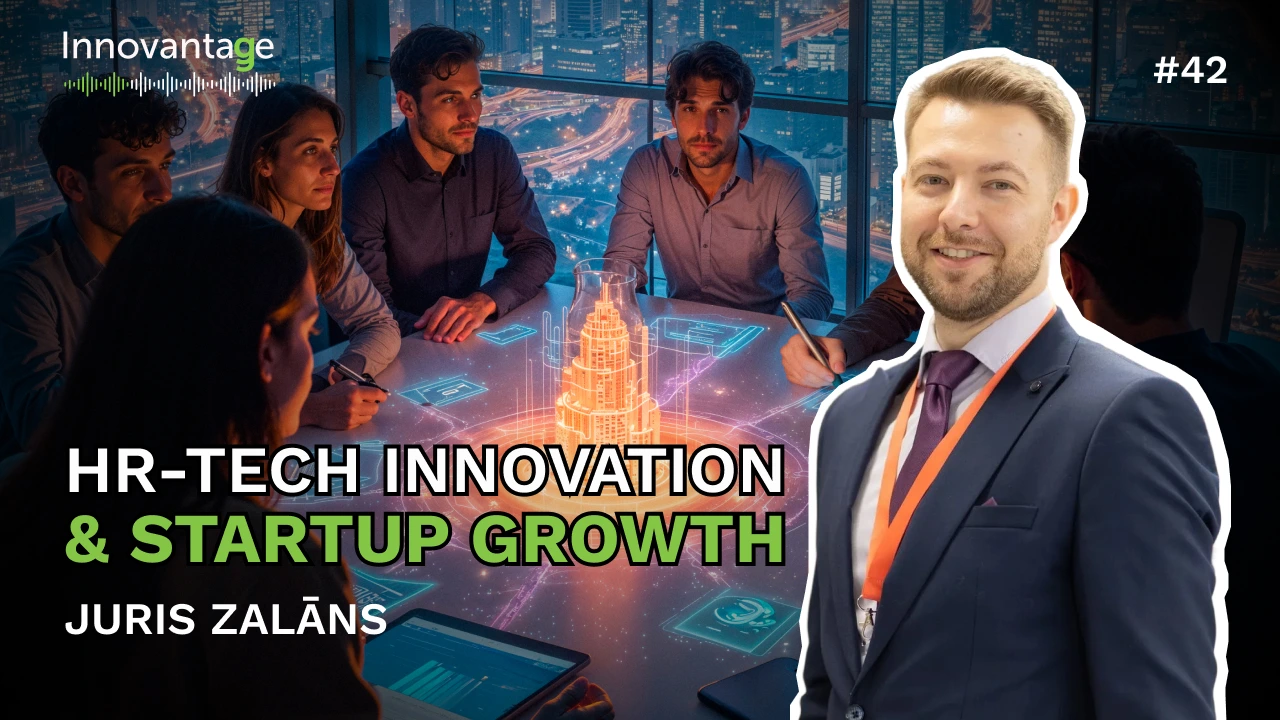
Does it mean that hiring is fully broken? This episode of the Innovantage podcast offers a solution. Its host and Sigli’s CBDO, Max Golikov, sat down with Juris Zalāns, co-founder of Talenme, to speak about the ongoing changes in the recruitment and HR space.
In this conversation, Juris explained how digital tools are reshaping this sphere and why human trust is still the most powerful algorithm of all.
Juris’s entrepreneurial journey began in the corporate world. At the beginning of his path, he held senior roles in procurement, logistics, and resource planning. He had a stable career, but he wanted to create solutions beyond the limits of traditional corporate responsibilities. He started contributing to initiatives outside his formal role and was looking for ways to deliver additional value within the organization.
This initiative eventually led to his first startup. He introduced a contract-based discount system for employees. It happened more than a decade ago. But his solution resembled models that are only now gaining traction in the Baltic region.
Now, Juris and his team are building Talenme. It is a referral-driven hiring engine designed to transform how companies find talent. Instead of relying only on traditional recruitment agencies or headhunters, the platform enables businesses to tap into broader human networks to identify suitable candidates.
The concept is quite simple. Companies publish open roles along with a referral bonus. As a result, anyone can recommend qualified candidates. In this model, individuals become active contributors to the hiring process. They help organizations discover talent through trusted connections instead of cold outreach. If someone knows a strong candidate for a role, they can recommend them and receive a reward once the hire is successful.
This approach aims to democratize headhunting and turn recruitment into a marketplace.
Additionally, the model allows recruitment agencies and professionals to reuse their existing candidate pipelines more efficiently. Candidates who may not fit one role can still be matched with other opportunities within the ecosystem. This makes the hiring process more dynamic and cost-effective.
A key differentiator of Talenme is the crowd effect. The offered hiring approach is built around the reality that most talent is not actively searching for jobs. Today, only a small portion of the market actively applies for open roles. As a result, companies often compete for the same limited pool of candidates on traditional platforms.
Talenme addresses this gap by focusing on access to passive talent through human networks. The model leverages personal connections as the primary channel to reach qualified specialists who may otherwise remain inaccessible.
With its incentives for referrals, Talenme improves reach and significantly reduces sourcing limitations.
Talenme is a compact, highly focused team. It consists of the co-founders and a CTO. Product development, sales, and marketing teams are freelancers who work part-time. This lean setup allows flexibility. But it demands significant multitasking and continuous prioritization.
Operating with limited resources means balancing multiple responsibilities (client communication, bug fixing, financial management, and strategic planning) simultaneously. Due to this, startup execution often feels like constant grinding, with late nights and ongoing problem-solving becoming part of the daily routine.
Another key challenge is aligning the product with real market needs. Initial ideas about features and client expectations often evolve when the product meets real users. It is crucial to listen to customers instead of relying on assumptions.
Juris believes that the idea of traditional work-life balance in the startup world is largely a myth. Instead of balance, founders operate in a constant state of shifting priorities, where the most urgent tasks demand immediate attention. To build a startup, you need to keep a sustained focus. Apart from this, you should be ready to accept trade-offs rather than expect a perfectly structured routine.
Startup life inevitably influences personal relationships, social time, and overall lifestyle. High responsibility and ongoing decision-making often blur the boundaries between professional and personal spheres.
During its first year, Talenme reached several milestones that demonstrate early market validation and steady progress. One notable achievement was generating over $20,000 in revenue within the same year the product was pre-launched. It is a very significant step for an early-stage startup, especially given how challenging it is to secure initial traction and paying customers.
The team also succeeded in attracting strong market interest. Major retail chains and well-known IT companies began testing the platform through pilot programs.
Early feedback has been particularly positive from organizations that previously relied on internal referral programs and are now exploring how to scale them externally.
In addition to this, maintaining team cohesion has been an important internal achievement. Despite the high workload and limited time, the team has preserved a collaborative and supportive culture.
In a small startup team, effective communication is less about sharing everything and more about sharing what truly matters. It makes no sense to overwhelm team members with constant updates. The focus should be on providing the information they need to perform their roles efficiently. Overcommunication can create noise and distract from execution.
For example, high-level updates about fundraising or long-term strategy may be shared as context. At the same time, detailed discussions should center on areas where the team can actively contribute (for example, product development or feature decisions).
However, transparency remains essential from the very beginning. Setting clear expectations helps align the team and attract people who genuinely believe in the vision. In early-stage startups, motivation is often driven by the opportunity to build something meaningful. Meanwhile, financial incentives are less important.
One of the defining trends in talent acquisition is the growing dominance of passive candidates. Unemployment rates are historically low across Europe. The majority of qualified professionals are already employed.
Organizations need to rethink their recruitment strategies. They can’t rely only on inbound applications. Businesses must focus on engagement and employer branding to attract and retain talent. Employee-centric approaches (increasing workplace satisfaction, maintaining strong internal culture, etc.) are becoming key competitive advantages.
Another trend is the growing reliance on external hiring channels. Many companies are outsourcing HR processes to recruitment agencies or headhunters. At the same time, gig work and flexible talent models continue to expand. This enables businesses to scale faster without fully increasing headcount.
Financial pressure also impacts hiring decisions. Rising salaries and slower wage growth stabilization mean startups and smaller companies must be more resourceful when they are competing with large corporations for skilled professionals.
The popularity of AI in talent acquisition is growing. But its role remains complex and often misunderstood. Automated screening tools and AI-powered applicant tracking systems promise faster candidate evaluation. However, real-world cases show that overreliance on automation can lead to flawed outcomes. Quite often, qualified candidates are automatically rejected due to rigid filtering criteria.
At the same time, both candidates and recruiters are now using AI in parallel. Applicants generate AI-enhanced resumes, while HR teams rely on AI-assisted scoring and shortlisting. This creates a loop where automation influences both sides of the hiring process and raises concerns about transparency and decision accuracy.
Juris explained that AI works best as a support feature rather than a replacement for human judgment. It can help structure data, speed up candidate scoring, and improve efficiency. However, blindly following AI recommendations can reduce hiring quality, especially in nuanced roles where context and interpersonal fit matter.
Regulatory uncertainty, including emerging AI legislation, is also making corporations more cautious about full-scale automation in HR processes. As a result, many organizations are adopting a hybrid approach. They try to combine AI-driven insights with human validation.
Referral-driven hiring models highlight the continued importance of human interaction. Personal context and reputation signals often provide stronger candidate validation than algorithmic filtering alone.
While organizations increasingly rely on AI for screening and data analysis, trust in automated decisions still has clear limits. Recruiters and hiring managers tend to treat AI outputs as guidance (not absolute truth), especially in high-stakes hiring decisions.
According to Juris, in the future, AI is likely to evolve into intelligent matchmaking. Instead of only filtering resumes, it may help identify strong candidate-role connections by analyzing skills and network relevance. For example, platforms could allow users to connect their professional networks and receive notifications when suitable roles match the profiles of people they know. This would transform recruitment into a more proactive process.
However, even with advanced AI capabilities, the human element will remain essential. A recommendation from a trusted contact carries social proof and additional insight into candidate fit that automated systems often miss.
When it comes to reviewing CVs, referrals often get priority over cold applications. This approach is not about favoritism, but efficiency. Referrals signal trust and reduce uncertainty. This allows hiring managers to focus their energy on the most promising candidates.
However, this system can pose challenges for those who are just starting their careers. Early-career candidates should concentrate on learning and demonstrating potential. It’s also vital to recognize that building a reputation and network takes time.
When it comes to recruitment in startups, referrals are highly effective for hard-to-fill mid- and senior-level roles, particularly in IT, fintech, and sales. But giants also rely on recommendations as well.
Data from 2024 shows that companies like Accenture hire roughly one in three employees through internal referrals.
However, for junior or high-volume positions like internships, referrals play a different role. They can accelerate hiring when speed matters. But they are less critical since candidates are more accessible through traditional channels.
Juris emphasized that resumes are rarely the deciding factor.
In his experience, hiring decisions are guided more by attitude and self-motivation than by formal degrees or prior titles. The ideal candidate is eager to learn and capable of taking initiative without constant supervision. For startups, assembling a team of motivated learners can have a huge impact on future growth.
As studies show, younger generations move through more jobs over their careers. According to a recent survey, Gen Z workers are expected to change jobs 20-30 times, compared to 10-12 times for millennials.
It is still not fully a gig economy since many professional roles require onboarding and company-specific knowledge. However, this trend points toward a project economy. It means that employees work on discrete assignments within organizations before moving on to the next project.
Platforms like Fiverr demonstrate the growing popularity of short-term, skill-based work.
In this environment, hiring solutions that accelerate the path from job posting to onboarding are crucial. The most effective recruitment approaches will be those that quickly connect companies with the right talent.
Hiring decisions often come down to the trade-off between breadth and depth of experience. For example, imagine that you consider two engineers. One of them has a long-term journey at a single company. This specialist has gained deep expertise in a specific product or enterprise. The other has multiple short-term project experiences across several companies. Thanks to this, this engineer has managed to accumulate diverse skills and exposure to different industries and workflows.
The optimal choice depends on the organization’s current needs. If the goal is rapidly scaling knowledge across new domains, a candidate with multiple project experiences may be a good choice. This specialist can bring fresh insights and accelerate learning within the team.
On the other hand, if the priority is leveraging existing expertise for execution and specialization, a candidate with long-term experience may deliver more consistent results.
For Gen Z, career choices are increasingly driven by lifestyle alignment and work-life balance rather than purely financial incentives. Unlike previous generations, many young professionals in Europe face less financial pressure. Very often, they are able to rely on family support while pursuing early career opportunities. As a result, their priorities shift toward roles that offer meaningful work and allow them to maintain a healthy work-life balance.
This trend challenges companies to reconsider traditional compensation-focused recruitment strategies. High salaries alone are no longer sufficient to attract or retain talent. Employers must also foster flexible work environments that prioritize employee well-being and personal growth.
Speaking about the future of HR technology, Juris highlighted the growing role of the combination of AI-driven analytics and human-centered interactions. AI is expected to become an essential tool in HR processes, from talent sourcing to workflow optimization. Its power in data analysis and pattern recognition can help HR teams make faster, more informed decisions.
However, AI can’t replace the human elements critical to recruitment and workforce management. Skills like reading interpersonal cues, detecting honesty or motivation, and building relationships remain inherently human. Missteps with fully automated interactions (such as AI-generated calls or outreach) can seriously frustrate candidates.
Regional regulations also shape the adoption of HR tech. Centralized systems like blockchain-based CVs could simplify hiring across borders. However, varying legal frameworks in different countries require human judgment to ensure compliance.
HR has historically lagged behind other business functions in adopting technology. Marketing, logistics, and production have been fully digitalized. But HR still relies heavily on manual processes for recruitment and talent development.
In such conditions, despite being the most human function, HR is in the most need of tech support. Digital solutions can cover data analytics, candidate matchmaking, operational automation, and many other tasks. This can allow HR professionals to focus on human-centered work.
The right balance between digitalization and human participation remains key to increased efficiency across every function. And HR is not an exception here.
If you want to learn more about the role of modern technologies in business and our everyday life, stay tuned! The next episodes of the Innovantage podcast will offer new insights and perspectives on these aspects from industry experts and tech leaders.
Talenme is a referral-driven hiring platform that helps companies find candidates through human networks. Instead of relying only on job boards or recruiters, businesses can publish roles with referral bonuses and receive recommendations from people who know qualified talent.
In a referral-driven model, companies share open positions and attach a reward for successful recommendations. People in the network can suggest suitable candidates, and if the hire is made, they receive the referral bonus.
Referrals help companies reach passive candidates who are not actively applying for jobs. Since a large part of the workforce is already employed, trusted recommendations often give employers access to talent they would not find through traditional channels.
Talenme focuses on activating broader human networks instead of depending only on recruiters or headhunters. This helps companies expand their reach, reduce sourcing limitations, and make hiring more dynamic and cost-effective.
Passive candidates are professionals who are not actively looking for a new job but may still be open to the right opportunity. They are often harder to reach through standard job ads, which is why referral-based hiring can be effective.
AI is commonly used for tasks like resume screening, applicant scoring, and data analysis. It can improve speed and efficiency, but it works best as a support tool rather than a replacement for human judgment.
Not fully. AI can help organize information and identify patterns, but it cannot replace trust, personal context, and human evaluation. Hiring decisions still benefit from human insight, especially when assessing motivation, attitude, and team fit.
Referrals are often reviewed first because they reduce uncertainty and come with an element of trust. Hiring teams may see them as a more efficient starting point when sorting through multiple candidates.
Referrals are especially effective for mid-level and senior roles, particularly in areas like IT, fintech, and sales. For junior or high-volume roles, they can still help, but traditional channels often remain important.
Some of the biggest trends include the rise of passive candidates, stronger employer branding, greater use of external hiring channels, more flexible work models, and growing but cautious adoption of AI in recruitment.
According to Juris, traditional work-life balance in startups is often more myth than reality. Startup founders usually work in shifting priorities and constant trade-offs, where urgent tasks regularly reshape their routine.
The future of hiring will likely combine AI-powered insights with human referrals and trust-based networks. Technology will help match roles and candidates faster, but personal recommendations and human interaction will remain essential.



.svg)
.svg)
.svg)
.svg)


.svg)

.svg)
.svg)
.svg)
.svg)
.svg)
.webp)


.webp)




.webp)