


Business Strategy & Growth

June 4, 2026

11 min read

When eCommerce growth slows down, the storefront often gets the blame first.
If conversion rates dip or user engagement drops, teams frequently assume they need a cosmetic redesign, a new CMS, a better product detail page, or a complete replatforming project. Sometimes, they do.
But more often than not, the real bottleneck is hidden safely out of sight:
The Reality Check: the storefront is where customers see your brand. The backend is where your business feels the actual cost of growth. Before changing what your customers see, you need to check what your engineering team is fighting behind the scenes.
Backend modernization is rarely just a technical preference or a cleaning exercise for developers. It is a direct driver of business agility.
When your backend architecture no longer fits your operations, it creates an invisible tax on your entire organization. A slow, fragile backend does not just frustrate engineers; it paralyzes your business roadmap.
When every new feature requires complex workarounds, when minor bug fixes take weeks to deploy, and when external integrations become impossible to maintain, the company loses market velocity exactly when it needs to scale.
How do you know if your platform is suffering from backend drag rather than frontend friction? Look for these six distinct symptoms:
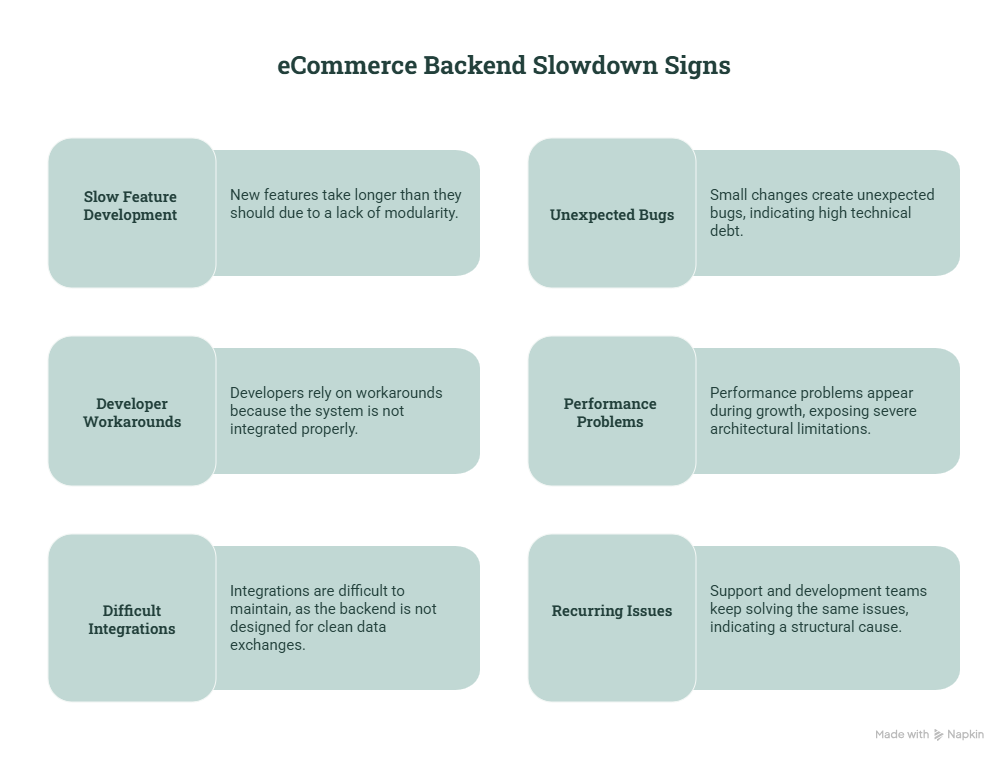
The business wants to launch a new loyalty tier or a localized checkout option, but the engineering estimate comes back at six months. Each change requires a massive effort because the code lacks modularity.
You deploy a minor update to the shipping calculator, and suddenly the checkout page stops processing payments. This whack-a-mole pattern points to high technical debt, hidden dependencies, or a fragile architecture.
The system works, but only because the team knows exactly which parts of the codebase not to touch. New features are bolted onto the side using custom scripts or fragile middleware rather than being integrated properly.
The site runs fine with average traffic, but more customers, expanding product catalogs, or concurrent API requests expose severe architectural limitations. Response times slow to a crawl when data volumes scale.
Connecting a new ERP, CRM, or inventory management system feels like open-heart surgery. The backend is not designed to support clean, reliable, and secure data exchanges.
The same data synchronization errors or checkout bugs recur month after month. Recurring bugs mean your team is treating the symptoms rather than fixing the root structural cause.
It is tempting to throw a beautiful new interface over a struggling system. A slick frontend redesign can temporarily boost user metrics, improve initial page loads, and make the platform feel modern to stakeholders.
However, a better interface can only hide backend problems for a while. It cannot remove them.
A frontend redesign will not solve slow release cycles, fragile business logic, weak integration architecture, or unpredictable data flows. If your underlying platform is structurally compromised, a new frontend is simply an expensive coat of paint on an unreliable engine. You will still face the same delivery delays, the same high maintenance overhead, and the same scaling limits.
At Sigli, we prioritize identifying whether backend risk is the actual blocker before recommending any major development work.
We partnered with a No-Code eCommerce Website Builder facing this precise challenge. From the outside, the product functioned as intended, but the underlying platform needed to evolve to support rapid growth. The challenge was not cosmetic; it was about platform stability, capability, and engineering velocity.
Instead of suggesting a risky, ground-up rewrite, the focus shifted to targeted, risk-led modernization:
The Result: The client achieved faster, significantly more reliable feature delivery and reduced the burden on customer support. The system became easier to maintain and scale because the core backend risk was mitigated systematically.
Broadening the Scope: In a similar engagement involving the Unification of a Complex Suite of Software Products, the risk was not feature development but fragmented architecture. Separate codebases and duplicated logic were driving up maintenance costs. By consolidating the underlying architecture, the business cleared away massive operational overhead and stabilized its roadmap.
Backend modernization should never begin with a blanket directive to "rewrite everything." Blanket rewrites introduce massive delivery risks and rarely solve the immediate business problem. Instead, modernization should start with a practical risk review.
Before committing resources, ask your technical and product leadership these core questions:
To avoid expensive technology mistakes, you need a pragmatic strategy for different parts of your platform. You can use this simple framework to evaluate your next steps:
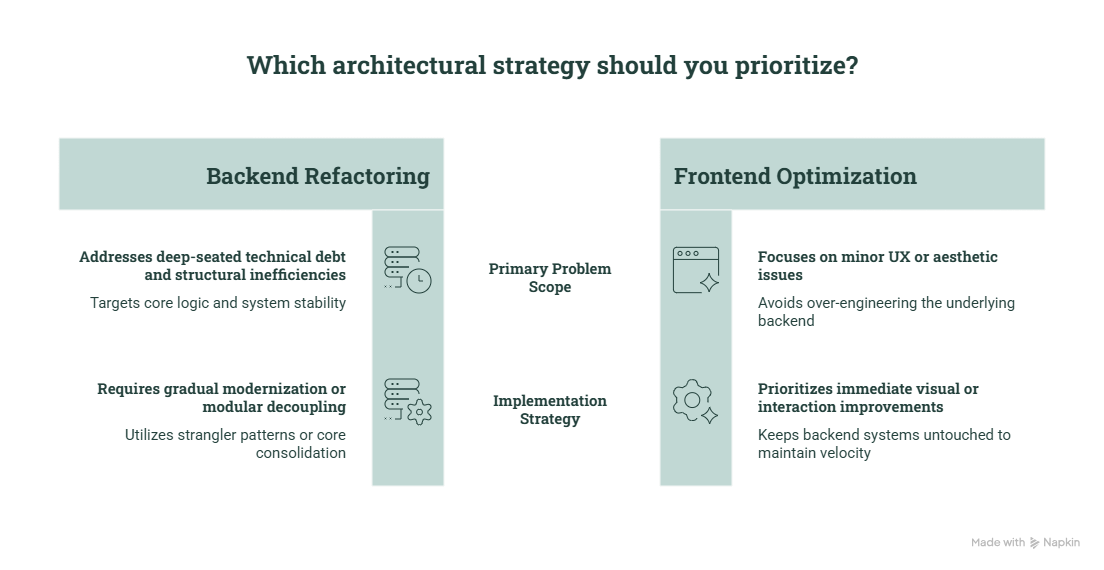
We do not believe in taking a project brief blindly and writing code. We help technology and business leaders challenge their assumptions to ensure they are solving the right problem before investing capital.
When partnering with Sigli for backend modernization, we help you:
We focus on minimizing technology mistakes so you can deliver working systems that predictably support business growth.
Before you invest in an expensive new frontend, a complex CMS, or an unpredictable platform rebuild, get a practical second opinion.
A full rewrite is rarely the right answer out of the gate, it introduces massive delivery risk and freezes feature development for months. You should only consider a full rebuild if your current architecture completely restricts your business model (e.g., shifting from a single store to multi-tenant B2B). For 80% of companies, a targeted refactoring approach where you isolate and systematically upgrade the high-friction modules, is faster, safer, and much more cost-effective.
Yes, but you need to manage expectations. A new frontend can optimize your user flows and initial page loads, but if the underlying database queries are slow or integrations are fragile, checkout failures and inventory latency will persist. If a frontend project is already in motion, use that time to run a parallel backend risk assessment so you can map out structural fixes immediately after the new UI goes live.
A Platform Risk Review is a practical, short-term diagnostic engagement designed to challenge technical assumptions before writing code. Sigli’s team analyzes your current architecture, data pipelines, integration health, and delivery bottlenecks. It requires minimal disruption to your daily operations typically just a few discovery sessions with your technical leads and access to your high-level architecture documentation.
We don’t believe in coming in and taking over. We act as an autonomous, senior extension of your team. By taking ownership of the isolated backend modernization work, we allow your internal engineering team to stay focused on shipping immediate roadmap features. Throughout the process, we provide clear documentation and structured handovers so your team can easily maintain the optimized system moving forward.



.svg)
.svg)
.svg)
.svg)


.svg)

.svg)
.svg)
.svg)
.svg)
.svg)
.webp)


.webp)





.webp)