


Business Strategy & Growth

June 8, 2026

11 min read
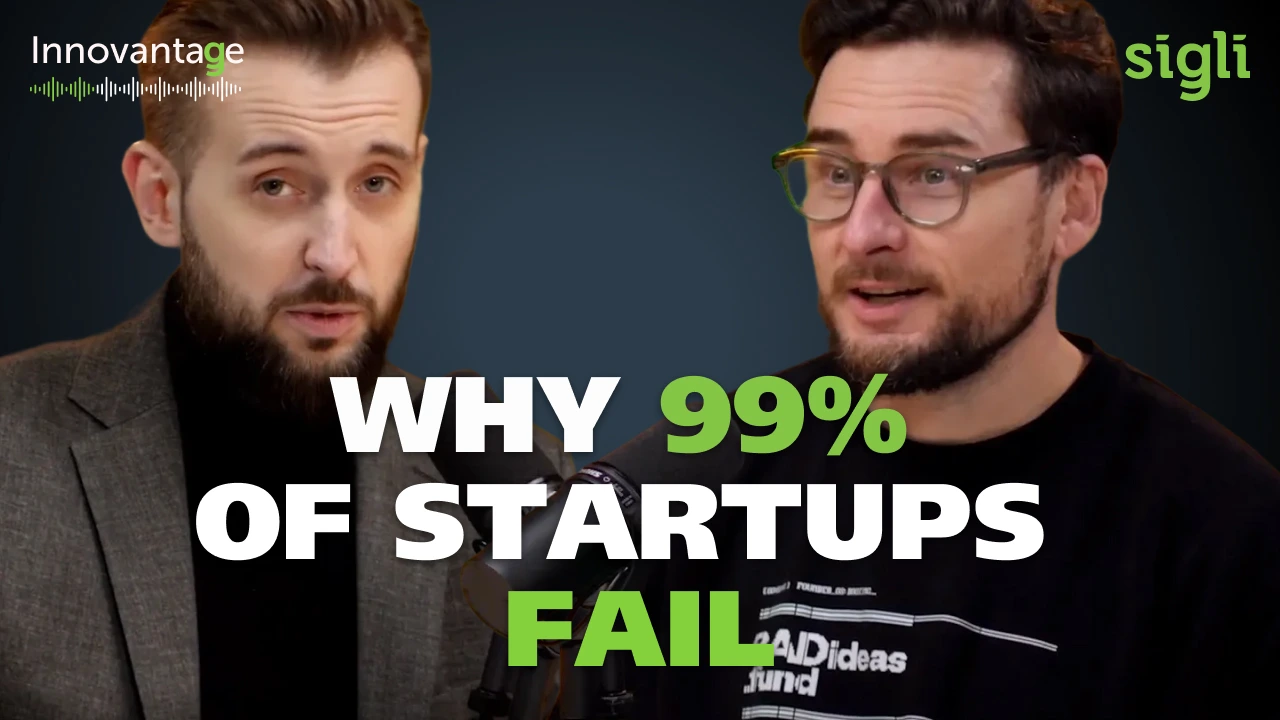
The math of the startup world is brutal: 99% of new ventures fail within 36 months. Most of the time, it’s not because the tech is bad or the team is lazy. Quite often, it happens because they are trying to solve a problem that nobody actually cares about.
In this episode of the Innovantage podcast hosted by Sigli’s CBDO, Max Golikov, Raimonds Kulbergs, founder of BADideas.fund, shares his journey from building companies to backing them. Apart from this, he also explains why early ideas are often wrong in their first form, and why the next wave of venture capital will look very different in the age of AI.
Before becoming a full-time investor, Raimonds was a three-time founder with one early exit behind him. But his path did not start in startups. It started in consulting.
He worked at Ernst & Young and Deloitte, advising clients across the Baltics and Ukraine. The work gave him exposure to buying and selling businesses, and to how companies operate at scale. But he understood that he was not making the decisions himself. In fact, he was helping others make them.
Over time, that became uncomfortable. He wanted to be in the driver’s seat: to build, to decide, and to take responsibility for the outcome. Eventually, he reached a point where staying in consulting felt safer than leaving it. And that was exactly why he left.
Kulbergs’ first startup focused on a very specific problem: helping universities improve how they collect donations from alumni.
Like many first-time founders, Raimonds quickly discovered how different building is from advising. Mistakes came fast. But thanks to this experience, he could understand how startups actually fail and what it takes to survive the early stages.
At one point, Raimonds joined the 500 Startups accelerator (now 500 Global) in Silicon Valley. The program gave him frameworks, tools, and exposure to how top founders think. But applying those lessons was not immediate. Real startups rarely follow frameworks cleanly.
Kulbergs also worked on a few smaller projects. One was a collaboration with a Baltic bank to build a Klarna-style product for the region. Another involved a marketplace model developed together with a co-founder of Pipedrive in Estonia.
These projects were shorter in scope, but they added more layers to his experience as a builder.
At a certain point, Raimonds began thinking more about his next chapter not in months, but in decades. He started evaluating his career in ten-year blocks, asking a simple question: “If money were not a constraint, what would actually be worth doing?”
The answer was not more startups of his own. He decided to help founders avoid mistakes and guide them through uncertainty.
Startup investing became the natural path forward. It allowed him to stay close to founders, but across many more companies than he could ever build himself.
There was just one problem: credibility.
In venture capital, track record matters. But building a track record requires capital, access, and a structure that usually does not exist at the beginning.
While working in Silicon Valley and later in Boston, Raimonds noticed a different model emerging. Founder-led communities were pooling resources and investing together.
That idea did not seem common in Europe at the time.
Back in Europe, he saw an opportunity. Instead of waiting for a traditional VC path to open, he decided to build something closer to what he had seen in the US.
He decided to bring experienced founders together, let them invest collectively, and learn from each deal as a group.
There was also a personal motivation behind it. He wanted to be surrounded by people who were more experienced in certain aspects of company building. In that environment, the group as a whole could see better deals and make better decisions.
That thinking eventually led to the creation of BADideas.fund.
It began as a collective of founders who decided to back other founders. The idea was simple: people who have built companies understand other builders better than most institutional investors.
Building a startup can be isolating. Founders are constantly under pressure, and most do not have time to connect with others in the same situation. Yet that connection is often exactly what is missing.
The goal became to create a space where founders could share what they are building, learn from each other, and spot emerging ideas early.
Over time, the fund became less about investing alone and more about exchanging experience.
What started with around a dozen founders has grown into a community of roughly 250 members across 20 countries.
Many of them have built or scaled well-known companies, including HubSpot, Shopify, Dropbox, Uber, Bolt, Vinted, NordVPN, Pipedrive, Printify, and Printful.
According to Raimonds, startup investing only works when it is treated as a portfolio game instead of a set of isolated bets.
In early-stage investing, concentration is the most common mistake. Many angel investors back a few startups heavily, then lose momentum. Capital runs out, patience fades, and deal flow slows down. But returns do not come from a handful of bets. They come from spreading risk.
Statistically, moving from a portfolio of 10 startups to 20 can significantly improve outcomes. More exposure to high-upside outcomes increases the chance that one or two companies drive returns for the entire portfolio.
However, diversification only works if the input is strong.
If the quality of startups being evaluated is low, even a large portfolio will underperform. That is why deal flow matters just as much as capital allocation.
There are two main paths to access it. One is to build a personal brand that attracts founders directly. The other is to join a network or community where high-quality deals are already being sourced and filtered collectively.
Meanwhile, Raimonds sees startups as one of the most compelling asset classes if approached correctly.
Unlike public markets, most of the value creation happens before companies ever reach IPO. By the time companies are listed, much of the growth has already been captured by venture investors.
In early-stage investing, the product is not the main factor. Neither is traction, nor market size, nor the current version of the idea.
The team is.
In the beginning, most startups are incomplete. The idea will change. The market will shift. The product will evolve. What matters is whether the founders can navigate that uncertainty and still build something meaningful.
Raimonds described strong founders as people who are not fully comfortable with the status quo. There is usually a certain restlessness, which is an internal push that things can be done better or faster.
He also looks for patterns in how founders process challenges. Personal history, including difficult experiences, can become a source of resilience if it has been reflected on and turned into a strength rather than avoided.
Integrity is another important point, as well as the ability to articulate ideas, which is a form of influence.
In BADideas.fund’s evaluation process, the team accounts for roughly half of the decision.
According to Raimonds, strong founders do not build for the present. They try to extend their thinking 12 to 18 months into the future. This often leads to ideas that do not make sense right now and may not generate revenue immediately.
But if the timing is right, being early becomes an advantage. The first movers are often the ones who define the category before others even notice it exists.
Building a startup today is significantly easier than it was 10 or 20 years ago. Infrastructure barriers have dropped. Tools are widely available, while distribution channels are more accessible.
What remains difficult is understanding the customer.
Instead of relying on heavy infrastructure or large teams, founders now win by being close to users. That can mean simple but consistent actions: talking to customers directly, observing how they work, or spending time inside their environment to understand real pain points.
One of the biggest early mistakes that Raimonds made in his work was conducting customer discovery too late (and doing it poorly).
At the time, he believed his idea was obviously needed. He invested his own savings, built financial projections, and convinced himself the path to profitability was clear. On paper, everything worked.
In reality, he had never properly validated the assumption.
He spent nearly a year targeting universities in continental Europe, assuming they needed a better way to raise alumni donations. It seemed logical, but it was wrong. Leadership simply did not see it as a priority.
If he had spoken directly to decision-makers earlier, he would have learned that much sooner. Once he realized the mistake, he pivoted. If continental Europe was not the right market, he moved to the UK, where universities had a stronger culture of alumni giving.
That shift worked. He landed institutions like Oxford and Cambridge colleges, and London Business School. But the market was too small.
The US had both the scale and the culture for large-scale university donations. The problem was access.
Without a strong network, entering that market was difficult. That is what eventually led him to an accelerator like 500 Startups and a move to Silicon Valley. From there, he was able to land customers such as Georgetown, West Point, and UC Berkeley.
Fundraising brought a different kind of mistake. Like many founders, he experienced the post-raise high. He believed that everything had finally clicked. Without clear milestones, it is easy for a startup to drift.
Founders need to work backwards from the next major milestone: what has to be achieved before the next round, what signals will attract strong investors, and what needs to be true to hire great talent.
Raimonds does not believe that joining a top accelerator is essential for startup success today.
Accelerators are still useful, but they are not as unique as they once were. The venture ecosystem has changed, and so have the tools available to founders.
Despite its strengths, the traditional VC model has clear limits. It is constrained by time and human bandwidth.
This is exactly where innovation is now possible, especially with the rise of AI and better tools for sourcing, analyzing, and supporting startups. BADideas.fund is now exploring this direction.
Instead of relying solely on traditional partner-led workflows, the idea is to build systems that help process deal flow, support decision-making, and extend what a small team can do.
Venture capital firms without a real community layer will struggle to stay relevant.
Capital alone is no longer enough. If you compare two funds, one that only deploys money and another that combines capital with a strong founder community, the second will consistently win.
Startups do not just need funding. They need access to experience and real-world context from people who have already built companies.
Founders want stories, mistakes, and honest guidance from people who have actually been through it. As more of the world becomes automated, relationships become more valuable.
The hard part now is matching the right founder with the right experience at the right time. In practice, this is a context problem: understanding what a startup is struggling with, and knowing who has actually solved something similar before.
If done well, this model could outperform traditional venture funds.
Corporate culture, according to Raimonds, often slows companies down, but it also creates the conditions that startups later exploit. Large organizations tend to move cautiously, which opens space for faster teams to disrupt them.
At the same time, his own corporate background gave him a useful foundation, such as decision-making frameworks and an understanding of how larger systems operate.
Meanwhile, today, too many founders still start with small, incremental ideas. Even in strong technical ecosystems like Ukraine or Central and Eastern Europe, Raimonds often sees startups built around safe concepts rather than bold ones. A calendar app can become a company, but it is not where transformative outcomes begin.
Founders who spend time in ecosystems like Silicon Valley tend to think differently. Being around people working on aggressive ideas naturally raises the baseline of what feels possible.
For Raimonds, returning to Silicon Valley regularly is about reading the mood: what founders are building, what problems they are chasing, and how the ecosystem feels emotionally.
For example, at a recent SaaStr conference, the message from experienced operators was that the old growth expectations in SaaS are no longer enough. Investors are increasingly focused on extreme outliers. Quite often, these are companies with the potential for massive, category-defining growth. Now, attention and capital are concentrating on a small number of breakout AI-driven companies. Everything else competes for less funding and less focus.
It is easy to underestimate how fast AI is progressing. Even tools like ChatGPT feel imperfect in the moment, but compared to a year ago, the progress is already dramatic.
In tech right now, founders often hold two conflicting emotions.
On one hand, everything feels possible. Building has never been easier.
On the other hand, there is a constant sense of being behind, like the world is moving faster than you can keep up.
Raimonds believes the next 18 to 24 months will be one of the most intense periods in tech history.
In speculative scenarios like “AI in 2027,” researchers imagine systems equivalent to hundreds of thousands of PhD-level minds operating continuously, pushing the limits of what companies can do. Even if it takes five or ten years, it is still a very short horizon in historical terms.
However, Raimonds does not think startups need to brand themselves around AI. In fact, he believes most should not.
AI is not a category anymore. It is a layer that should already be embedded in how companies build, design, and operate.
Developers use coding copilots to move faster. Designers use tools like Lovable to prototype in minutes. The advantage is not in having AI, but in how naturally it is used across the workflow.
Small teams can move quickly because they have no legacy systems, no heavy feature sets, and no long-standing customer expectations. Everything is flexible.
But once a team reaches 20 or 30 people, complexity builds as there is more pressure and less time to experiment. At that point, even when urgency increases, experimentation often decreases.
The solution is a small but consistent effort. Even a short daily block of time spent testing new tools or workflows can compound over time. Without it, teams risk slowly falling behind while thinking they are still operating efficiently.
Most early mistakes come from skipping the basics. In his conversation with Max, Raimonds shared the following practical tips.
It may look too time-consuming at first, but it prevents much bigger mistakes later. Nevertheless, second-time founders tend to do this better. They slow down earlier, validate more carefully, and avoid premature scaling.
Want to find out more insights from business and tech experts? That’s exactly what you can expect from the Innovantage podcast. Stay tuned for the next episode!
Many startups fail because they build solutions for problems that are not urgent or important enough for customers. According to Raimonds Kulbergs, weak customer discovery is one of the biggest early mistakes founders make. Before building, founders need to speak directly with potential customers, understand their real pain points, and validate whether the problem is worth solving.
A strong founder is not defined only by technical skills or the first version of the idea. Raimonds believes the team is often the most important factor in early-stage investing. Strong founders are resilient, uncomfortable with the status quo, able to adapt quickly, and capable of communicating their vision clearly.
Customer discovery helps founders avoid building something nobody truly needs. It forces them to test assumptions early, understand the market, and identify whether customers see the problem as a priority. Skipping this step can lead to wasted time, wasted money, and products that fail to gain traction.
Founders should not treat fundraising as the final goal. After raising money, they need clear milestones, a plan for the next round, and a strong understanding of what signals future investors will expect to see. Without this, startups can lose focus even after a successful raise.
According to Raimonds, top accelerators can still be useful, but they are no longer essential. Today, founders have access to more tools, communities, and resources than ever before. What matters most is not the accelerator itself, but the quality of learning, connections, and support founders can access.
Raimonds believes the future of venture capital will combine strong founder communities with AI-powered tools. Capital alone is no longer enough. Founders need access to experience, context, and practical guidance from people who have built companies before.
Not necessarily. Raimonds argues that AI is no longer a separate category for many startups. Instead, it is becoming a natural layer in how companies build, design, sell, and operate. The advantage comes from using AI effectively, not simply adding “AI” to the company positioning.
His advice is to do real customer discovery, avoid chasing revenue too early, and think big enough about the future. Founders should deeply understand the problem space, validate assumptions carefully, and build for where the market is going, not only where it is today.



.svg)
.svg)
.svg)
.svg)


.svg)

.svg)
.svg)
.svg)
.svg)
.svg)
.webp)


.webp)


