Business Strategy & Growth

April 20, 2026

10 min read
The technology sector has greatly evolved over the last decade, becoming more diverse and more open to specialists with different skills. But a persistent gap remains: women still make up a small minority of tech leadership. Can the situation change in the near future?
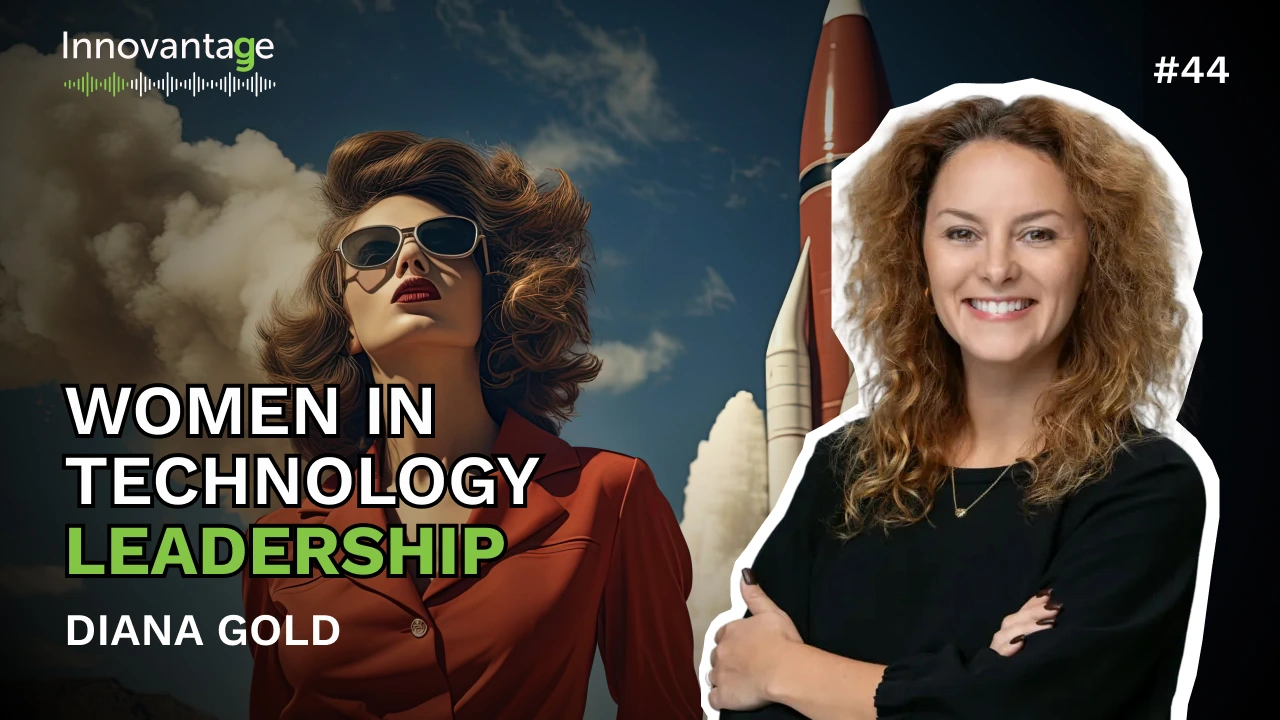
To find an answer to this question, Max Golikov, Sigli’s CBDO and the host of the Innovantage podcast, invited Diana Gold to his studio. Diana is CTO and Head of Digitalization and Technology at Gijos, Partnership Associate Professor at Vilnius University, and PhD candidate at ISM University of Management and Economics. And her impressive experience has helped her develop a broad perspective on the tech industry.
Diana’s journey into IT began with her choice of a university program. She was strong in mathematics and interested in technology. So she enrolled in Management Information Systems at Vilnius University.
During her studies, she began working as an IT analyst at Siemens. She helped develop a new system by preparing technical specifications and conducting user training. Later, she spent a year in Sweden pursuing a master’s degree in ICT Entrepreneurship.
After returning, she joined IBM as an SAP consultant. Following certification training in India, she worked on international projects across Scandinavia, particularly in Sweden and Finland. Over more than eight years at IBM, she gained extensive consulting experience. But she realized that the role required constant travel, which was challenging as she had young children.
Looking for opportunities closer to home, she joined Telia in Lithuania as a team lead for the SAP team. At the time, the company was undergoing a major transformation program and was rebuilding its system architecture and migrating legacy systems.
Eventually, she transitioned from leading a team of around 30 people to becoming a delivery manager responsible for standardizing project delivery across the entire IT organization. Later, organizational changes within the group led her to take on the role of Country CIO.
She was then invited to join the top management team as Chief Digital and Data Officer. The role placed her in close collaboration with leaders from marketing, HR, legal, and other functions. At this position, Diana needed to translate complex technological concepts into strategic decisions for the broader organization.
Today, as CTO at Gijos, she continues to expand her expertise. Gijos is an energy company primarily focused on providing district heating, while also operating in the broader energy sector. The company is involved in electricity balancing and is actively developing a range of innovative projects. One of the most notable initiatives is the construction of a hydrogen production facility in Lithuania.
As CTO, Diana oversees the company’s entire technology landscape, including servers, cloud infrastructure, and networks, as well as advanced technologies like artificial intelligence.
She leads a technology team of nearly 50 people, which is relatively large for a company of this size. Current initiatives include replacing the billing system and upgrading key platforms such as self-service solutions, asset management, and finance systems. At the same time, her team is responsible for maintaining existing systems and services (service desk operations, end-user devices, and everyday IT infrastructure).
Another major part of her role involves preparing the organization for upcoming regulatory changes, including the NIS2 Directive. This European regulation will impose stricter cybersecurity and infrastructure requirements on critical sectors. It means that companies will need to meet comprehensive standards for how their networks, infrastructure, and applications are managed and secured. Organizations are expected to comply by the first quarter of 2027.
Diana believes that digitalization plays a central role in the company’s long-term strategy. Technology is not just a support function but a key driver of progress and transformation.
While new regulations introduce strict compliance requirements, she sees them less as a burden and more as an opportunity. In her view, such regulations force organizations to address technology hygiene. These are the foundational elements of infrastructure, systems, and data management that are often overlooked in favor of more visible innovation projects.
Many companies struggle with outdated infrastructure and poor data quality. These issues make it difficult to implement advanced technologies.
The new directive provides a rare chance to prioritize these fundamentals. By upgrading infrastructure, improving system architecture, and resolving legacy issues, organizations can build a much stronger technological base.
Organizations do not need to reinvent processes that already exist. That’s one of the main lessons that Diana has learned in her professional journey. Many well-established frameworks and best practices are available. But the real challenge is to choose the ones that best fit a company’s needs.
During a large transformation program earlier in her career, her team initially attempted to design their own methodology for managing collaboration among more than 100 people. After several unsuccessful attempts, they turned to an existing framework. It immediately improved coordination and outcomes.
Today, there are tools like large language models that can help identify relevant frameworks.
When teams share the same rules, priorities, and roadmap, collaboration becomes significantly easier. Everyone understands the direction of the project and how decisions are made. All this reduces confusion and unnecessary escalation.
According to Diana, digital transformation is not only about technology. While organizations often focus on new systems and architectures, the more important task is to change how people work together. Transformation affects how teams collaborate, how priorities are set, and how decisions are made. In many cases, shaping this cultural shift takes even longer than implementing the processes or technologies themselves.
For that reason, building the right organizational culture is a critical part of any transformation effort.
Diana explained that successful change usually begins with a critical mass. It is a group of people who genuinely believe in the transformation and are willing to experiment with new approaches. There is no need to change the entire organization at once. Instead, it is often more effective to start with a smaller initiative that demonstrates real results. When teams can see tangible benefits in practice, the impact is far more convincing than explanations alone.
However, cultural change cannot succeed without strong leadership support. Introducing new roles and working methods requires alignment from senior management. Leaders need to understand the transformation and actively champion it across the organization.
Leading cultural change begins with people. No transformation can be driven alone. It requires a committed team that believes in the direction and is willing to move forward together. Diana said that building such a team takes time. Nevertheless, it is the most important foundation for meaningful change.
What is necessary for efficient changes?
Over time, Diana realized that technology leaders must develop a form of internal sales. Promoting ideas inside an organization is very similar to selling. Instead of external customers, the audience is internal stakeholders.
This ability to sell ideas is not limited to business environments. It also plays a key role in education. As a Partnership Associate Professor at Vilnius University, Diana sees teaching as another form of communication and persuasion.
In the classroom, educators must engage students. Lecturers need to present knowledge in a way that keeps them interested and motivated to participate. In this sense, teaching also involves selling ideas and knowledge.
Diana first considered teaching after gaining extensive industry experience. She designed her first course entirely from scratch. The positive feedback from students and the energy of working with young people greatly inspired her to pursue a PhD at ISM University of Management and Economics.
Balancing a career with personal responsibilities requires strong planning and discipline. With multiple professional roles, Diana relies on structured time management to stay organized.
Her approach involves planning well in advance. Instead of leaving tasks until the last moment, she reviews upcoming weeks or months to anticipate deadlines and prepare early. This helps reduce last-minute stress and ensures that important responsibilities are handled with the necessary focus.
Prioritization is another key part of her approach. She carefully evaluates which tasks require immediate attention and which can be postponed. As she said, it is sometimes necessary to decide “which battles can be lost” in order to concentrate on what matters most.
Even with careful planning, maintaining multiple roles can become challenging. Recently, she decided to step back from teaching at Vilnius University because balancing it alongside her full-time work and doctoral studies had become too demanding.
When Diana started her career at IBM, workplace conversations around gender were very different from today. She mentioned an internal employee survey that asked women whether they used so-called female traits to influence colleagues (for example, pretending not to understand something to encourage others to explain it). Such a question would be difficult to imagine in a modern corporate survey.
While the technology sector has become less male-dominated over time, progress is still limited. Diana’s doctoral research at ISM University of Management and Economics explores whether artificial intelligence could influence diversity in technology leadership.
Early research shows that interest in technology careers among women remains relatively low. Around 26% of girls say they aspire to work in technology. But only about 14% to 20% eventually pursue such careers in Western countries. Even among those who enter the field, some leave during hiring or early career stages due to stereotypes in recruitment processes.
The numbers shrink further at leadership levels. Decisions about promotions can still be affected by biases. Some women choose not to pursue management roles due to concerns about work-life balance or the pressure associated with leadership positions.
Diana can analyze the situation firsthand through her involvement in CIO.LT, an association of IT leaders in Lithuania where female members remain a small minority.
On one hand, the rise of AI tools, along with no-code and low-code technologies, may shift the focus from purely technical skills to broader capabilities such as analytical thinking, problem-solving, and strategy. This shift could make technology careers more accessible to a wider group of people.
On the other hand, AI systems trained on historical hiring data can unintentionally reinforce existing biases. If past data reflects male-dominated hiring patterns, AI-driven recruitment tools may replicate those patterns unless the data is carefully audited and corrected.
Despite these challenges, Diana is optimistic. She believes AI will primarily automate repetitive tasks rather than replace human roles. This will allow professionals to focus more on creative and analytical work.
Moreover, diversity in teams leads to better products. When teams include people of different genders, ages, and cultural backgrounds, they bring a wider range of perspectives and can make products more successful.
The greatest barrier for women in technology is rooted in mindset. The challenge often begins early, with family expectations, schooling, and even university guidance shaping how girls perceive their potential in technical fields.
In the workplace, barriers are less pronounced. For instance, when Diana joined Gijos, her team had only five women out of 46 members. Today, that number has grown to 14.
To overcome invisible barriers, a conscious effort to counteract biases is a must. Encouragement plays a critical role. Girls and young women need to hear that technical fields are accessible to them and that they do not need to master everything from the start. The technology sector offers a wide range of roles, so there is a fit for many different skills and interests.
Reaching young people at schools and universities is key to sparking interest and showing the diverse opportunities within the field.
Hackathons, coding workshops, and career talks are effective ways to inspire girls and demonstrate what is possible in tech. One example in Lithuania is the Empowering Girls program. It introduces school students to technology and shares real-life career experiences.
For women already in the workforce or looking to reskill, programs like Women in Tech provide structured support to transition into technology roles. These initiatives have successfully helped hundreds or even thousands of women gain skills and confidence to enter IT.
Diana believes that artificial intelligence is already transforming the way we work and it will continue to reshape the future. She notes that even 30 and 50 years ago, many tasks were highly unproductive. However, modern systems have become essential for business operations. Similarly, AI is no longer optional. Organizations that fail to adopt it risk falling behind.
Technology itself is a tool. That’s why the outcomes depend entirely on how it is used. When applied thoughtfully, AI can drive better decisions and generate positive societal impact. At the same time, its misuse, such as relying on biased or incomplete data, can lead to poor results.
Diana observes two schools of thought about AI’s impact on the workforce. One predicts widespread job losses and social disruption. Meanwhile, the other sees an opportunity for unprecedented productivity and innovation.
She aligns with the more optimistic view. According to her, AI, when implemented responsibly, enables people and organizations to accomplish far more than they could previously.
Artificial intelligence can become a transformative force across every sector (public, private, and education alike). The cultural differences between the public and private sectors are smaller than expected. Both must collaborate and adapt to achieve meaningful results for society.
When it comes to education, it’s important to understand that students are already using AI tools, such as large language models, in their projects. It makes no sense to restrict access. Instead, educators must embrace these technologies and teach students how to use them responsibly. This includes validating results and distinguishing between accurate and misleading outputs.
The tech field is broad. There are opportunities for a wide range of talents and personalities. Analytical individuals can thrive in roles like data analytics or IT analysis. Holistic thinkers may focus on architecture, strategy, and vision. At the same time, collaborative personalities can excel as scrum masters or team coordinators. In short, there is a place for everyone in tech.
Diana also noted that coding, once seen as a high barrier, is increasingly a commoditized skill. Today, anyone can build a minimum viable product in minutes, test it, and iterate quickly. This fail-fast approach allows innovators to experiment without needing years of deep programming expertise. Professional developers remain essential. But their work is becoming smarter and more productive thanks to modern tools.
Both Max and Diana agreed that now is an ideal time for women to enter technology. With curiosity and the willingness to learn, everyone can leverage their unique skills to create meaningful impact in a rapidly evolving field.
Interested in discovering more about the present and the future of the tech space? That’s what you can learn from the next episodes of the Innovantage podcast. Don’t miss them!
This episode focuses on women in tech, the future of AI, digital transformation, leadership, and cultural change. Diana Gold shares lessons from her career and discusses how technology can become more inclusive and accessible.
According to Diana, the issue often starts early, with family expectations, school guidance, stereotypes, and limited encouragement for girls to pursue technical fields. Later, hiring biases, promotion processes, and concerns about work-life balance can also affect women’s career growth.
AI can help make technology more accessible by reducing the need for purely technical skills and supporting broader capabilities such as analytical thinking, problem-solving, and strategy. However, AI can also reinforce existing biases if it is trained on historical hiring data that reflects past inequalities.
Women may face invisible barriers such as stereotypes, lack of encouragement, biased recruitment processes, and the perception that tech careers require deep coding skills from the start. Diana emphasizes that the tech industry offers many different roles for different talents and personalities.
Schools, universities, hackathons, coding workshops, career talks, and reskilling programs can help show girls and women that technology careers are accessible. Real-life role models and practical experience are especially important for building confidence.
Coding remains important, but it is no longer the only path into technology. With AI, low-code, and no-code tools, people can now build prototypes, test ideas, and contribute to tech projects without years of programming experience.
Digital transformation is not only about implementing new systems. It also requires changing how people collaborate, make decisions, set priorities, and work together. Diana believes that cultural change is often harder and more important than the technology itself.
Diana believes AI will automate repetitive tasks and help people focus more on creative, analytical, and strategic work. She sees AI as a powerful tool that can increase productivity and create positive impact when used responsibly.


.svg)
.svg)
.svg)
.svg)


.svg)

.svg)
.svg)
.svg)
.svg)
.svg)
.webp)


.webp)