Business Strategy & Growth

December 15, 2025

12 min read
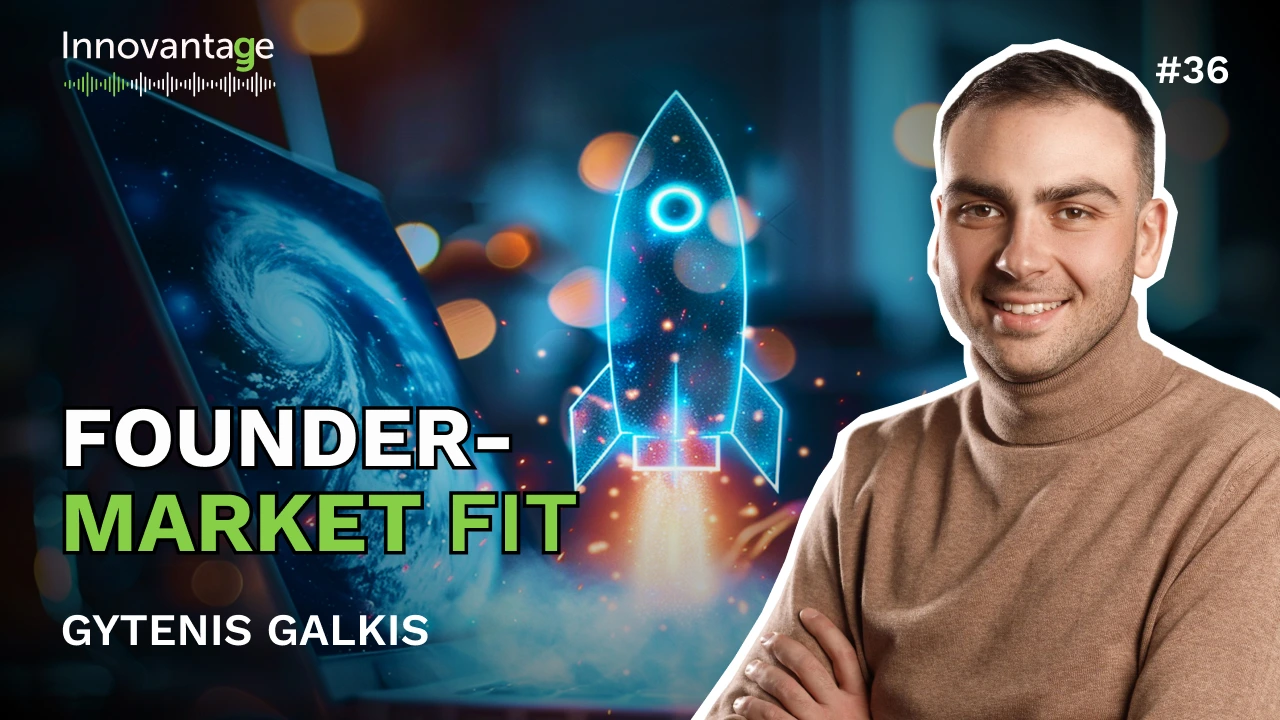
In the Innovantage podcast, we have often discussed technology and its role in business, but we have never talked directly about market fit. What are investors looking for today? And how do they determine whether a project is set up for success?
To find the answers to these questions, podcast host and Sigli’s CBDO Max Golikov, invited Gytenis Galkis, Partner at Superhero Capital, to his studio.
Gytenis is a venture capitalist with over a decade of experience investing across the Baltic and Nordic startup ecosystems. Over the years, he has reviewed hundreds of startups annually and made direct and fund-based investments in nearly 100 tech companies.
He works with pre-seed and seed-stage companies, which provides him with a comprehensive picture of the market trends. Thanks to this, he has a deep understanding of the patterns and traits that separate high-potential teams from the rest. And he agreed to share his expert insights with the audience of the Innovantage podcast.
To find the projects that align with the fund’s investment strategy, Gytenis and his team review approximately 600 startups every year. Over a decade, this process has amounted to thousands of startup evaluations, including both direct reviews and indirect exposure through events and pitch sessions.
Gytenis explained that filtering such a high volume is essential to identify the few startups with true potential. When it comes to early-stage investments, traditional product-market fit is very difficult to assess. That’s why he prefers evaluating so-called founder-market fit. It means that in the first turn, he looks at the entrepreneur’s skills and vision of the market opportunities, as every project starts with a founder.
Nevertheless, even with a very careful selection, outcomes are often uncertain. But identifying strong founder-market fit increases the likelihood of success.
Is there a huge difference between the approaches to assessing product-market and founder-market fit?
According to Gytenis, product-market fit occurs when a company clearly defines its value proposition, and customers understand and actively adopt the product. In such a way, a product is moving beyond early adopters to broader market awareness. Here, he named OpenAI as an example. Mainstream recognition came only several years after initial development. Product-market fit was achieved after a row of iterative improvements.
Meanwhile, founder-market fit refers to the alignment between the founding team’s skills, experience, and the market they aim to serve. Gytenis noted that teams with relevant industry knowledge or unique insights are always better positioned to succeed. Bill Gates can be named as a good example of a founder who determines the future success of his company. His early exposure to one of the first computers gave him a competitive advantage that later enabled software innovation.
Startup success rarely comes overnight. Very often, a team needs to accumulate sufficient experience and insight over years (or even decades) to address a particular market need effectively and build a sustainable venture.
Age and experience provide founders with an advantage in building successful startups. More mature entrepreneurs typically understand fundamental business operations, possess relevant industry contacts, and have experience in such basic processes as hiring, training, and scaling teams. These skills allow them to methodically grow companies and navigate challenges effectively.
That’s why, according to statistics, there are more successful entrepreneurs among those who started businesses in their 40s than among people who try to launch their projects in their 20s and 30s.
Of course, younger founders can also succeed, especially when they bring unique insights and the ability to learn rapidly.
Such cases are quite rare, but they still exist and demonstrate that experience is not an absolute requirement for startup success.
When communicating with founders, Gytenis always pays attention to whether they can clearly explain why their team is uniquely positioned to solve a problem and why the timing is right. YouTube and Uber were among those companies that came to the market when they were needed, which enabled their success. In these cases, founders were able to detect the missing pieces in the ecosystem and leveraged emerging technologies to create scalable solutions.
Gytenis explained that evaluating market fit is both art and science. Many founders often overestimate demand and rely heavily on marketing without deep technology. Others assume that a great product alone will drive adoption. At the same time, some teams possess strong technological capabilities but lack go-to-market understanding. As a result, though their ideas may be good from a tech perspective, they simply don’t align with the market realities.
Gytenis and Max also discussed the balance between consensus and non-consensus investing in venture capital. Highly hyped deals are often expensive and competitive, similar to public stock markets. At the same time, non-consensus opportunities are riskier, but they can generate outsized returns. In this context, it’s worth mentioning Airbnb. Most investors initially rejected this startup. But ultimately, it delivered exceptional outcomes.
Early-stage investing has some similarities with poker. Initial investments are modest, which allows the investor to monitor whether a company shows signs of product-market fit
If the startup progresses, additional funding follows through subsequent rounds. If not, the position is cut. Such a staged approach helps manage risk and still maintain the potential for high returns.
Speaking about efficient investing, Gytenis highlighted that access to deals is critical. VCs with broader networks can evaluate and select more opportunities. This gives them a better chance to identify undervalued startups.
Investment size, stage, and risk tolerance all influence portfolio strategy. While some funds favor high-conviction bets, others, like Superhero Capital, prioritize diversification across many early-stage companies to have more chances for higher yields.
The interplay between founders and market opportunity is a must for a startup to succeed. As Gytenis explained, even the best teams struggle if the market is not ready or the product does not address a pressing need.
He used the analogy of vitamins versus painkillers. We always forget to take vitamins, but we never forget to take a painkiller if we have pain. So if you find the product that can address a big market pain, you will buy it. That’s why products that solve urgent problems naturally attract customers. However, desirable but non-essential offerings often fail to gain traction.
In venture capital, success often comes when an “A” team meets an “A” market, which means that both the founder’s capabilities and the market’s demand align.
Companies like Tesla and Better Place can illustrate the importance of timing and market readiness. Despite significant funding and an innovative battery-swapping model, Better Place failed. It happened because the mass market was unprepared for widespread EV adoption.
Tesla chose another approach. It targeted affluent early adopters and then gradually scaled to broader markets over a decade.
It’s also important to define the right way to access the market. Even with a strong product, founders must understand distribution, early adopters, and positioning. Otherwise, their projects will easily fail. Historical examples like MySpace, Kodak, and Nokia demonstrate that early technological insight alone is insufficient without market alignment and the patience to grow in step with adoption.
Early-stage investing is a balance between founder-market fit and risk-return assessment. At Superhero Capital, the team first evaluates whether a startup’s founders have the right experience and insight to succeed in their market. Once that alignment is confirmed, they assess the risk-reward profile. It means that they consider potential ownership stake and the likelihood of generating meaningful returns for the fund.
When assessing a startup’s risk-reward profile, Gytenis considers whether an investment can realistically return the entire fund within 7–10 years. For a €50M fund making around 30 early-stage investments, he expects most to fail or only return the initial capital. Given this, the top five must generate the full returns.
This is why ownership size and valuation discipline matter: buying only 1% of a company requires a multi-billion-euro exit (and that is an unlikely outcome at the early stage). At the same time, acquiring 15% or 20% at a reasonable price can deliver a full-fund return even with a nearly €250 million exit, which is far more achievable.
While unicorns are desirable, the fund aims for several “mid-sized” outcomes (investments returning between €100 million and €500 million) that cumulatively meet the fund’s target returns. This disciplined approach balances exposure across multiple bets, because it is still crucial to bear in mind that many early-stage investments will either break even or fail.
Speaking about investments, it also makes sense to touch on the topic of missed opportunities. As well as any other investors, Gytenis has experience of this kind. He recalled passing on investments due to personal conviction or competing priorities. These cases provide valuable lessons in evaluating founders and market potential.
Gytenis shared that early-stage decisions often involve not only data-driven analysis but also subjective judgment, which can be quite dangerous for decision-making. Factors such as founder drive, insight, and market understanding may be difficult to quantify but crucial for success. That’s why documenting decisions and learning from both successful and missed investments helps improve evaluation processes over time.
While many early-stage investments may fail, systematic reflection on what worked, what didn’t, and why can enhance long-term venture performance.
Does luck play an important role in entrepreneurial success? Definitely yes, but not only. Preparedness also makes a huge contribution. Gytenis mentioned an example of a young startup entering a rapidly growing market. Initially, it was rejected by investors. But later, the company secured a contract with a major unicorn customer, which became a milestone in its business journey and opened new horizons for it.
Such an opportunity could be seen as luck. However, Gytenis noted that the founders’ preparation for offering a competitive system and effectively executing the tender was critical. The contract enabled the startup to scale rapidly, growing 70-fold within two years, and attract additional customers.
Luck alone is insufficient. Success comes when consistent effort, market understanding, and operational readiness intersect with favorable circumstances. Founders must be ready to act decisively when luck strikes.
Gytenis advised founders to focus on market insight and anticipate how the world will evolve. Successful startups often emerge from bets on future trends and technological shifts. For instance, Netflix was among those companies that capitalized on changes in internet speed and content consumption. Founders must develop a unique perspective on how markets and technologies will change, even if the outcome is uncertain.
The importance of complementary founding teams shouldn’t be underestimated as well. Solo founders can succeed, but they must be able to hire talented individuals who can fill the existing gaps in their knowledge or skills.
Ideal teams often form through prior collaboration on projects or professional relationships where complementary skills (like marketing or technology) are already proven. This shared experience and understanding of each other’s strengths, together with a clear market insight, provides a stronger foundation for building successful ventures.
In their conversation, Max also asked Gytenis to share his opinion about the current state of the Baltic startup ecosystem.
This ecosystem is relatively small, but it is gradually growing, and each country is working in its own niche. Government initiatives (such as Lithuania’s 2017 program to become a regional hub) have delivered tangible results and already attracted international companies to establish local operations there.
Strong GDP growth and rising purchasing power further support the ecosystem’s development. Nevertheless, talent acquisition remains the primary constraint. Attracting skilled professionals (especially from abroad) and retaining them is a challenging task due to cultural and geographic factors.
According to Gytenis, education and high-quality job opportunities are key levers for building the talent pool. It’s crucial to understand that salaries in the region are lower than in Western Europe. However, infrastructure and lifestyle quality make it an attractive location for startups.
Relocation to Silicon Valley can be a necessary step for later-stage funding, but pre-seed and early-stage ventures can succeed by focusing on building a global product locally and securing regional investor validation.
Trust and relationships remain central to venture investment in the Baltics. Face-to-face interaction helps investors gauge founder credibility and commitment. Long-term collaboration always relies on mutual confidence and shared vision for growth.
Already today, we can see how powerful computers can be in optimizing various tasks, like deal-making or data analysis. Nevertheless, Gytenis believes that humans will continue to engage in activities, but it’s highly likely that they will do it for enjoyment and personal fulfillment. Even if fully autonomous vehicles dominate, some people will still choose to drive classic cars for pleasure.
Gytenis assumed that business will also retain a human dimension, particularly in areas like relationship building and judgment-based decision-making. Despite the efficiency of AI, markets are not purely logical. Human behavior, sentiment, and psychological biases will continue to shape outcomes. FOMO, trends, and other emotional drivers ensure that human participation remains essential, even in a highly automated future.
Nowadays, a lot of experts agree that the future will be hybrid: AI will ensure efficiency and scale, while humans will focus on creativity and meaningful engagement in business and life. This sounds like a quite optimistic forecast.
Want to learn more about the present and future of technologies in the business world? That’s what you can find in the episodes of the Innovantage podcast. Don’t miss the next one!
At the earliest stages, investors focus less on “proof” and more on signals: founder-market fit, clarity of the problem, a credible wedge into distribution, and early evidence the market pain is real.
Founder-market fit is the alignment between the founder’s skills, insights, and experience and the market they’re building for, plus a compelling reason they’re uniquely positioned to win.
Product-market fit is proven adoption and repeatable demand. Founder-market fit is the early-stage proxy investors use when product-market fit is not yet measurable.
They look for “why now” logic: a shift in tech, regulation, behavior, or economics that makes the solution viable today, and a clear narrative that demand is emerging.
Strong teams still fail if the market isn’t ready, the problem isn’t urgent, or distribution is unclear. Execution can’t compensate for weak demand.
Painkillers solve urgent problems customers will pay for immediately. Vitamins are “nice to have” and often struggle to convert because urgency is low.
Depends on the business, but common signals include: strong user retention, repeated usage, fast sales cycles, LOIs/pilots, growing waitlists, or clear engagement from a defined ICP.
A lot. Ownership plus valuation determines whether an exit can realistically return the fund. Early-stage investors need a path to meaningful ownership at a sensible price.
Consensus deals are widely believed to be great (often expensive). Non-consensus deals are less obvious, riskier, and can produce outsized returns if the thesis is right.
Yes, especially if they have unique insight, learn fast, and build a complementary team. Experience helps, but it isn’t the only path to credibility.
A clear “why us / why now,” crisp problem and ICP definition, early demand evidence, distribution plan, competitive angle, and an honest view of risks and milestones.
They stage risk: smaller initial checks, then follow-on funding if strong signals appear, while diversifying across multiple bets to increase the odds of standout winners.



.svg)
.svg)
.svg)
.svg)


.svg)

.svg)
.svg)
.svg)
.svg)
.svg)
.webp)


.webp)