The Innovantage podcast, hosted by Sigli’s CBDO Max Golikov, covers a wide range of topics that explain how emerging technologies empower people to change the world around them. While the podcast often focuses on innovation and tech-driven impact, the latest episode takes a deeper turn and shifts the spotlight to the human force behind it all.
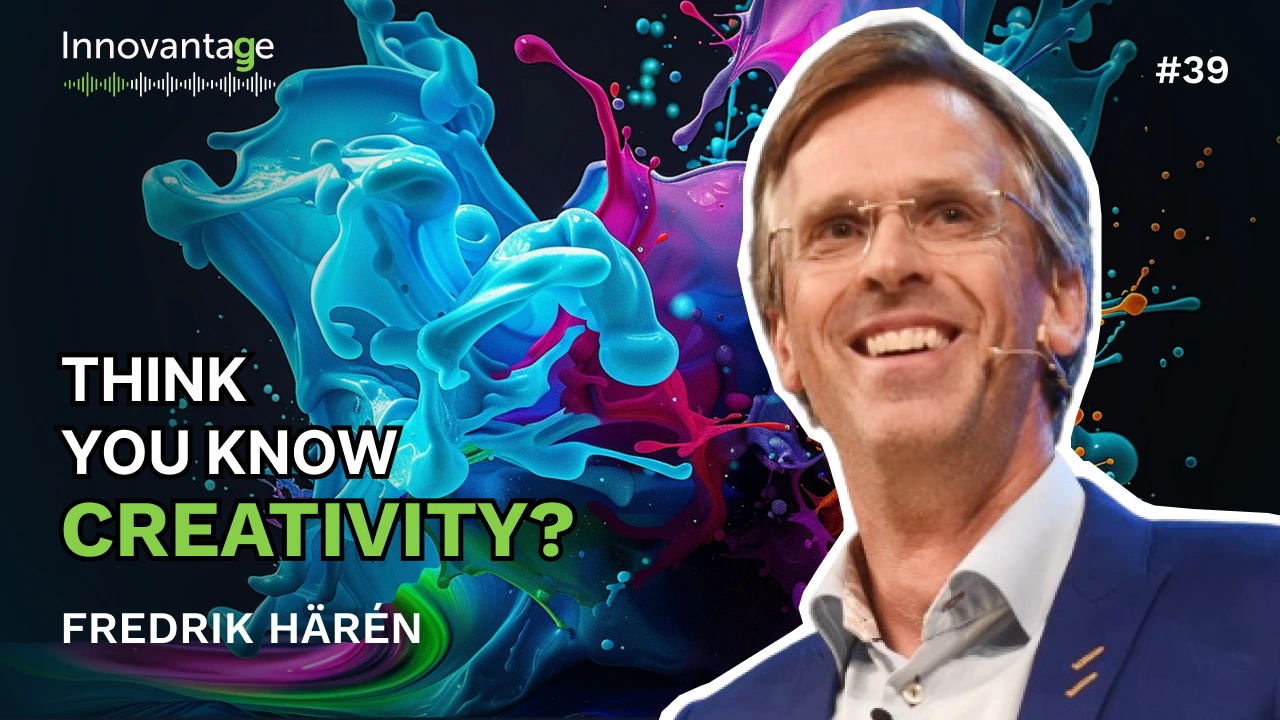
For this episode, Max invited Fredrik Härén, a Creativity Explorer who has spent decades traveling the world to understand how humans create. It’s interesting that a lot of things that he has discovered seriously challenge many of our mainstream assumptions about creativity.
Speaking about his career, Fredrik mentioned his university thesis on the internet and marketing that he wrote in 1994. At that time, his professor said that these two notions had nothing in common. But later, he asked for permission to use parts of the thesis for a book on the same subject. That’s when Fredrik learned a defining lesson: expertise is often simply knowing more than the audience.
In his late twenties, Fredrik became an early internet speaker, founded an internet company, and sold it in 1999. When the company exited, he asked himself what to explore next and decided to choose creativity.
For the past 25 years, Fredrik has studied creativity by interviewing people across 75 countries. These thousands of conversations help him to understand how different humans use their power to create new things and how we can all become better at doing it.
Explaining the reasons behind his decision to study creativity, Fredrik mentioned several factors. When he started researching the internet, it was not the technology itself that attracted his attention. He was captured by its newness.
When the World Wide Web emerged, no one came from the internet industry. People arrived from consulting, software, advertising, and other spheres. And they were trying to build something from scratch. There were no rules, no experts, and no established paths. That uncertainty provided all the necessary conditions for an unusually creative moment in business.
Fredrik worked on early online campaigns (such as advertising games for Adidas). There were no best practices to follow. Everything had to be invented. Those first years were defined by freedom and experimentation. Around 2000, Fredrik realized something important for himself. He had never liked the internet itself. But he liked the human ability to see and create the new. From that point on, he stopped focusing on the internet and devoted his life to studying creativity.
That desire became a deliberate decision around 2005. Fredrik left Sweden and moved to China to study creativity in a completely different cultural context. After relocating to Singapore in 2008, he understood that focusing on one country, especially a small one, wasn’t enough.
Here’s when he decided to study creativity wherever it existed. The goal is to conduct the research in 100 countries. With 25 still to go, Fredrik believes that exploring creativity in more than half of the world’s countries will ensure a unique understanding of human creativity.
In recent years, his focus expanded even further. Alongside entrepreneurs, CEOs, and well-known creative professionals, he began interviewing people rarely included in these conversations, from the slums of Mumbai to nomadic communities in Mongolia, and even North Korea.
During a recent trip to Bhutan, Fredrik interviewed the country’s former Minister of Tourism to explore how creativity is understood there.
The minister challenged the Western view of creativity as self-expression and output. We often perceive creativity as the act of producing and improving the world through what we make. Instead, he described creativity as an inward journey. At its core, creativity is about understanding yourself better.
That idea reshaped how Fredrik sees his own work. The creations that truly mattered to him were those that led to personal growth. However, even failure holds value because learning about yourself becomes the real outcome. At the same time, the final product is simply a bonus.
This inward approach also raises a serious question to think about: if you create something but learn nothing about yourself, was it a meaningful creation or just work?
Fredrik compared creativity to food. Just as Filipino, Indian, and Italian cuisines are vastly different, creativity takes distinct cultural forms. However, beneath those differences lies something universal. In the case of creativity, it is he human desire to connect and express meaning.
This pattern holds true across disciplines, from food and music to art, business, and entrepreneurship. While the surface varies, the underlying creative impulse is shared.
In Bhutan, after interviewing Buddhist monks, Fredrik visited a web design agency in the capital. Inside, it looked exactly like a creative studio anywhere in the world: familiar branding, pop culture references, and a global work culture. He had seen the same thing before in Mongolia. Outside, you can see a very traditional environment, but when you walk into an office, you will see just the same as what you can find in offices of web design agencies in Berlin or Stockholm.
To Fredrik, this is very remarkable. Technology has made a truly global mindset possible. For the first time in human history, creativity powered by technology is shaping global tribes that transcend borders and culture. Speakers connect with speakers, designers with designers, creators with creators.
Fredrik has written twelve books on creativity, but his latest work, called “The World of Creativity,” brings his global perspective together in a new way. As he has found out in his research, creativity should be studied at a human level. Different cultures approach creativity differently, and each approach offers a unique tool.
By learning how people innovate around the world, readers expand their creative toolbox. The more perspectives you understand, the more ways you gain access to your own creativity.
At its core, his work is about exploration. Fredrik travels the world interviewing people, but believes exploration only matters if the insights are shared. One of the chapters of his latest book is dedicated to Japan.
In Japanese, there is a word that can be translated as “someone who cultivates the future.” This is a person who sees what’s coming and brings that knowledge back to others. For Fredrik, that mindset defines creativity itself. It covers venturing into the unknown, learning from it, and returning to enrich your own community. When we share what we have learned, everyone becomes richer.
During his trips, Fredrik learned an old Icelandic word from the Viking age, “hiemskur.” Now, this word has become one of his favorites, and it sits at the heart of his philosophy on creativity.
In Viking times, Icelanders were expected to travel. They needed to sail south, gather resources, and bring back ideas. How were ships built elsewhere? How were weapons made? These insights were meant to be applied back home. Anyone who stayed on their farm and never ventured out was called hiemskur.
The word itself reveals its meaning. Heim means “home.” To always stay home, in this sense, was to become ignorant of the world.
For Fredrik, this idea feels surprisingly relevant today. Innovation is happening right now in many places, like Nigeria and Indonesia. But they often stay unnoticed by the West. The real danger, according to Fredrik, is believing you understand the world when you don’t.
You don’t need to travel constantly to avoid becoming hiemskur. Small changes help as well. Even steps like diversifying who you follow online matter. Seeing the world through the perspectives of people in other countries can radically expand your understanding of creativity and humanity.
As Fredrik highlighted, companies often limit themselves by thinking in terms of nationality or demographics. Instead of designing for Swedes, Koreans, or any specific group, companies should focus on universal human needs, like humor, love, and curiosity. These values connect people across cultures. Products designed this way naturally reach global markets.
There are a lot of products that feel truly universal, as companies behind them didn’t tie them to their countries of origin. The same can be said about many global businesses. For instance, KPMG operates across multiple countries with no single “home.” It defines itself by corporate values rather than nationality.
Unfortunately, some companies still let national identity dictate talent decisions. In one shipping company, Danish captains were paid more than equally qualified Filipino captains simply because of their nationality. According to Fredrik, such things shouldn’t happen.
Creativity is deeply individual. Introverts often generate their best ideas in solitude, while extroverts are more active in collaboration. The key is understanding your own creative process. To create something new, you need to know when your ideas flow, when they stall, and what helps or hinders your creativity. Fredrik even recommends using tools like ChatGPT to brain dump your habits and patterns, then ask it to summarize your process as if it were a creativity consultant.
When he interviewed a Thai origami artist, he asked her about the methods that help her overcome creative blocks. Her was simple: she takes an “idea nap.” She steps away, drinks coffee, and returns when the block naturally dissolves.
Fredrik realized that the stress often associated with creativity is largely a Western construct.
Of course, some people work best under pressure. Their ideas thrive on deadlines and the tension of urgency. That’s why, first of all, you need to find what works for you.
Fredrik highlights a concept known as ideation empathy. Ideation is the art of generating ideas. Meanwhile, ideation empathy is understanding how others generate theirs.
In teams, people often misinterpret each other’s behavior. Introverts might appear disengaged in meetings. At the same time, while some may feel involved only when challenged, others freeze under provocation. By sharing how each person works best, teams can adapt and collaborate more effectively. Fredrik notes that most groups never do this. As a result, they waste creative potential.
But while empathy is important, curiosity is even more powerful. Empathy lets you understand someone. Curiosity makes you care enough to want to learn more about them.
Fredrik compared Western and Eastern approaches to creativity. In the West, innovation often emphasizes speed and disruption. A Silicon Valley motto sounds: “Move fast and break things.” It reflects a mindset of tearing down old structures and building new ones. This method works, particularly in fast-moving industries. But it is just one of all possible options.
Fredrik also shared the example of an Afghan artist who follows a centuries-old tradition. Before she can paint, she must make her own paper, grind her own pigments from stones and emeralds, and even craft brushes from cat hair. The process takes weeks. And only then can she begin painting. She calls this profound patience. The careful preparation allows the final work to evolve beyond her initial idea. It has depth and quality that speed alone cannot achieve.
Though these two methods are completely different, they are both valid. When we learn different cultural approaches, we expand our creative toolbox. Some projects benefit from speed and disruption. Others thrive on reflection and patience.
The word “inspiration” comes from the idea of “breathing in,” while creation is like “breathing out.” Inspiration fuels creativity, but it must be balanced with the act of producing. Otherwise, ideas remain trapped inside.
To create, Fredrik sets aside dedicated time to turn off the input and focus on output. Every year, he isolates himself with his family on an island for over two months. This period is devoted to thinking, writing, and reflection. He compares this practice to Bill Gates’ “Think weeks.” These are retreat periods, when he has enough time for reading, personal reflection, and setting goals.
Fredrik is highly optimistic about AI. He believes that it is the greatest creativity tool humanity has ever invented. AI can seem threatening at first. But when it is used properly, it expands human potential. There are concerns that artificial intelligence can replace creative thinking. But in reality, AI can even enhance it, just as calculators enabled more advanced math.
Artificial intelligence can act as a brainstorming partner. It can challenge ideas from multiple perspectives and generate thousands of problem definitions or concepts. Let’s be honest, all this is impossible for the human mind alone. Fredrik shared an excellent example from a Stockholm kindergarten. Children were provided the possibility to ask ChatGPT endless questions via a microphone. Unlike adults, AI never tires. Such an initiative encourages curiosity and teaches kids that asking questions is central to creativity.
AI is good at combining ideas and generating novel concepts. As a result, it can create millions of new ideas that humans can build on. However, misuse can limit creative growth, just like drinking too much water can be harmful.
Fredrik also mentioned early studies that showed reduced creativity in AI users. These comparisons are premature. People just didn’t know how to use AI effectively.
Creativity helps people solve problems. Without it, humans would still be cold, hungry, and living in caves. But that’s not the only reason for its importance in the upcoming years.
Fredrik quoted his friend, Swedish entrepreneur Johan Staël von Holstein, who argues that while love may be the most powerful human emotion, the second most profound is the moment when you have a truly great idea or when you see one of your ideas come to life. According to Fredrik, that feeling is central to what it means to be human. Creativity makes us happier and more alive.
Creativity isn’t limited to the arts. It is also essential in government, technology, and everyday systems. Poorly designed services (like endless visa applications or broken digital platforms) are often not a lack of resources, but a lack of creative thinking.
The expert explained that creativity won't become obsolete or replaced by technology. The world is far from running out of problems to solve, from inequality and mental health to inefficient institutions. Until those challenges disappear, creativity will remain one of humanity’s most vital tools.
In fact, new technologies don’t eliminate creative work. They expand it. Programmers, designers, and builders can now create more than ever before.
Don’t focus first on making your people more creative. Focus on developing your own creativity. That’s what Fredrik recommends to tech leaders.
Creativity is not something that can be mandated. It spreads through example. Children learn more from what parents do than what they say. And employees are inspired by leaders who think creatively and are not afraid of taking risks.
At the end of their conversation, Max voiced an important idea. Business is defined less by success than by failure. Progress comes from overcoming setbacks along the way. Failure is essential for learning. Without it, success simply isn’t possible. The real skill is understanding how to live with failure and continue moving forward until something works.
Want to explore more insights from business and tech experts? That’s exactly what you’ll find on the Innovantage podcast. Don’t miss upcoming episodes!
AI can generate ideas fast, but it doesn’t replace the human reasons behind creation: meaning, taste, values, and lived experience. Used well, AI expands what people can explore and build.
Use it as a brainstorming partner: generate alternatives, challenge assumptions, reframe the problem, and propose wildly different directions. The value comes from your judgment and selection.
It can if you outsource thinking instead of using AI to explore. The key is to stay active: ask better questions, compare options, and reflect on what you learned.
Ideation empathy is understanding how different people generate ideas. Teams often waste creative potential by misreading introverts, extroverts, or different working styles. Naming those differences helps collaboration.
Both. Creativity looks different across countries and traditions, but the underlying human impulse(connection, meaning, expression) shows up everywhere.
A simplified contrast: Western creativity often values speed and disruption; many Eastern traditions emphasize patience, craft, and depth. Both are valid and learning both expands your toolbox.
Step away on purpose. Try an “idea nap,” a walk, or a reset ritual. Creative blocks often dissolve when you reduce pressure and allow your brain to recombine inputs.
It’s an old Icelandic word associated with staying “too close to home” and missing the world. Today it’s a reminder to diversify your inputs: people you follow, places you learn from, perspectives you seek.
Start with yourself. Creativity spreads through example: show curiosity, run safe experiments, normalize learning from failure, and make space for different creative processes in the team.
Set boundaries. Create “output-only” time where you turn off inputs and focus on making. Even short retreats(an hour, a day, a week) can unlock depth and clarity.



.svg)
.svg)
.svg)
.svg)


.svg)

.svg)
.svg)
.svg)
.svg)
.svg)
.webp)


.webp)


.webp)


.webp)