Digital Transformation

December 4, 2025

10 min read
.webp)
Idea validation workshops in the Benelux can either save your SME months of waste or become yet another nice-looking exercise that goes nowhere. The tricky part is that choosing the right format rarely feels straightforward. If you run an SME in Belgium, the Netherlands or Luxembourg, you are constantly bombarded with offers for innovation sessions, design sprints, bootcamps, labs and strategy workshops. Many of them promise the same thing: faster decisions and less risk when launching new products or services. On paper they sound similar. In reality, the format you choose for your Idea Validation Workshops Benelux can make or break your initiative. If you pick something too light, you end up with sticky notes on the wall but no validated decision. If you choose something too heavy, your team loses momentum or you never manage to get all stakeholders in the room.
This article walks through the three most common formats for Idea Validation Workshops Benelux — short 1–2 day sessions, full Design Sprint–style weeks and multi-week bootcamps or mentoring — and shows how to choose the one that actually fits your SME.
Most offers you see around idea validation in the Benelux fall into one of three categories. The first is the 1–2 day workshop. This is a short, focused format that helps you sharpen an idea, map your assumptions and prioritise what to test next. It often looks like a strategy offsite, but with a strong validation angle. You gather key people in a room, clarify the problem, agree on who the customer is, and leave with a concrete plan for what you need to learn.
The second format is a Design Sprint–style Idea Validation Workshops Benelux approach. A Design Sprint usually runs for four to five days and is based on a structured process that moves from problem to tested prototype in a week. A small cross-functional team — product, business, tech and someone close to the customer — works together to frame the challenge, sketch solutions, decide on one concept, build a prototype and test it with real users. The outcome is not just a better idea, but real evidence from customers.
The third type is the multi-week bootcamp or mentoring programme. These Idea Validation Workshops Benelux are spread over several weeks and often organised by innovation hubs, clusters or public programmes. They combine workshops, homework, mentoring sessions and sometimes a final pitch. Instead of one intense burst, you move through several cycles of customer discovery, solution refinement and business model evolution. This format is less about one workshop and more about building validation as a habit inside your company.
Each of these formats can be effective, but only if you match it to the maturity of your idea, the risk involved and the capacity you actually have inside your SME.
Before you compare prices or ask about facilitation methods, it helps to get very clear on the outcome you want. The simplest way to do that is to ask yourself what decision you expect at the end of your Idea Validation Workshops Benelux. Sometimes you just need a rough direction and a prioritised list of next steps. In other cases you want a clear Go or No-Go for a specific product concept. And for bigger bets, you might need enough evidence to support an investment decision and a roadmap for the next three to six months.
You also need an honest view of how risky and complex the idea is. An incremental feature for existing customers sits in a different risk category than a completely new subscription service in a new market. A small improvement can often be addressed with a compact workshop. A new business model that touches multiple teams usually deserves something more intensive. Finally, you must be realistic about what your team can commit to. Some SMEs simply cannot free up key people for a full week, while others can only make progress if they block that time and escape day-to-day operations. The number of stakeholders and decision-makers you need to involve will also influence your choice of format.
Once you have clarity on decision, risk and capacity, it becomes much easier to see which Idea Validation Workshops Benelux formats are overkill and which ones are dangerously shallow.
Short Idea Validation Workshops Benelux of one or two days work best when your idea is relatively contained and the risk is low to medium. They shine in situations where you have several ideas on the table and need to narrow them down, or where different departments are looking at the same problem from different angles and you need a shared understanding. In a compact timeframe, you can clarify your target segment, agree on the problem you are trying to solve, and list the assumptions that need to be tested around desirability, feasibility and viability.
At the end of a 1–2 day workshop, you should expect to leave with a focused problem statement, a structured set of assumptions and a prioritised list of simple experiments you can run afterwards. These experiments might be customer interviews, landing pages, prototypes, or internal data analyses. For smaller bets and incremental improvements, this type of Idea Validation Workshops Benelux often delivers a very good return on investment. It can also be an excellent way to kill weak ideas early, which usually saves more money than anything else.
However, there are clear warning signs that a short workshop is not enough. If you are about to commit serious budget, if the idea cuts across multiple business units or countries, or if you need to show clear, tested outcomes to a board or investors, then a simple two-day alignment session will probably leave you with more questions than answers. In those situations, a Design Sprint–style format gives you more depth and more evidence.
A Design Sprint–style Idea Validation Workshops Benelux is designed for cases where the stakes are higher and the uncertainty is real. The classic Design Sprint is a four- or five-day process developed to answer critical business questions through design, prototyping and testing ideas with users. For an SME in the Benelux, this format is particularly useful when you are dealing with a strategic digital product or service: a new platform, a major feature, a new customer portal, or a significant redesign that will require substantial development effort.
In a Design Sprint–style week, you bring together a small, dedicated team with a clear decision-maker. The week starts by aligning on the problem and defining what success would look like. The team then explores different solutions, decides on one concept to prototype, and spends a day or two building a realistic prototype. At the end of the week, you put this prototype in front of real customers or close proxies and gather feedback. The strength of this format is that it compresses months of debate and unclear slides into a single, intense week with concrete user reactions.
This approach to Idea Validation Workshops Benelux is a good fit if internal stakeholders are stuck in endless discussions, if you have already done some discovery but still face too many unknowns, or if you need direct user feedback before committing to a significant development budget. It does require a higher level of commitment compared to a short workshop: you must free the core team for several days in a row and be ready to make decisions based on what you learn. In exchange, you dramatically reduce the risk of building the wrong thing.
Multi-week bootcamps or mentoring-style Idea Validation Workshops Benelux are a different animal. Rather than one intense block of time, they are spread over three to eight weeks or even longer. Participants join a sequence of workshops, perform assignments between sessions and work with mentors or coaches. This format is especially relevant when your idea is still vague or when the main goal is to build innovation capability inside your organisation instead of validating just one project.
In these programmes, you move through several cycles of problem exploration, customer discovery, solution shaping and business model design. There is more space to conduct interviews, explore partnerships, run small experiments and adjust your direction based on feedback. By the end of a multi-week Idea Validation Workshops Benelux bootcamp, you are likely to have a clearer value proposition, a more credible business model and evidence from multiple validation cycles. For some SMEs, especially those exploring new markets, data-driven services or AI-based offerings, this approach provides the structure and accountability needed to move steadily forward instead of getting stuck in wishful thinking.
This format does, however, require steady commitment over time. You need people who can consistently work on the idea between sessions and an organisation willing to accept that not everything can be rushed into a single week. In return, you get a deeper and more robust validation process that can support larger funding decisions or more ambitious pivots.
Even without a table, you can think of these three formats along a few simple dimensions. A 1–2 day Idea Validation Workshops Benelux session is the lightest option. It demands the least time, works well for lower-risk ideas and focuses on clarity, alignment and a backlog of experiments. It is ideal when you need a shared understanding and better prioritisation rather than a fully tested solution.
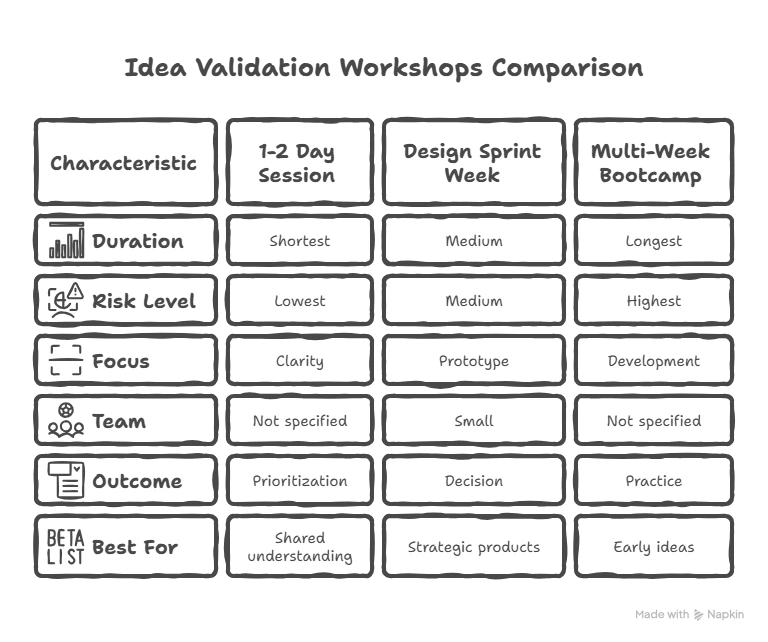
A Design Sprint–style week sits in the middle in terms of duration but high in terms of intensity. It suits strategic digital products and services, requires a small cross-functional team that is available for almost the entire week, and culminates in a tested prototype and a concrete decision to proceed, pivot or stop. This format delivers a very high reduction in risk for medium- to large-sized bets.
A multi-week bootcamp or mentoring programme spreads the effort over several weeks. The time commitment per day is usually lower than during a sprint, but it extends over a longer period. This format is best for early, high-uncertainty ideas, new markets and new business models. It is also the best option when you want to develop people and culture around innovation, because teams practice validation repeatedly instead of treating it as a one-off event.
By mentally placing your idea on this spectrum — small and incremental, strategic but defined, or early and highly uncertain — you can quickly see which type of Idea Validation Workshops Benelux is the closest match.
Imagine a 70-person logistics SME based in Flanders. The company has a strong base of existing customers and a good reputation in its niche. The leadership team has an idea for a subscription-based digital portal that would allow small retailers to track deliveries and see the CO₂ impact of their orders in real time. Building such a portal would require significant investment in data integration and user experience. Management wants a clear Go or No-Go decision within a month, and there is already tension between sales, operations and IT about priorities.
At first, the CEO leans towards a one-day strategy workshop. It feels easier to schedule and less disruptive. However, once the team looks at the stakes more honestly, they realise they are not simply prioritising between many ideas; they are discussing one big bet. They also recognise that internal opinions will not be enough: they need real feedback from retailers before they can commit budget with confidence.
In the end, they opt for a Design Sprint–style Idea Validation Workshops Benelux. During the week, they start by selecting a very specific customer segment and identifying the main risk: whether small retailers would actually pay extra for better visibility and CO₂ insights. Over the next two days, they sketch different approaches and converge on one concept for a portal that combines shipment tracking with alerts for delays and clear, visual sustainability metrics. Then they build a clickable prototype. On the final day, they test this prototype with several existing customers and a few prospects.
The conversations are revealing. Retailers appreciate the transparency but admit they are primarily interested in tools that save them time. While sustainability information is nice to have, it is not the first thing they would pay for. The team realises that the initial idea has to be adjusted: the portal should focus on exception management and time-saving features, with CO₂ insights added as a secondary benefit. The final decision is a confident “yes” to the portal, but with a sharper and more realistic scope. Without the sprint, the SME might easily have invested in the wrong priorities based on assumptions rather than evidence.
Many SMEs choose the wrong Idea Validation Workshops Benelux format because they decide based on what seems easy to organise rather than on what they truly need. A good way to avoid this is to ask yourself whether you can clearly articulate the decision you expect at the end of the workshop and whether the duration matches the risk of the idea. A one-day workshop for a million-euro bet should immediately feel suspicious. You should also check whether you can genuinely free the right people, including someone who can make decisions, for the proposed time.
Another important question is whether the provider’s format includes actual validation rather than just ideation. If someone offers you a “Design Sprint” that does not involve building a prototype or testing with users, you are not buying a sprint, just a brainstorming session with a trendy label. For multi-week bootcamps, be realistic about whether your team has the capacity to do the interviews, experiments and follow-ups between sessions. Consider whether the style of the workshop, the language, and the online or offline set-up fit your company culture. Finally, ask yourself if the budget is proportional to the risk and potential upside of the idea. The point is not to spend as little as possible, but to invest an amount that makes sense compared to the decision you are trying to make.
If, while going through these questions, you notice that you cannot answer them clearly, or that the format you are looking at is mostly convenient but not truly aligned with your needs, there is a good chance you are about to choose the wrong workshop.
The good news is that Idea Validation Workshops Benelux do not need to be a gamble. You can treat the choice of format as a strategic decision. Start by defining the decision you want to make at the end of the process and work backwards from there. For small, lower-risk ideas, a well-designed 1–2 day workshop is often enough. For strategic products and services where development will be expensive, a Design Sprint–style week that culminates in user tests is usually a better fit. For early, high-uncertainty ideas and new business models, or when you want to build lasting innovation skills inside your company, a multi-week bootcamp or mentoring programme will serve you better.
Whatever format you choose, it is worth co-designing the agenda with your provider so that it reflects your sector, your customer reality in the Benelux and your internal constraints. And importantly, you should plan what will happen after the workshop before it even starts. The true return on investment of Idea Validation Workshops Benelux comes from what you do in the weeks and months afterward: the experiments you run, the pilots you launch, and the product or business decisions you finally make.
When you approach idea validation in this way, the confusion around formats fades. Instead of asking “Which workshop should we book?”, you begin to ask “What decision are we trying to make, and what is the smartest way to de-risk it?” That is how Idea Validation Workshops Benelux become a clear, low-risk step in your innovation roadmap rather than an expensive, one-off event.
Idea validation workshops in the Benelux are structured sessions where SMEs test assumptions about new products, services or business models before investing heavily in development.
For low-risk ideas, 1–2 day workshops can be enough. For strategic digital products, a 4–5 day Design Sprint–style week is often better, while multi-week bootcamps suit early-stage or high-uncertainty ideas.
Look for a provider who can clearly explain their format, show real examples, adapt the agenda to your SME, and connect the workshop outcomes to measurable decisions and follow-up actions.



.svg)
.svg)
.svg)
.svg)


.svg)

.svg)
.svg)
.svg)
.svg)
.svg)
.webp)


.webp)