software development agencyTwo overlapping white elliptical loops on a black background, one solid and one dashed.
Thank you! Your submission has been received!
Oops! Something went wrong while submitting the form.

Onze artikelen

Sigli x Aimaras partnership
PoC & MVP Ontwikkeling
Huur MVP Ontwikkelaars in Londen | FinTech SCA, KYC & FCA
October 21, 2025
6 min leestijd

FinTech-MVP’s zijn niet ‘minimal’. Huur developers die SCA/PSD2, KYC/AML, FCA en AVG (GDPR) standaard meebouwen — lever sneller met minder compliance-gedoe.

Launching an MVP is supposed to be the fastest way to validate demand. In financial services, the word “minimal” can be misleading: you are shipping into an environment shaped by SCA/PSD2, Open Banking, UK GDPR, and the FCA’s expectations for governance and resilience. This guide turns the usual checklist into a readable playbook — so you can hire the right team in London, make the right architectural calls, and keep momentum without stumbling over compliance.Why FinTech MVPs are different (and risky)Even a slim payments or onboarding flow touches multiple regulated surfaces at once. Strong Customer Authentication (SCA) dictates how you structure two‑factor experiences and when you can legitimately avoid them via exemptions such as merchant‑initiated transactions, low‑value payments, or transaction risk analysis. Know‑Your‑Customer and anti‑money‑laundering controls influence everything from what data you collect to how you handle false positives, sanctions matches, and suspicious activity reports. Data protection runs in parallel: your lawful basis, retention policies, DPIAs and DSAR handling determine whether your product is both usable and defensible.What happens if you under‑engineer these layers? Banks and PSPs may refuse to onboard you or shut you down after testing. The FCA can query your governance and operational resilience. Privacy missteps lead to audits and reputational damage. Worst of all, re‑architecting after a failed pilot can cost more than building it correctly the first time. The safe conclusion is not “move slowly,” but “design compliance into the product fabric from day one.”What a regulatory‑ready MVP looks likeA credible FinTech MVP treats authentication, onboarding, and privacy as product features, not as paperwork.SCA/PSD2. Map your payment scenarios — one‑off, recurring, merchant‑initiated — and implement two‑factor authentication with a measured step‑up. Exemptions should be evaluated by a server‑side policy engine and every decision should be recorded so you can explain why SCA was, or wasn’t, applied. Recovery and retry paths must avoid duplicate charges and preserve the authorisation context.KYC/AML. Choose providers for PEP and sanctions screening, decide when documentary evidence or non‑documentary checks are appropriate, and define thresholds that trigger manual review. Ongoing monitoring is not a later phase: set the cadence now, capture adverse media, and keep tamper‑evident evidence of what you checked and when.FCA expectations. Decide early whether you need your own permissions (EMI, AISP, PISP) or will operate as an agent. Build your policy stack — risk, complaints, financial promotions, incident management and outsourcing — alongside the product. Operational resilience is practical: who declares an incident, what your impact tolerances are, and how you communicate with customers and partners.Open Banking. Scope consent to the minimum necessary, explain purpose and duration in plain language, and implement token lifetimes, refresh, and revocation from the outset. Resist copying bank data you don’t need; minimise and expire.UK GDPR & privacy. Complete a DPIA where risk is high (for example, biometrics or credit‑related processing). Record lawful basis per activity, separate consent from your terms, automate retention and deletion, and honour user rights without a support backlog.PCI DSS (if you touch cards). Aim for zero PAN handling by pushing tokenisation and vaulting to your PSP. If card data ever crosses your boundary, scope tightly, segment networks, and keep evidence of scans and controls.Security and accessibility. Align builds with OWASP ASVS, manage secrets properly, enforce least privilege in cloud/IAM, and maintain an audit trail that links user actions to business decisions. Accessibility is not a nice‑to‑have: authentication and payments journeys must work for keyboard and screen‑reader users, with clear focus order, contrast, and time‑outs that can be extended.How to hire MVP developers in LondonLook for teams that have shipped into this reality before. References for SCA and KYC implementations are worth more than generic portfolios; ask to see sample architectures and test evidence. Probe for FCA awareness — have they collaborated with SMF holders or an MLRO, and can they show you the artefacts?On the engineering side, expect a secure SDLC with design reviews and threat modelling, CI gates for linting, tests and dependency checks, and an automated suite that regression‑tests authentication, onboarding, payments, and consent. Mature teams arrive with playbooks: incident response, rollback, fraud handling, and a plan for collecting evidence during the incident so audits aren’t guesswork later. Cadence matters too — short, focused iterations with a demo every one to two weeks, and explicit compliance checkpoints during discovery, build, and pre‑launch.When you run vendor due diligence, ask for real outputs rather than promises: exemption decision logs from a previous build, a DPIA template they actually used, a working audit trail, and a redacted incident post‑mortem. The right partner will be comfortable showing you how they work, not just what they say.Pitfalls to sidestepMost failures rhyme. Over‑collecting personal data creates GDPR exposure without improving conversion. Skipping exemption logic bloats your SCA prompts and crushes success rates. Storing or logging PANs — even unintentionally — explodes your PCI scope. Thin or immutable audit trails make it impossible to explain KYC and payment decisions. Ignoring accessibility excludes customers and draws scrutiny. And unclear permissions with your FCA status or PSP role can stall onboarding when you can least afford it.Timelines and cost, realisticallyDisclaimer: This guide is informational and not legal advice. Engage qualified compliance counsel and coordinate with your principal firm and PSP as needed.A typical path looks like two to four weeks of discovery and design to map data flows, choose providers, draft your DPIA and SCA policy; six to ten weeks of integration work across auth, KYC, payments, consent and logging; and a further two to four weeks for hardening—pen testing, accessibility review, game days and an evidence pack. Budget for PSP fees, KYC checks, sanctions data, fraud tooling, observability, penetration testing, accessibility audit, legal review and a contingency for iteration after PSP or FCA feedback. The secret to hitting dates is simple: tie each user story to a control or evidence item so you never scramble before launch.Ship faster without compliance re‑work. Get an evidence‑ready MVP team versed in SCA/PSD2, KYC/AML, FCA & GDPR.Book a 30‑minute call →Prefer email? Write to info@sigli.com.
Sigli x Aimaras partnership
Team Augmentatie
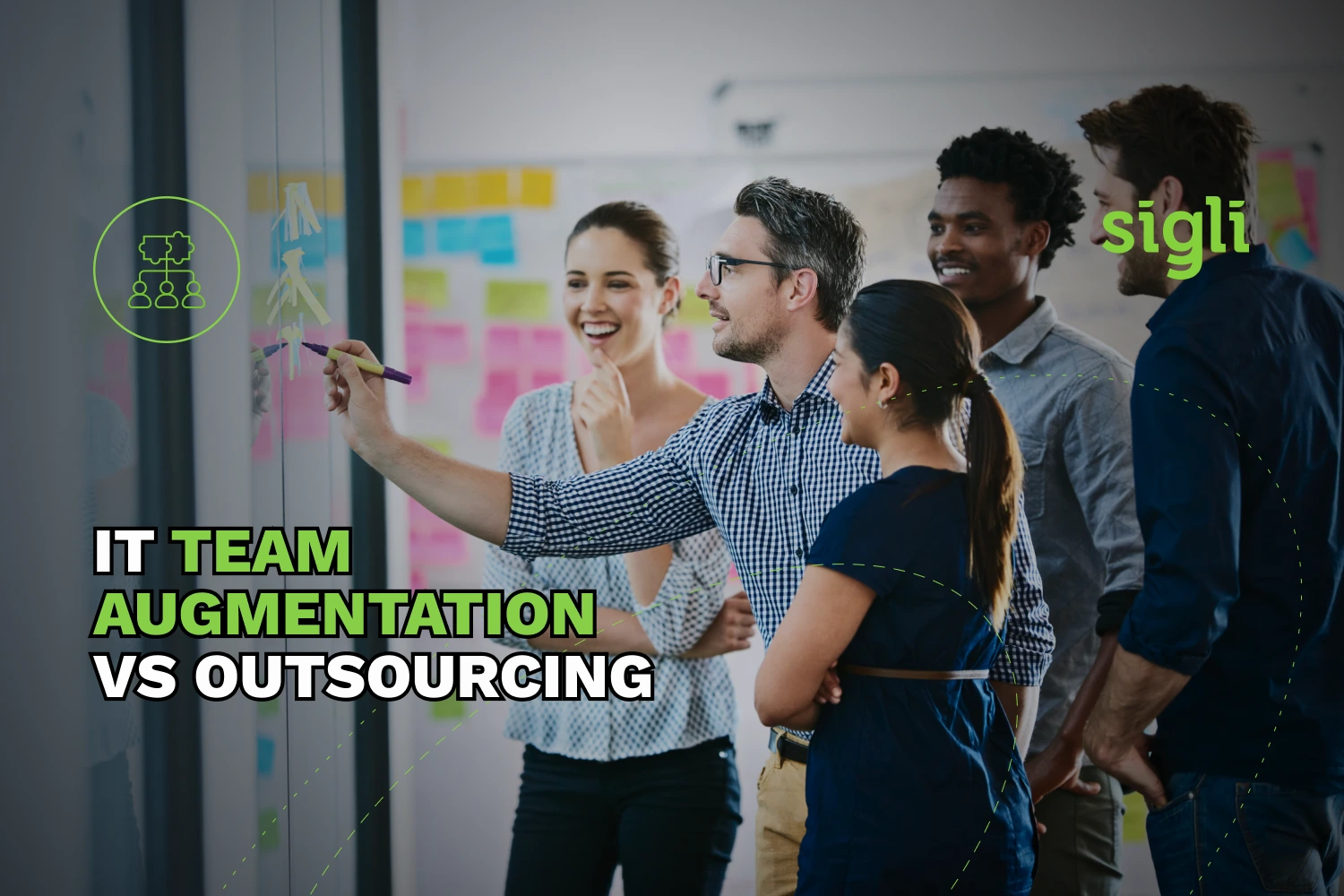
IT Team Augmentatie vs Outsourcing: Welk Model Past bij Jouw UK 2025 Routekaart?
October 8, 2025
5 min leestijd

Vergelijk IT-teamuitbreiding versus uitbesteding voor 2025. Bekijk de voor- en nadelen rond snelheid, controle, intellectuele eigendom (IP) en risico — plus een UK-ready checklist en beslismatrix.

If you need to move quickly without giving up product direction or intellectual property, IT team augmentation is usually the right call. You can add experienced engineers within days, keep your ceremonies and technical standards, and ensure that code, documentation, and know‑how remain inside your organisation. When your scope is clearly defined, outcomes are fixed, and the budget must be capped, outsourcing delivers best: treat it as a black‑box engagement with strong governance and acceptance criteria. Prefer a deeper dive? Compare models on the Team Augmentation page, and see how staff augmentation services for developers in the UK work in practice.The Decision Factors for IT Team Augmentation in the UK (Control, IP, Speed, Risk, Cost)Control is the clearest dividing line. With augmentation, you keep the steering wheel: your product and engineering managers decide the roadmap, architecture, tooling, and Definition of Done, while augmented engineers pair with your team and follow your sprint rituals. Outsourcing flips the operating model. You still set business goals and review outcomes, but the vendor runs delivery day to day, optimising for contractual milestones rather than your internal cadence.Intellectual property and knowledge transfer follow from this. Augmentation concentrates all assets in your systems — from source code and infrastructure‑as‑code to runbooks and architectural decision records—so practices like pairing, code reviews, and internal wikis steadily build your long‑term capability. Outsourcing can also transfer IP, but the tacit knowledge that makes systems maintainable often remains with the vendor unless you plan structured shadowing, joint incident drills, and a formal handover.Speed to impact tends to favour augmentation in the early weeks. Once access is granted, a small pod can start within days and aim for a first production‑ready pull request within ten business days. Outsourcing typically needs a period of discovery and a statement of work; once underway it can deliver large packages predictably, but that initial ramp is slower.Risk profiles differ. If your scope is evolving, augmentation lets you absorb volatility sprint by sprint and adjust priorities without change requests. Outsourcing excels where the scope is stable and risks are best handled through specification, acceptance tests, and change control. Neither model is inherently cheaper; cost outcomes depend on throughput, quality, and time‑to‑value. A senior augmented pod that ships the right thing faster will often outperform lower day rates that lead to rework. Fixed‑price outsourcing can be highly efficient for a well‑bounded scope, but chasing the lowest rate can increase total cost of ownership when quality and integration suffer.When to Choose IT Team AugmentationChoose augmentation when scope is fluid and learning can’t pause, when you want to upskill your existing team through pairing and rigorous code reviews, and when you need specialist capability now without adding permanent headcount. The goal is early and visible impact — first PR in ten business days, then steady ownership of a defined slice of the backlog—while all IP and operational knowledge remain in your repositories. See it in action in Implementing AI on one of the UK’s most popular property data tools: an embedded data/ML pod worked within the client’s rituals and infrastructure, delivering production value quickly while keeping code and know‑how in the client’s repos. Curious how this looks end‑to‑end? Explore a pilot plan on the Team Augmentation page and see how staff augmentation services for developers in the UK are run in practice.When to Choose OutsourcingOpt for outsourcing when requirements are stable, outcomes are easy to measure, and the budget must be capped. It works well for non‑core modules and integrations that can be delivered as a black box with a clear interface and strong acceptance criteria. Your governance should emphasise discovery, traceability to acceptance tests, performance gates, and a structured handover so that maintenance is predictable once the engagement ends.Hybrid ModelsMany UK organisations blend the two. Keep core, domain‑heavy work close — either fully in‑house or with augmented engineers embedded in your team — while outsourcing peripheral modules such as adapters, migrations, or dashboards. Make the hybrid model safe with shared repositories, agreed integration patterns, common CI gates, a unified Definition of Done, and scheduled handovers. The result is scale without fragmentation: the centre of the product remains coherent, while specialist work streams progress in parallel.Decision MatrixImagine a simple 2×2. The horizontal axis represents scope clarity from low to high; the vertical axis represents the need for control and IP retention from low to high. High control and low clarity points to augmentation: run a short discovery sprint, fix access on day one, and target an early PR. Low control and high clarity favours outsourcing: lock the scope, codify acceptance tests, and budget a buffer for edge cases. If both clarity and the need for control are high, use a hybrid: keep the kernel of the system in‑house and contract peripheral work with tight integration checks. When both are low, resist committing to a delivery model; re‑scope first and use two to four weeks of discovery to de‑risk assumptions. Typical pitfalls include onboarding delays, hidden edge cases, integration drift, and premature commitment to fixed price.Implementation PlaybooksFor augmentation, think in a fourteen‑day arc. Day zero to one cover access, security briefings, and IR35/GDPR paperwork. Days two to three focus on pairing to set up environments and smoke tests. By the end of the first week the team should have selected and delivered a scoped starter ticket and opened a production‑ready pull request with tests and documentation. The second week is about incorporating review feedback, releasing safely—feature flags help—and then independently owning a small backlog slice. Define KPIs such as lead time, PR cycle time, and escaped defects so value is visible.For outsourcing, sequence the engagement from discovery to delivery to handover. Discovery clarifies goals, constraints, non‑functional requirements, data flows, and security and accessibility needs. The statement of work then fixes scope, milestones, acceptance tests, change control, IP transfer, and residency and audit rights. Delivery proceeds in iterations with regular demos and traceability to acceptance tests. Handover closes the loop with code, documentation, runbooks, test suites, and a joint production‑readiness review so operations do not inherit surprises.Use augmentation when you must move fast without losing control or IP; use outsourcing when your scope is stable and outcomes and budget are fixed; use a hybrid when you want core knowledge to remain in‑house while peripheral work streams scale externally. To see how this plays out in delivery, compare models on the Team Augmentation page or review how staff augmentation services for developers in the UK operate in practice.
Sigli x Aimaras partnership
Software Testing
Functioneel en regressietesten in het VK: wat als eerste te automatiseren
October 7, 2025
8 min leestijd

Gids voor Britse mkb’s over functioneel testen en regressietesten. Bekijk de 7 high-ROI processen om te automatiseren, tooling die past bij Britse tech-stacks, de kosten en hoe je snel ROI aantoont.

In today’s digital-first business environment, functional and regression testing is essential for UK SMEs seeking to protect revenue, reduce churn, and improve operational efficiency. Functional testing ensures that every feature works as intended, covering both happy paths and key negative scenarios. Regression testing acts as a repeatable safety net, confirming that recent changes haven’t broken previously working functionality. Together, these approaches safeguard your product, protect revenue, and provide measurable ROI.Functional vs Regression Testing — Executive DefinitionsFunctional testing evaluates whether individual features work correctly, covering both positive scenarios (happy paths) and negative edge cases. It ensures users can complete their core tasks without friction.Regression testing focuses on stability after changes. Every new release or code update risks breaking previously functional workflows, and regression testing acts as an automated safety net. Together, functional and regression testing give UK SMEs confidence that releases are reliable, errors are caught early, and revenue-critical paths remain intact.By combining both, UK SMEs gain confidence in product stability while reducing manual QA effort and incidents.The 7 High-ROI User Journeys to Automate FirstTo maximize ROI, focus on flows that directly impact revenue, retention, or support costs.1. Authentication & Account Access (including SSO/MFA)Login friction is a key driver of churn, and account lockouts generate costly support tickets. Automation should cover signup, login, password reset, MFA, SSO, and role checks. This ensures that new account flows are stable and that any changes to authentication logic don’t introduce errors. Case Study: Permissions and Onboarding Stability2. Checkout & Payments (SCA/3DS)Revenue depends on smooth payment flows. Automation should validate the entire checkout process, including cart, address entry, shipping, Strong Customer Authentication (SCA) challenges, and receipt/refund handling. Testing edge cases such as failed 3DS challenges or interrupted sessions ensures fewer chargebacks and lost sales.Case Study: Ecommerce portal/booking flow QA3. Billing & SubscriptionsBilling errors directly impact retention and create disputes that escalate to legal or customer support costs. Automated tests should cover plan changes, proration, VAT, credit notes, and subscription cancellations. Validating billing calculations and invoicing logic protects revenue integrity and customer trust. Case Study: Finance logic regression coverage in platform upgrade4. Core Transaction / Order or Booking LifecycleYour money path must be flawless. Automation should verify all stages: create → update → cancel → state transitions → notifications → audit trails. End-to-end testing ensures that orders, bookings, or transactions remain consistent even as business logic evolves.Case Study: Manufacturing & Industrial Monitoring Case Study 5. Search & Filters (with Sorting/Pagination)Discoverability drives conversion. Automated tests should validate search relevance, empty states, boundary conditions, and sort stability across datasets. Silent failures here can quietly reduce sales or frustrate users, especially in complex marketplaces or content-heavy platforms.Case Study: Data-heavy UX correctness6. Data Import/Export & IntegrationsData corruption or failed integrations can be catastrophic. Automation should handle CSV templates, validation rules, large file handling, webhook events, retries, and contract tests for APIs. Automated coverage ensures onboarding and data migration processes remain smooth, saving both time and support costs.Case Study: Modern integration surface7. Settings & Permissions (RBAC, Tenant Isolation)Security and compliance are non-negotiable. Automated tests should validate the allow/deny matrix, audit logs, and multi-tenant isolation. This prevents costly access leaks or accidental data exposure in SaaS or enterprise platforms.Case Study: Role-heavy ERP or B2B platformFor teams looking to get started, Sigli’s QA on Demand can help set up a lean regression suite for your top journeys, making testing efficient and scalable.
Sigli x Aimaras partnership
PoC & MVP ontwikkeling
MVP-ontwikkeldiensten in het VK: Beste Bedrijven & Kosten (2025)
October 2, 2025
8 min leestijd

Op zoek naar MVP-ontwikkeling in het VK? Ontdek de beste bedrijven van 2025, de kosten, doorlooptijden en hoe je de juiste partner voor jouw MVP kiest.

In today’s fast-paced startup ecosystem, getting a Minimum Viable Product (MVP) to market quickly is crucial. MVP development services in the UK allow businesses to test ideas, validate assumptions, and engage customers before committing to full-scale development. Whether you’re a UK-based startup or a scale-up, leveraging MVPs helps reduce risk, ensures market fit, and accelerates time-to-market.In this article, we will break down the best MVP development companies in the UK, provide realistic cost estimates for 2025, and give you a no-nonsense checklist for selecting the right partner for your MVP project. If you want to dive deeper, feel free to schedule a PoC & MVP Discovery call with Sigli to discuss how we can help your business grow.‍The Rankings (UK-Focused)Sigli — PoC & MVP Development (UK/EU Delivery)‍Sigli is best suited for B2B SaaS, data/AI, integrations, and measurable validation. They specialize in a discovery → prototype → release methodology, ensuring that analytics are implemented from day one. Post-go-live support and success are central to Sigli’s approach, offering a comprehensive MVP development process with a strong focus on data-driven decision-making and analytics that drive future iterations.Coreblue (Plymouth, England)‍Coreblue is ideal for regulated/enterprise MVPs, offering strong discovery and quality discipline. Their meticulous approach to discovery and MVP foundations makes them a great choice for regulated industries like finance and healthcare, ensuring compliance with industry standards.thoughtbot‍Thoughtbot focuses on design-led product practices, combining high-quality UX/UI design with functionality. They are perfect for businesses focused on user experience, delivering MVPs that blend intuitive design with solid performance.MVP Development Costs in the UK (2025)The cost of MVP development varies depending on the complexity of the project. For entry or lightweight MVPs, the typical cost ranges from £15,000 to £30,000. These MVPs usually feature basic functionalities, are built for a single platform (web or mobile), and have limited integrations.For standard MVPs, costs generally fall between £30,000 and £70,000. These MVPs tend to have more complex features, support multiple platforms, and integrate third-party services, offering a more robust solution for testing product-market fit.When it comes to complex or enterprise-level MVPs, costs can range from £70,000 to £200,000+. These MVPs typically include advanced features such as real-time data processing, machine learning, support for multiple platforms, and high security, making them ideal for regulated industries like finance or healthcare.What Drives MVP Costs?Several factors influence the cost of MVP development:Scope/Feature Count: More features like user authentication, payment systems, and data storage increase costs.Platforms: Developing for multiple platforms (iOS, Android, web) adds complexity and cost.Integrations: APIs, third-party services, and data integrations raise the price.Data/AI: Projects involving advanced data processing or machine learning require additional expertise and resources.Compliance & Security: For industries with strict regulations, such as healthcare or finance, additional security measures and certifications are necessary.Design Depth: Custom UI/UX design adds to costs compared to pre-built templates.Seniority Mix: Senior developers or specialists (like data engineers or AI experts) typically come at a higher price.Pricing ModelsFixed-Scope Discovery → Fixed/Target-Cost Build: This is a common approach where the MVP’s features are defined during the discovery phase and built within a set budget.Sprint-Based (Agile): Ideal for projects that need flexibility and ongoing iterations.Hybrid: A combination of fixed-scope discovery with agile sprints for future feature development.How to Control Your BudgetYou can control your MVP budget by focusing on ruthless scoping, prioritizing must-have features, and launching on a single platform first before expanding to others. Reusing design systems, using no-code or low-code solutions for simpler MVPs, and focusing on analytics before "nice-to-haves" can also help keep costs down.Timelines & Delivery PatternsThe typical timeline for developing an MVP ranges from 4 to 12 weeks, depending on the complexity and features. Timelines can be shortened or extended depending on factors such as team size, feature complexity, platform support, and integration depth.The milestones generally include:Discovery (1-2 weeks): Defining the MVP scope and features.Prototype (2-3 weeks): Creating a clickable prototype to validate concepts.MVP Build (4-6 weeks): Developing the first usable version of the MVP.Beta (2-4 weeks): Releasing to a select group of users for feedback.Iterate & Refine (ongoing after launch): Enhancing the product based on user feedback.According to Adriana Gruschow, building an MVP is not about speed alone; it’s about structured experimentation. While typical timelines range from 4–12 weeks to the first usable release, allowing time for early testing and iteration ensures the MVP truly meets market needs.How to Choose the Right UK MVP Partner (Checklist)When choosing an MVP development partner in the UK, consider the following:UK presence/time-zone fit: Ensure the partner’s location aligns with your team’s working hours.Sector experience & case studies: Look for partners with relevant industry experience.Architecture & code quality standards: Make sure they follow best practices for scalable and maintainable code.Security/compliance: Ensure they meet your security and compliance requirements.Analytics/experiment setup: Make sure they can implement tracking and testing for future iterations.Handover/scale plan: Ensure there is a clear plan for handover and scaling the MVP post-launch.Support SLAs: Ensure they offer adequate support and maintenance post-launch.Red Flags to Watch Out ForVague scope with no clear definition of features.Lack of a release plan or commitment to post-launch iterations.No commitment to QA automation or proper testing.No guarantee of post-launch iteration or support.Sigli’s MVP Approach (Why Work With Us)Sigli follows a three-stage MVP development model: Discovery Sprint → Clickable Prototype → MVP Build & Telemetry. We leverage CI/CD, feature flags, observability, and experiment frameworks to ensure that our MVPs are built for long-term success. Our engagements typically follow a fixed-scope model for pilots and sprint-based development for iterative builds.Ready to take your MVP to the next level? Book a scoping call to see how Sigli can accelerate your MVP development.
Sigli x Aimaras partnership
AI in het Bedrijfsleven
Inzichten van de CEO van Mobilexpense: AI in Zakelijk Leiderschap
September 30, 2025
10 min leestijd

AI in bedrijfsleiderschap verandert de bedrijfsvoering ingrijpend. Thibaud De Keyzer, CEO van Mobilexpense, deelt inzichten over AI-adoptie, innovatie en de impact daarvan op besluitvorming.

The initial wave of hype around AI triggered widespread concerns about the potential risks of the technology. However, now, it has become clear that AI can act as a powerful tool capable of transforming business processes. But how can companies find the right approaches to enterprise transformation? And how can they distinguish true innovation from mediocre solutions? Max Golikov, Sigli’s CBDO, discussed these questions with Thibaud De Keyzer, CEO of Mobilexpense, Board Advisor at TechWolf, and Strategic Advisor at Fortino Capital, in the latest Innovantage podcast episode.Thibaud began his career at IBM, and later spent nearly a decade at SAP, Europe’s largest software company, where he held roles across Belgium, France, and the Netherlands. He founded and successfully sold an SAP consulting business before becoming the CEO of Mobilexpense.Thibaud joined this company three years ago. At that time, the team had a clear goal to make expense management fully touchless. Founded in 2000, Mobilexpense is headquartered in Belgium but operates as a truly European company. It has a presence in eight countries. Its team consists of 200 employees, who represent 28 nationalities. These are people from different generations and with different backgrounds.Bridging cultural gaps in such a team is a crucial task. Thibaud admitted that the foundation was already in place when he became the CEO of the company. His role has mainly been to nurture and strengthen it. For Thibaud, this diversity is not just a cultural asset but a business advantage as it offers perspectives from many angles.The value of AI in business leadership and the role of CEOsInnovation has always been part of Mobilexpense’s principles. For example, the company launched a web-based solution long before mobile technology became mainstream. Many of the processes were embedded in the product years ahead of competitors.When it comes to AI, for Thibaud, it is not just a new feature but the next fundamental utility. It is comparable to the internet in the 1990s or mobile phones in the 2000s. Artificial intelligence represents the next great wave of transformation. According to Thibaud, innovation is one of the strongest cultural drivers. And at the same time, it is a leadership responsibility. At Mobilexpense, he encourages curiosity across the team and provides employees with access to the tools, time, and resources needed to experiment. His role as CEO is to connect the dots between these initiatives and ensure they align with the company’s broader vision.AI is a non-negotiable priority that requires CEO-level ownership. He leads this effort personally and guides teams to focus on solving real business problems instead of pursuing technology for its own sake. How to prioritize innovation projects As Thibaud explained, at Mobilexpense, every new idea enters through a discovery tool where employees can contribute suggestions. From there, the most promising concepts are evaluated with input from business stakeholders and the CTO.Projects that pass this initial filter quickly move into a 90-day pilot phase. If early results are positive, the next step is to test scalability. Once a project proves it can scale, it is moved into production. Here, governance becomes critical. It is very important to track ROI and ensure that the project is secure and ethical.AI projects are not prioritized just because this is AI. Their value is measured by the tangible improvements they can bring to the business. For example, in customer success, that might mean reducing ticket resolution time; in sales, accelerating deal conversions; and in HR, shortening the time required to qualify candidates.For Thibaud, it is necessary to make sure that AI adoption delivers compounding value across the entire organization.How to learn from experience: AI in business leadership insightsBoth failed and successful projects can teach us a lot. Thibaud mentioned a couple of examples from his practice. One early AI experiment involved deploying a sophisticated chatbot in customer success. The team attempted to load the model with a large volume of information to provide comprehensive answers. However, the results fell short. Responses were unclear, unhelpful, and frustrating for customers.Looking back, Thibaud noted that the project’s biggest mistake was removing the human-in-the-loop too quickly. The team later corrected this. They scaled back the chatbot’s scope and reintroduced experts at critical points in the process. The failure demonstrated that human oversight remains essential in AI-driven customer support.On the success side, he pointed to an internal project designed to help auditors quickly access compliance information related to expense reports and company policies. Initially, it was introduced as a small internal efficiency tool. But the project attracted unexpected customer interest and was rolled out externally. It enabled clients to check compliance before submitting expense reports and turned out to be five times more valuable than anticipated.AI in business leadership and the modern CEO insightsAI is reshaping not only how companies operate but also how CEOs should lead their teams. Today, CEOs often feel the pressure to innovate, driven by the fear of being outpaced by competitors. In this context, AI can help a lot. A decade ago, product development cycles required months of effort. Modern AI tools allow companies to test, iterate, and scale at unprecedented speed. A “10x engineer”, who is 10 times better than a mediocre engineer, can become a “1000x engineer”. A skilled professional who leverages AI effectively can outperform peers not just tenfold but a thousandfold. Now, for Thibaud, one of the greatest concerns is neither the technology itself nor the competition. It is vital for him to ensure that his team remains curious and engaged with AI. For him, a lack of interest in AI can be a sign of the organization’s weakness in today’s fast-moving landscape.Building a culture of innovationThibaud believes Mobilexpense has successfully fostered a culture of innovation.To make innovation part of everyone’s responsibility, Mobilexpense holds monthly all-hands meetings where teams share outcomes, discuss opportunities, and raise concerns. He is confident that it is important not to make innovation a purely top-down initiative. It needs to come from the people.He explained that in his role, he also has strong leadership support from the CPO and the CTO. At the same time, he values continuous employee feedback.Though he remains quite optimistic about the future of this technology, AI’s rapid evolution at a large scale looks like an “uncontrolled experiment.” Only time will show the real impact on people and humanity.An AI learning curveThibaud shared that the past 12–15 months have been a period of intense learning for him as he wanted to truly understand what AI is, what it is good at, and what it is not.He recalled that during his time at IBM (it was around 2007–2010), artificial intelligence was already a buzzword, but there was little clarity on practical application. Today, thanks to breakthroughs in large language models (LLMs), the possibilities have become tangible.Even though, as a CEO, Thibaud doesn’t need to code or build infrastructure himself, he sees the potential of AI in such tasks. According to him, it is essential to grasp AI at the application level. It is important to find the use cases where AI can give an advantage in business, for example, in identifying patterns, creating content, or running predictive models.With AI, innovation.has become more accessible than ever before. Young people demonstrate outstanding skills in working with tools like LLMs to explore business problems and potential startup ideas. Now, you don’t need to have a full-stack developer or a machine learning engineer for every task. Nearly 80% of questions can be answered by an LLM. And these answers will be good enough at least for moving forward with your ideas.AI in business leadership and the future of workAccording to Thibaud, AI is unlikely to eliminate roles entirely. However, it will transform how people work. While some jobs may become obsolete, new roles will emerge. And quite often, these new roles will require different skills and approaches.Curiosity and engagement with AI will be key for employees to thrive. Entry-level roles may be affected first, particularly tasks that are repetitive, as they can be easily automated. However, younger professionals who embrace AI early are well-positioned to adapt. At the same time, more experienced employees can leverage AI tools to work more efficiently and focus on higher-value tasks.For example, developers using tools like GitHub Copilot can reduce time spent on routine documentation or repetitive coding. It means that they will have more time to concentrate on more meaningful work.AI in business leadership and educationAI is also reshaping learning for the next generation. Students increasingly rely on laptops and digital tools. As a result, the value of traditional skills like handwriting can become rather questionable. The pace of technological change means today’s students may receive education very differently from previous generations. Curricula must adapt continuously, and the skills taught at the start of a multi-year program may be outdated by graduation. AI can now draft essays or assist with research far more efficiently than students could on their own. But true learning comes from the process, which includes structuring ideas, conducting research, and developing critical thinking.Apart from that, Thibaud noted that formal education is no longer the only path to success. Many of his colleagues at Mobilexpense, including some in leadership roles, never completed traditional schooling. But they have strong self-learning skills and solid practical experience. Moreover, AI can be used as a great research tool. Nevertheless, it shouldn’t be seen as a replacement for critical thinking. It is still very important to know how to ask the right questions.AI can help with market research or idea generation. But the ultimate intelligence lies in identifying the right problem to solve and understanding the target audience. Human judgment still remains central. AI-native companiesToday, we can observe the emergence of AI-native companies. Such startups are built from the ground up with AI tools integrated into their business models. These can be just five-person teams creating projects that could become unicorns. Such companies can scale efficiently and leverage AI to accelerate research, planning, and product development.However, established companies like Mobilexpense retain significant advantages. They have extensive transactional data, deep industry insights, and a loyal customer base. With all this, they can leverage AI to enhance existing operations and create new value.For example, for Mobilexpense, AI presents an opportunity to transform expense management from a routine administrative task into a strategic process. Thanks to the AI capabilities, the company can provide a comprehensive solution that supports better decision-making and creates a more engaging experience for users.How investors should evaluate innovationsLarge language models are just a small subset of AI, which spans a wide range of computing capabilities. For executives and investors, understanding the different subsets and their practical applications is crucial. While AI offers significant opportunities, not every solution represents true innovation.Many new startups that enter the market appear to leverage AI superficially. For instance, they just package LLMs into niche applications without addressing real business problems. These so-called “ChatGPT wrappers” often fail to deliver long-term value and are likely to be demystified quickly. Investors always need to analyze the actual impact and novelty of AI solutions to distinguish genuine innovation from marketing hype.Thibaud mentioned that AI is similar to prior waves of tech cycles, where repetitive business tasks were transformed into scalable software solutions. The potential of artificial intelligence is enormous. But not every AI application substantially improves outcomes. For this reason, investors should focus not only on the initial idea alone, but also on teams and their ability to pivot and execute. Enterprises have broader expertise and resources than smaller businesses. That’s why they are better positioned to validate emerging AI technologies. Smaller companies or less experienced investors may be more vulnerable to hype and may adopt solutions that lack sustainability. Thibaud predicted that the current wave of AI hype is likely to settle within the next 12–24 months. Its true winners will be those startups that can integrate AI into enterprise-ready, platform-ready, and scalable solutions.AI’s greatest impact: What to expectAt the end of their conversation, Max also asked Thibaud to share his thoughts about the areas that are most likely to be transformed by AI.While it is still difficult to predict the full scope of AI’s impact, Thibaud believes the greatest potential lies in enabling augmented humans. These employees across different departments will leverage AI tools to dramatically enhance productivity and decision-making.According to Thibaud, in the future, engineers, salespeople, and product managers will be able to operate at a thousand-times capacity. It will be possible not only through technology, but also by using AI to solve real business problems. The key idea that Thibaud emphasized is that tech transformations have never been about technology but also about business problems. In turn, business is always directly related to people.Given this, it becomes vital to educate people, motivate, and incentivize them to get on the AI train. As long as organizations stay transparent, they can work together to make this world a better place for everyone.How technologies are changing the world around us is one of the most widely discussed topics in the Innovantage podcast. If you are curious to learn more, don’t miss our next episodes that will uncover new insights from leading tech and business experts.
Sigli x Aimaras partnership
Business & Technology
Litouws talent en uitbesteedde ontwikkeldiensten verkennen – met Max Golikov van Sigli
September 23, 2025
8 min leestijd

Max Golikov over waarom Litouwen uitblinkt in outsourced development: Sigli’s dubbel model, nabijheid & kwaliteit, en praktische, data-gedreven AI die resultaat oplevert.

This article has been initially published at Outsource Accelerator. Check out the episode on Podbean.In this week’s episode, we visit Lithuania, a small but highly capable country in Northern Europe that’s making waves in the software development space.Through conversation with Max Golikov, Chief Business Development Officer of Sigli, we explored how his company delivers outsourced development services, what makes Lithuania a strategic location for tech talent, and how artificial intelligence is changing the expectations of both engineers and clients.SigliSigli is a Lithuanian-based outsourcing firm specializing in high-quality software engineering. As Max explained, “We are a team of about 100 people, give or take, and our focus is on delivering high quality software solutions for our clients all over Europe.”Their work spans both project-based delivery and long-term staff augmentation. “Our clients need either specific pieces of software developed and we help them with that, or they may require additional workforce. We then provide our people to work for them just remotely as parts of their team integrating seamlessly,” Max said.This dual approach allows Sigli to work with both mid-sized companies and large enterprises. “We’ve always been focusing on mid to larger size businesses, and their projects are also pretty large. They can go on for years and involve dozens of people and many teams from different countries,” Max noted.Beyond technical delivery, Sigli also invests in professional development. “Every engineer has a mentor within the company, somebody who is more proficient in something they want to be proficient in, and they help those people further along on their developmental path,” Max explained.Lithuanian offshore talentLithuania’s advantages as an outsourcing hub go far beyond cost savings. Although not originally Lithuanian himself, Max has lived and worked there since 2018. “At the very least I’m able to survive here, and that in and of itself is a testament to the environment and how supportive it is to outsiders coming in and doing business,” he said.He pointed to strong infrastructure and connectivity as critical strengths. “There’s a very developed level of connectivity, which is very important for tech. We have great internet, great infrastructure for innovation, [and also] strong connections at the university level,” Max shared.English fluency is another key advantage, making collaboration with European and US clients seamless. Salaries, while higher than offshore destinations, reflect both talent quality and cultural proximity.“Our hourly rates [are not] cheap definitely, but what we are trying to give is flexibility and quality,” Max explained.The country’s location also plays a role in its appeal. “You’re probably two hours away from most European capitals by plane, [and that] creates a great environment, a very international, very developed society eager to contribute,” he said.The reality of AI in tech and developmentWhen discussing AI, Max first establishes what the term actually means. “For us within the tech scene, AI has always been there. The race towards artificial intelligence has been on everyone’s minds since the very first computers were invented. Now what is being called [AI] is actually a collection of many different technologies that have always been in use in one place or the other.”He notes that much of the public discourse around AI is driven by hype.“It helps a lot in particular use cases, [but] LLMs specifically as a part of AI [is] only a small part. A lot of practical AI comes down to more ‘boring’ stuff, and for us, that has always been around data.”Max makes it clear that it’s truly data that lies at the heart of AI technologies. With good data, the real beneficial use case of artificial intelligence goes far beyond generative language models. “Any AI project that exists or [is going to] exist is very reliant on the type of data that company has access to. Without good data, it’s garbage in, garbage out.What I dislike in the current discourse is that when you hear ‘AI,’ you immediately think ChatGPT or Gemini or whatever, and it’s not really the case. There’s a lot of interesting stuff going on in machine learning and computer vision, and [they’re] not at the front of the hype cycle, but they are actually being developed and deployed and making businesses run better.” The evolving landscape of AI and client demandClient demand for AI projects has been growing, but expectations are shifting toward more realistic goals. “Even last year, a lot of requests that are connected with AI came to us with a very high-level vision of what they wanted to do,” Max recalled.Those big visions often clashed with practical realities. “You need to train a specialized model on lots and lots and lots and lots of data. So naturally it would take millions of years to do that. Once clients understand that, they go, ‘maybe some other time.” Now, the focus is on achievable improvements. “Nowadays more and more requests are much more grounded, much easier to do, and have much more going for them in the beginning,” Max explained.For Sigli, this reflects a broader truth: outsourcing is not just about cutting costs. “Some clients value bigger savings, but others value proximity, cultural alignment, and the ability to visit and work closely with their teams. Those are the clients we usually find ourselves working with,” Max said.As AI continues to evolve, Max believes the most valuable outcomes will come from data-driven applications rather than hype-driven initiatives. “For us, it all comes down to the data. If the data is there, then any project is feasible to do. If the data isn’t there, then regardless of the purchases you have access to, it’s probably better to focus on something else instead of AI.” You can learn more by visiting Sigli’s website. Max is also open for questions via his LinkedIn profile, and himself is the host of the Innovantage Podcast. If you’re interested in learning about outsourcing, send us an email at ask@outsourceaccelerator.com.
Sigli x Aimaras partnership
Digital Transformation
Hoe Digitale Transformatie de Organisatiecultuur Beïnvloedt: Inzichten en Strategie | Sigli
September 15, 2025
3 min leestijd

Ontdek hoe digitale transformatie de organisatiecultuur beïnvloedt. Leer meer over leiderschapsbetrokkenheid, continu leren en het opbouwen van een cultuur die blijvende verandering stimuleert met de expertinzichten van Sigli.

How Digital Transformation Affects Organisational CultureIn today’s fast-paced business environment, digital transformation is often seen as the key to staying competitive. Organizations are investing heavily in new technologies to streamline processes, improve efficiency, and deliver better products and services. But what about the human element? How does digital transformation affect organizational culture, and why is it such a critical factor for success?While technology plays a central role in digital transformation, the true long-term success of any initiative depends on how well the organizational culture adapts to these changes. It’s not just about adopting new tools—it’s about changing how employees think, work, and collaborate. Culture, therefore, becomes a pivotal part of the transformation journey.The Impact of Digital Transformation on Organizational CultureDigital transformation requires a shift in mindset. This is not only a technological shift but also a cultural one. The changes brought on by digital transformation can be unsettling for employees who are accustomed to traditional ways of working. As organizations move towards more digital, agile, and data-driven approaches, employees need to embrace new ways of thinking, collaborating, and even learning.One of the primary impacts of digital transformation on organizational culture is the need for leadership buy-in and a strong vision. Leaders must communicate the importance of digital transformation and inspire their teams to embrace the changes. Without leadership support, the cultural shift necessary for transformation becomes much more difficult to achieve. Employees will likely resist change if they don't see their leaders fully committed to it.Sigli’s Digital Transformation Guide dives deeper into the cultural aspects of transformation, emphasizing the need for leadership buy-in and a mindset that embraces continuous learning. By creating an environment that fosters learning and innovation, organizations can ensure that their employees are not only adapting to new tools but also aligning with the company’s evolving goals.Overcoming Challenges: The Role of Culture in Digital TransformationThe true challenge in digital transformation lies in overcoming the cultural barriers that can arise. Many organizations face resistance due to fear of the unknown, lack of understanding, or simply the comfort of established routines. Overcoming these cultural challenges requires a well-thought-out strategy that includes training, clear communication, and continuous feedback loops.As companies move forward with their transformation efforts, it’s essential to create a culture that is both resilient and adaptable. This means instilling a mindset of continuous learning, where employees are encouraged to experiment, fail, learn, and grow. Digital transformation is not a one-time event—it’s an ongoing journey, and an adaptive culture will ensure that organizations remain flexible enough to evolve as new technologies emerge.For more on building a transformation culture that lasts, refer to the Sigli Digital Transformation Guide. It provides actionable insights into how to create a cultural foundation that supports sustained digital success.Conclusion: Why Culture Matters in Digital TransformationIn conclusion, digital transformation is as much about culture as it is about technology. Without the right cultural framework, even the most advanced digital tools will fail to deliver long-term value. Organizational culture affects how employees interact with new technologies, how they perceive change, and how they drive innovation. As businesses continue to evolve in the digital age, fostering a culture that embraces continuous learning, agility, and leadership buy-in will be crucial to success.Download the Sigli Digital Transformation Guide to learn more about creating an adaptive culture that supports digital transformation and drives lasting change.
Sigli x Aimaras partnership
Sigli News
Sigli uitgeroepen tot een van de Top 100 Entertainment Software Development Bedrijven van 2025 door Techreviewer.co.
September 12, 2025
4 min leestijd

Sigli is er trots op te zijn uitgeroepen tot een van Techreviewer.co’s Top 100 Entertainment Software Development Companies van 2025, waarmee onze innovatie en expertise worden benadrukt.

We at Sigli are thrilled to announce that we have been selected as one of the Top 100 Entertainment Software Development Companies in 2025 by Techreviewer.co. Being recognized among such an esteemed group is a testament to the passion, innovation, and technical rigor we bring to every project. It illustrates our growing influence in blending entertainment with digital transformation, AI, and user-centric software engineering.Our Commitment to Entertainment & InnovationFrom our founding, we have focused on delivering software solutions that not only meet business goals but also elevate user experiences in sectors that demand creativity – gaming, media streaming, interactive platforms, digital content ecosystems. At Sigli, we harness AI, data engineering, product development, and web technologies to provide not just technical excellence, but solutions that entertain, engage, and endure.We understand that in entertainment software, speed matters, design matters, scalability matters – and so does delight. Whether building proof of concept products, minimum viable products (MVPs), or full-scale platforms, we aim to fuse form and function. Our services – from QA on demand to teams on demand, from staff augmentation to data-driven systems – are structured to support partners from ideation through launch and beyond.What This Recognition ReflectsBeing selected for this Top 100 list by Techreviewer.co reflects many things we believe deeply in:The strength of our technical expertise, especially in AI & data science, web engineering, and quality assurance, enabling us to craft solutions that work reliably under demanding entertainment workloadsOur adaptability in transforming ideas into interactive, engaging, and market-ready software productsThe trust that clients have placed in us, including those seeking to push boundaries of how people consume or interact with digital contentThe dedication of our team in making each project both technically strong and creatively satisfyingOur Journey & What We DeliverWe have grown steadily over the years, not only in numbers of projects and clients but in the breadth of challenges we can tackle. Our process is designed to minimize risk and maximize value: we begin with validating ideas, proving feasibility, and ensuring market demand before moving ahead. We integrate QA, augment staff when needed, and embed teams that operate as extensions of our clients’ own operations.We pride ourselves on being responsive, reliable, and deeply aligned with our partners. We do not see ourselves simply as vendors; we see ourselves as collaborators, co-creators, and builders of shared visions.Looking ForwardWith this recognition, we feel renewed energy to continue pushing the envelope. We plan to double down on integrating cutting-edge AI, improving immersive experiences, enhancing performance and scalability for high-traffic entertainment platforms, and deepening our investment in user experience research.We are committed to helping entertainment companies, content creators, and media platforms harness technology that not only works, but also inspires.About Techreviewer.coTechreviewer.co is a well-established research and analytics organization that identifies, evaluates, and ranks top software development firms and technology providers across various industries. Their methodology involves thorough assessment criteria including project portfolio, client feedback, technical competence, innovation, and overall market impact. Their annual rankings are trusted by businesses seeking software partners that deliver high performance, reliability, and forward-looking capabilities.‍
Sigli x Aimaras partnership
Fintech & Crowdfunding
Investor Relations in een crowdfundingtijdperk: wat EU-regelgeving betekent
September 9, 2025
10 min leestijd

Investor Relations ontmoet crowdfunding: Aušrinė Armonaitė over vertrouwen, toegang vanaf €500 en waarom EU-regelgeving het concurrentievermogen moet vergroten in plaats van innovatie te blokkeren.

Innovation is one of the key topics typically covered in the Innovantage podcast. To explore this theme from multiple angles, its host and Sigli’s CBDO, Max Golikov, invites guests who bring diverse ideas and insights. While many conversations focus primarily on the business perspective, this episode takes a broader view.This time, Max welcomed an expert who has a unique experience in the public and private sectors and can provide her vision from both angles. The podcast guest was Aušrinė Armonaitė, former Lithuanian Minister of Economy & Innovation.Aušrinė entered politics at a very young age, as she had always been interested in public affairs and actively participated in youth organizations. In 2019, she founded the political party Laisvės partija (the Freedom Party).She spent nearly a decade in politics. During this period, she served both as a Member of Parliament and later as Minister of Economy and Innovation until December 2024. After leaving politics, Aušrinė began her journey in the private sector. Today, she is the Head of Investor Relations at InRento, a leading European prop-tech crowdfunding platform. Though these two chapters of her career have clear differences, they also have some things in common. And that was also one of the topics discussed in this podcast episode.Crowdfunding: Is it a good opportunity for investors in Europe?InRento is a buy-to-let crowdfunding platform that was founded in 2020 amid the active development of Lithuania’s fintech sector. The company enables individuals to invest in real estate rental properties. What is very special here is that people don’t have to make big investments at once. They can start from as little as €500.Disclaimer: Investing involves the risk of losing some or all of the amount invested, so it is recommended to diversify your investments and evaluate them responsibly.InRento is rooted in Lithuania. But it is actively expanding its presence in Poland, Italy, and Ireland, and has plans to reach a broader European region.The key idea behind it is making investing more accessible. Traditionally, people associate investing with deep financial knowledge and significant capital. InRento, alongside other crowdfunding models, lowers these barriers and brings investment opportunities closer to a wider audience. Aušrinė sees this as a game-changing shift in the investment world.InRento works with partners who develop real estate rental projects. Quite often, these are conversions and renovations that give older buildings a new life. Numerous investors can participate in one project with their contributions, which are lent to project owners. Over 24 or 36 months, these projects typically generate an average return of nearly 12%.Such returns may sound high, but they really reflect the dynamics of this market. At the same time, Aušrinė emphasized that investing always involves risk. To mitigate it, investors should consider diversification across tools, geographies, and projects.Max and Aušrinė also discussed the peculiarities of the society in Central and Eastern Europe and people’s attitude to investing. The legacy of the Soviet system has greatly eroded community trust, which is a crucial element for business and investment.However, today we can observe that this foundation is undergoing rapid change. Lithuania was once a small post-Soviet economy. Now, it has transformed into the European Union’s leading fintech hub. The country currently hosts 14–15 crowdfunding platforms. Meanwhile, many EU nations have none.Politics vs the private sector: Differences and similaritiesSpeaking about her career, Aušrinė explained that politics offers a broad, global perspective. It touches on various areas, from biotechnology and lasers to fintech and entrepreneurship. By contrast, the private sector demands depth. It requires a focus on details and nuances within a single industry. And leaders must master every aspect to perform effectively.During her time as Lithuania’s Minister of Economy and Innovation, Aušrinė and her team strengthened the country’s position as an advanced technology economy. This was achieved despite multiple overlapping crises, including the COVID-19 pandemic, war in Ukraine, and challenges linked to illegal migration. Under her leadership, Lithuania avoided recession, introduced innovation reforms, helped businesses enter new markets, and attracted record levels of foreign investment.As a Member of Parliament for over eight years, she also championed human rights and worked to position Lithuania as an open, inclusive society. While some initiatives remain unfinished, others have become established policy.When Max asked Aušrinė about the reasons for leaving politics, Aušrinė named both external and personal reasons. The weaker-than-expected election results for her political party signaled the need for change.Though some politicians aim to remain in office at any cost, Aušrinė doesn’t share such views. She preferred to start a new chapter. Moreover, she strongly believes that meaningful change for the country can be achieved in business as well, sometimes on an even larger scale. Lithuanian companies are already shaping not only the national economy but also Europe’s technological landscape.Aušrinė highlighted the importance of change and renewal in both politics and business. Staying in the same position for too long can limit perspective and reduce creativity.Experience in public service is highly valuable. But constant evolution is equally necessary. When it comes to politics, democracies risk stagnation when leaders don’t support changes. Democracies need not only experienced professionals, but also new people with fresh ideas.Building trustAušrinė explained that building trust with investors is central to her role at InRento. According to her, trust in the investment industry is earned through experience and a strong track record. InRento’s team, for example, has operated for over five years without any defaulted or late projects. That’s an excellent proof of careful and conservative management.For Aušrinė, establishing her own credibility means building on this foundation from day one and ensuring that investors can rely on both her and the company. In her opinion, trust extends beyond business. It is rooted in everyday interactions and relationships. Though Eastern European background and historical distrust have shaped attitudes in the local society in Lithuania, social norms are gradually shifting toward openness and connection.One of the factors that can also be used to demonstrate such shifts is the good level of English that people in Vilnius have. Today, it is much more than a communication tool. Good command of English also signals a global mindset and readiness to connect with the world.For smaller countries, like Lithuania, being outward-looking is essential. The economy relies heavily on exports, and technology solutions developed locally must be applicable and competitive worldwide.How Eastern Europe can help Africa in building its economic futureSpeaking about the global arena and international cooperation, Aušrinė said that Eastern Europe can become a natural partner for Africa’s economic future. In the African region, we can find many parallels with Central and Eastern Europe in the 1980s and 1990s. Countries like Lithuania, Estonia, and the Czech Republic transformed from Soviet-planned economies into thriving technology hubs with rapidly growing purchasing power. It’s important to highlight that these achievements were made within a single generation. According to Aušrinė, this situation shows that similar economic leaps are possible elsewhere, including in Africa.She emphasized the significance of respecting cultural differences and work styles. Many African nations are cautious as they are afraid of European “teaching” due to colonial histories. However, Eastern Europeans have themselves experienced occupation and external control. Now, people in this region are open to connecting and do not support a top-down approach. Their historical perspective fosters empathy and understanding.Meanwhile, Africa has a huge potential as a continent of opportunities, particularly for Europeans. Geographic proximity, aligned time zones, and growing digital and business hubs, such as Rwanda, make collaboration feasible and attractive. While other global powers, like the US, are reducing their engagement in certain African regions, European countries have a good chance to step in and establish meaningful economic partnerships.Core pillars of the Lithuanian economyBut what is behind the Lithuanian success? Aušrinė named four core pillars of Lithuania’s economic development that could offer lessons for African countries.Investment in infrastructure. Basic infrastructure, such as roads and bridges, is essential for an economy to function effectively. Without it, business growth and economic activity are constrained.Opportunities for work and entrepreneurship. Despite some stereotypes, people are always eager to work when real opportunities exist. Governments should focus on attracting businesses and supporting entrepreneurship to enable growth.Leapfrogging technology. Just as Lithuania bypassed certain stages of older technologies, African countries can adopt the latest innovations, from blockchain to AI, without the need to follow every historical step.Education. Developing critical thinking and creativity is fundamental. Independent, well-educated individuals form the backbone of sustainable economic development.The role of education and efficient hiringThe private sector has a vital role in shaping education systems. Aušrinė mentioned such an initiative as Teachers Lead Tech. It was launched in Lithuania, and now, it is scaling internationally. Programs of this kind help teachers integrate technology into classrooms while supporting creativity and collaboration among students.Aušrinė believes that education should not be left solely to policymakers. Broad participation helps cultivate critical thinking and independence in communities. All this is especially significant in today’s world, where diplomas are no longer enough. Practical experience and skills gained over time are becoming much more valuable than any formalities.Max and Aušrinė also talked about modern hiring practices. Today, a lot of leaders pay much more attention to the personality and real experience of candidates than to their CVs. Nevertheless, understanding candidates requires time. Both the employer and applicant need to grasp the role and fit.On the one hand, we can say that now personality matters more in hiring than it used to. On the other hand, AI is greatly disrupting the hiring process nowadays. Candidates can submit countless applications with AI-generated cover letters. At the same time, recruiters rely on AI to filter large volumes of submissions. As a result, meaningful interactions between candidates and decision-makers are becoming difficult. And very often, it represents a barrier for talents looking for the right opportunities.Challenge of evaluating progress and identifying mistakesAušrinė admitted that she is quite optimistic when it comes to evaluating progress and learning from mistakes. When she analyzes the results of her work, she always tries to find out whether her actions leave things better than they were found. Despite imperfections or occasional errors that may happen, making improvements is what matters most.She believes that time and self-reflection are essential. Understanding one’s own approach to people, processes, and self-perception helps identify areas for growth.Analyzing the outcomes, she also places achievements in perspective. For example, when she thinks about the results of her work in politics, she compares Lithuania’s progress to other regions, including Africa. Of course, setbacks occur, but according to Aušrinė, Lithuania’s story is a big success in the region.In general, recognizing progress in daily operations is quite difficult. Lithuanians, culturally, tend to downplay achievements and focus on criticism.Aušrinė mentioned a survey that named young Lithuanians among the happiest in the world. Such data sparked widespread debate and skepticism. Similarly, during an election campaign, she stated that Lithuania was experiencing its best economic period. This comment drew criticism even from her own team.Nevertheless, acknowledging incremental progress shouldn’t be ignored. Comparing current outcomes to the starting point helps maintain perspective and even prevent discouragement.Regulation should enhance competitiveness, not prevent itIn their discussion, Max and Aušrinė also spoke about the regulation. Aušrinė expressed caution regarding what is currently happening in the European regulatory environment. Recent proposals from the European Commission, including a pan-European tax on certain enterprises, can be potentially counterproductive.Aušrinė believes that such measures are unlikely to be implemented. However, she stressed the need for policies that enhance competitiveness. Otherwise, their introduction can lead to the risk of undermining business growth.Strong need for forward-looking innovationAccording to Aušrinė, the European region needs forward-looking innovation, particularly in the context of AI and machine learning. While businesses have already embraced AI to automate processes and improve efficiency, its integration into education requires careful thought. Some people try to block AI from classrooms and universities. But it is not the best approach. Instead, AI can be used as a tool to enhance learning and better prepare students for a competitive world.While someone may believe that ChatGPT can help students cheat, it’s vital not to forget that it can also become a private tutor available 24/7.Apart from this, Aušrinė touched on the broader challenge of maintaining competitiveness in Europe. Staying in place requires running as fast as possible, while progress demands running even faster. This principle is applicable to both politics and business. Careful decision-making to preserve economic growth is a must. Meanwhile, businesses are ready and willing to innovate to keep pace with global change. And this should be supported.‍Want to learn more about technology and innovation in business? That’s what you will find in the next episodes of the Innovantage podcast. Don’t miss them!‍
software development agency
Rapid PoC for tech product UK

suBscribe

to our blog

Subscribe
MVP consulting firm UK
Thank you, we'll send you a new post soon!
Oops! Something went wrong while submitting the form.